On this page
Kinetic theory explains a gas's pressure, temperature and heat capacity from how its molecules move. In NEET physics it is a short, formula-heavy unit where most lost marks come from Celsius slips and miscounted degrees of freedom.
What does the NEET syllabus include in Kinetic Theory of Gases?
The NMC "NEET (UG)-2026" syllabus (updated syllabus for NEET (UG)-2026, dated 22-12-2025) lists Physics Unit 9, Kinetic Theory of Gases: "Equation of state of a perfect gas, work done on compressing a gas, Kinetic theory of gases - assumptions, the concept of pressure. Kinetic interpretation of temperature: RMS speed of gas molecules: Degrees of freedom. Law of equipartition of energy and applications to specific heat capacities of gases; Mean free path. Avogadro's number." No 2027 syllabus is on the NTA NEET site yet; check there before finalising your plan.
It maps to Chapter 12, Kinetic Theory, of NCERT Class 11 Physics Part II (Reprint 2026-27), Sections 12.2-12.7. One gap: the chapter does not work out the work done on compressing a gas. That sits in Chapter 11, Thermodynamics, under isothermal and adiabatic processes, so study the two together.
Formulas to know cold (NCERT Chapter 12):
PV = μRT = k_B NT.
P = (1/3) n m ⟨v²⟩, so v_rms = √⟨v²⟩ = √(3P/ρ) = √(3RT/M).
Average translational kinetic energy per molecule = (3/2) k_B T, for any ideal gas.
Each translational or rotational degree of freedom carries ½ k_B T; a vibrational mode carries k_B T.
Molar Cv = (3/2)R (monatomic), (5/2)R (rigid diatomic); Cp − Cv = R.
Mean free path l = 1/(√2 nπd²).
How is Kinetic Theory tested in NEET?
As in NEET-UG 2026, the NTA information bulletin set 180 compulsory questions in 180 minutes, with 45 Physics questions worth 180 marks. Each is a multiple-choice question with four options and a single correct answer or best option: +4 if right, -1 if wrong, 0 if unanswered.
That is about a minute per question, so learn the proportionalities (v_rms ∝ √(T/M), l ∝ T/P) and turn questions into quick ratios.
How do you solve Kinetic Theory questions fast?
Example 1: the Celsius trap. Nitrogen is heated from 7 °C to 287 °C. By what factor does its rms speed rise? Options: 1.41, 2, 6.4, 41.
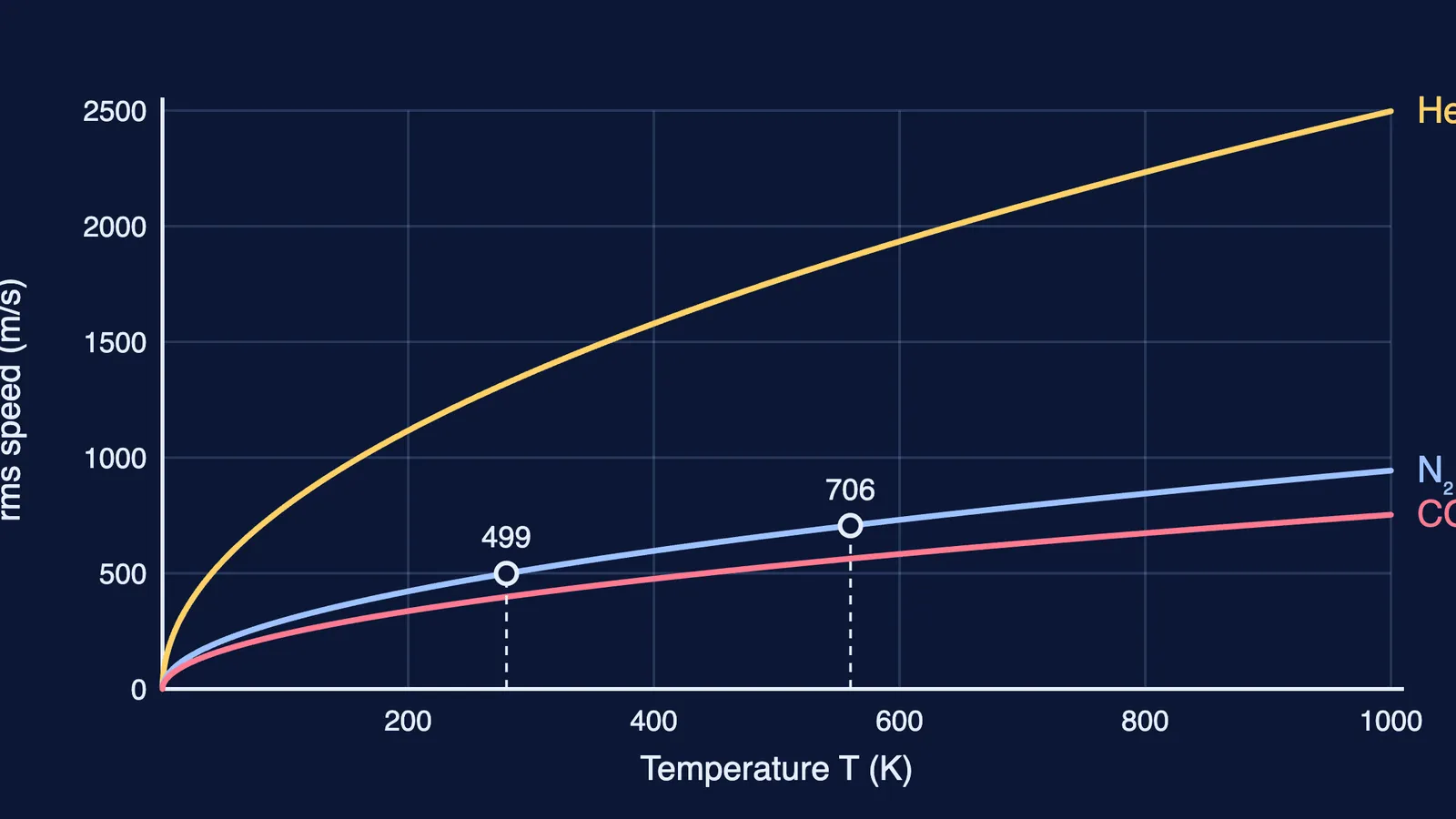
Convert first: 280 K to 560 K, so T doubles and v_rms rises by √2 ≈ 1.41, from about 499 to 706 m/s (M = 0.028 kg/mol), as marked on the graph above. 6.4 is the trap: √(287/7) uses Celsius.
Example 2: a mixture's γ. A container holds 4 mol of argon (monatomic) and 1 mol of nitrogen (rigid diatomic). Find γ.
Add heat capacities, not γ values. Cv = (4 × 1.5R + 1 × 2.5R)/5 = 1.7R per mole. Cp = Cv + R = 2.7R. So γ = 27/17 ≈ 1.59. Averaging 5/3 and 7/5 by moles gives about 1.61, a tempting wrong option.
Example 3: heating a sealed flask. A rigid, sealed flask of gas is heated from 300 K to 600 K. What happens to the mean free path?
Nothing. The number of molecules per unit volume, n, is fixed, and l = 1/(√2 nπd²) has no T in it. Molecules move √2 times faster and collide more often, but travel the same distance between collisions. Use l ∝ T/P only when pressure can change.
Can't picture molecules in motion? The Fermi Simulation Lab has interactive simulations for the ideas that are easier to see than to read.
What are the common traps?
Giving a vibrational mode ½ k_B T. It has kinetic and potential terms, so it adds k_B T.
Giving a heavier gas more translational kinetic energy per molecule. At equal temperature it is (3/2) k_B T for all.
Squaring the average speed to get the mean of v². NCERT notes they differ.
Putting M in grams per mole into √(3RT/M). Use kilograms per mole, or the answer is off by about 31.6 times.
What should a one-week plan look like?
Day 1: NCERT Sections 12.1-12.4 and the pressure derivation.
Day 2: rms speed and the kinetic meaning of temperature; ratio questions.
Day 3: degrees of freedom, equipartition and Table 12.1.
Day 4: mean free path, plus compression work from Chapter 11.
Days 5-7: timed sets of 20 questions in 20 minutes; tag each mistake as unit, kelvin, formula or reading.
Stuck on a step? The Fermi Problem Library has worked problems with a step-by-step solver that explains the reasoning rather than printing an answer.
Practice questions
A gas at 75 kPa has a density of 0.90 kg/m³. Find its rms speed.
Find the internal energy of 2 mol of a rigid diatomic gas at 400 K (R = 8.314 J/mol K).
A gas has a mean free path of 60 nm at 300 K and 100 kPa. Estimate it at 450 K and 50 kPa.
Answers: 1. 500 m/s. 2. About 16.6 kJ. 3. 180 nm.
For derivations, see our Kinetic Theory guide for Class 11 Physics; for JEE, the Kinetic Theory of Gases for JEE Main guide.