On this page
This unit joins two NCERT chapters. Here is the syllabus mapped to the books, three solved problems, the traps and a plan.
What does the NEET syllabus include in Magnetic Effects of Current and Magnetism?
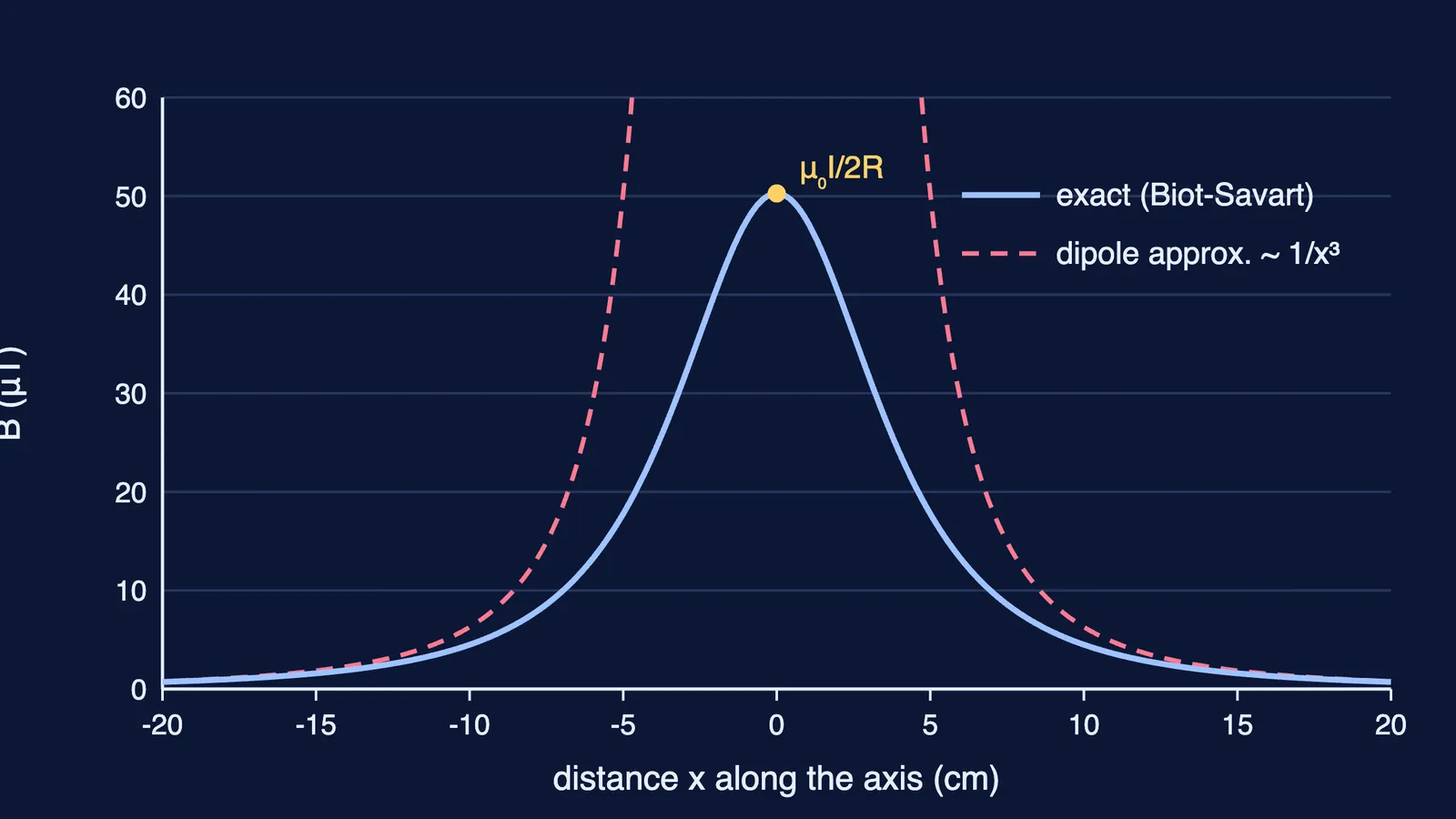
The NMC "NEET (UG)-2026" syllabus lists Unit 13 topics including: Biot-Savart law for a circular loop; Ampere's law for a straight wire and a solenoid; forces on moving charges, conductors and parallel currents; torque on a loop; the moving coil galvanometer, its sensitivity and its conversion to ammeter and voltmeter; the loop and bar magnet as dipoles, with axial and equatorial fields; para-, dia- and ferromagnetism; and the effect of temperature.
In the 2026-27 reprint, the current half is Chapter 4, Moving Charges and Magnetism, of NCERT Class 12 Physics Part I, sections 4.2 to 4.10. The magnet half is Chapter 5, Magnetism and Matter, sections 5.2 to 5.5. One gap: Chapter 5 treats temperature only in words (paramagnetic magnetisation rises as temperature falls; a hot enough ferromagnet turns paramagnetic). Curie's law is not in it, so learn those trends. Board-style guides: Moving Charges and Magnetism for Class 12 and Magnetism and Matter for Class 12.
How is this unit asked in NEET?
In NEET-UG 2026, physics had 45 questions in a 180-question paper answered in 180 minutes, with +4 for a correct answer and −1 for a wrong one, according to the NTA information bulletin. Each was a multiple-choice question with four options and one correct answer: about a minute each. More in the NEET-UG paper pattern.
Three habits help:
Formula recall in seconds: r = mv/(qB), F/L = μ₀I₁I₂/(2πd), B = μ₀nI, τ = mB sin θ.
Unit checks to strike out options: magnetic moment is in J/T (or A m²), and μ₀ is 4π × 10⁻⁷ T m/A.
Elimination by limits: a shunt must be far smaller than the galvanometer's resistance, and a voltmeter's series resistance far larger.
Worked examples: three NEET-style problems
1. A proton in a magnetic field. A proton (m = 1.67 × 10⁻²⁷ kg, q = 1.6 × 10⁻¹⁹ C) enters a 0.050 T field at 2.0 × 10⁵ m/s, perpendicular to the field. Find r and T.
r = mv/(qB) = (1.67 × 10⁻²⁷ × 2.0 × 10⁵)/(1.6 × 10⁻¹⁹ × 0.050) ≈ 0.042 m, about 4.2 cm. T = 2πm/(qB) ≈ 1.3 × 10⁻⁶ s. Double the speed and r doubles; T has no v in it, so it stays.
2. Converting a galvanometer. A galvanometer of resistance 45 Ω gives full-scale deflection at 4.0 mA. Make it read up to 2.0 A, then up to 12 V.
Ammeter: a parallel shunt, S = I_gG/(I − I_g) = (0.004 × 45)/1.996 ≈ 0.090 Ω. Voltmeter: a series resistance, R = V/I_g − G = 3000 − 45 = 2955 Ω.
3. Two parallel wires. Long parallel wires 5.0 cm apart carry 6.0 A and 2.0 A in the same direction. Find the force per metre and where the field between them is zero.
F/L = μ₀I₁I₂/(2πd) = (2 × 10⁻⁷ × 6 × 2)/0.05 = 4.8 × 10⁻⁵ N/m, attractive. Between the wires the fields oppose, so set 6/x = 2/(0.05 − x): x = 0.30/8 ≈ 3.8 cm from the 6.0 A wire.
What are the common traps?
Using total turns N for a solenoid instead of turns per metre n in B = μ₀nI.
Forgetting that parallel currents attract, the opposite of like charges.
Mixing up the dipole fields: for a short magnet at the same distance, the axial field is twice the equatorial field.
Assuming more turns raises voltage sensitivity. Doubling turns doubles current sensitivity, but NCERT notes the coil's resistance is likely to double too, so voltage sensitivity stays the same.
Calling copper or bismuth paramagnetic: NCERT lists both as diamagnetic.
Stuck on a step? The Fermi Problem Library has worked problems with a step-by-step solver that explains the reasoning rather than printing an answer.
How should you plan the two weeks?
Days 1-3: Chapter 4 to the solenoid; write each field formula with its diagram.
Days 4-6: forces, torque and the galvanometer; ten timed problems a day.
Days 7-9: Chapter 5; tabulate the three material types with the book's examples.
Days 10-12: mixed sets; label each error as formula, sign, unit or concept.
Days 13-14: reread both chapter summaries and redo every miss.
Hard to picture fields? The Fermi Simulation Lab has interactive simulations for the ideas that are easier to see than to read.
Practice questions
A 50-turn circular coil of radius 5.0 cm carries 0.80 A. Find the field at its centre.
A magnet of moment 2.0 J/T sits at 60° to a 0.15 T field. Find the torque.
A solenoid 30 cm long has 600 turns and carries 1.5 A. Find the field inside.
Which is weakly repelled by a strong magnet: aluminium, bismuth or nickel?
Answers: 1. about 5.0 × 10⁻⁴ T; 2. about 0.26 N m; 3. about 3.8 × 10⁻³ T; 4. bismuth.
Recheck units before you mark an answer.