On this page
Magnetism and Matter is Chapter 5 of NCERT Class 12 Physics, and the CBSE Class XII Physics curriculum for 2026-27 gives it no separate marks. One cell reading "17" spans Unit III (Magnetic Effects of Current and Magnetism) and Unit IV (Electromagnetic Induction and Alternating Currents), out of 70 for theory.
What does the CBSE 2026-27 syllabus keep from this chapter?
The curriculum lists the bar magnet as an equivalent solenoid, the dipole field on the axis and perpendicular to it, and torque on a dipole in a uniform field, each marked "qualitative treatment only", plus field lines. It also lists para-, dia- and ferromagnetic substances with examples, magnetisation, and the effect of temperature. Gauss's law for magnetism is not on that list, but NCERT covers it and the sample paper asks it, so learn it.
The NCERT chapter (Reprint 2026-27):
argues a bar magnet acts like a finite solenoid, because their far axial fields match
gives the torque on a dipole as m × B and its energy as −m·B, lowest (−mB) at 0° and highest (+mB) at 180°
states Gauss's law for magnetism: net magnetic flux through any closed surface is zero
defines magnetisation M, magnetic intensity H and susceptibility χ, with B = μ0(H + M) = μ0(1 + χ)H
describes dia-, para- and ferromagnetism, domains, and hard and soft ferromagnets
The reprint has no section on Earth's magnetism and no hysteresis loop, so for the theory paper skip old notes on dip and retentivity.
How do you set out 2-, 3- and 5-mark answers?
2 marks: statement plus consequence. Question 20(B) of the 2026-27 sample paper, a 2-mark choice, asks for Gauss's law for magnetism and why it matters. Write the law, give ∮B·dS = 0, then add: there are no isolated poles, so field lines form closed loops.
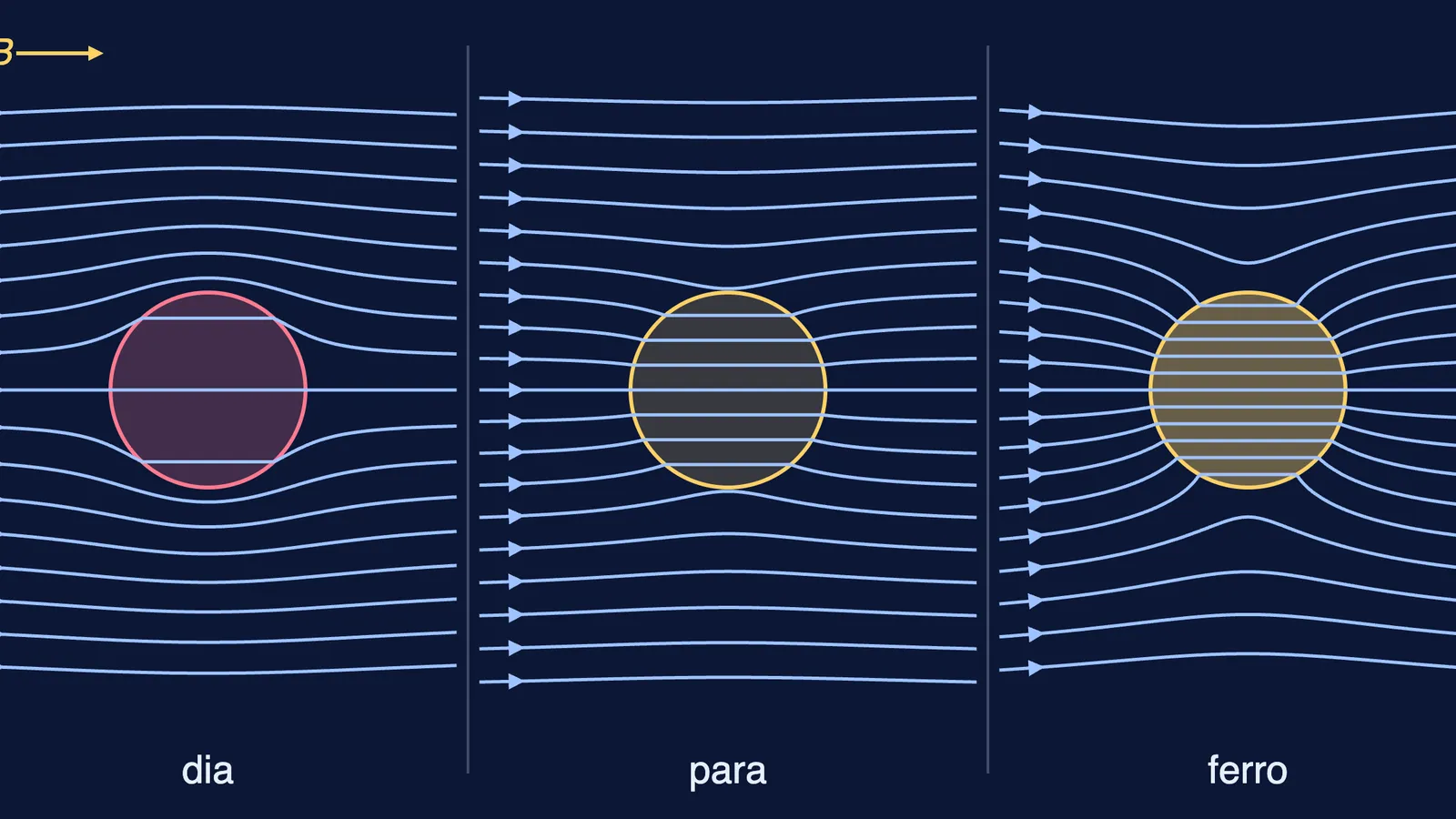
3 marks: compare in a fixed pattern. Give dia, para and ferro the same four lines: sign and size of χ, value of μr, which way the sample moves in a non-uniform field, and NCERT examples (bismuth, copper; aluminium, sodium; iron, nickel). Add a field-line sketch.
5 marks: define, derive, solve, conclude. Define M and H, show B = μ0(1 + χ)H, solve a numerical, then classify the material.
Worked numerical, solved twice
The sample paper bans calculators: practise by hand.
Question. A long solenoid has 1000 turns per metre and carries 0.5 A. Its core has relative permeability 1000. Find H, χ, M and B in the core, and name the material type. Take μ0 = 4π × 10⁻⁷ T m A⁻¹.
Pass 1, through μr.
H = nI = 1000 × 0.5 = 500 A/m.
χ = μr − 1 = 999.
M = χH = 999 × 500 = 499 500 A/m, about 5 × 10⁵ A/m.
B = μ0μrH = 4π × 10⁻⁷ × 1000 × 500 = 0.2π T, about 0.63 T.
χ is large and positive, so the core is ferromagnetic.
Pass 2, a second route through M. Use B = μ0(H + M): H + M = 500 + 499 500 = 5 × 10⁵ A/m, so B = 4π × 10⁻⁷ × 5 × 10⁵ = 0.2π T. Same answer. Check: the empty solenoid gives μ0nI = 2π × 10⁻⁴ T, and the core multiplies that by 1000.
When working slips, the Fermi Problem Library has worked problems with a step-by-step solver that explains the reasoning rather than printing an answer.
Which assertion-reason traps catch students in this chapter?
The sample paper has four 1-mark assertion-reason questions. Magnetism items include a superconducting-ball MCQ (Question 8) and classifying a material with μr = 800 (Question 20(A)). Traps built on the NCERT chapter:
Uniform field. In a uniform field a compass needle turns but is not pulled. An iron nail near a bar magnet is also attracted, because the field there is non-uniform and induces a moment in the nail.
Tiny χ, opposite behaviour. Diamagnetic χ is about −10⁻⁵, paramagnetic about +10⁻⁵, yet one moves towards weaker field and the other towards stronger.
Perfect diamagnet. A superconductor has χ = −1 and μr = 0; field lines are fully expelled.
Temperature. Paramagnetic magnetisation rises as temperature falls. Heated enough, a ferromagnet becomes paramagnetic; the magnetisation fades gradually.
Hard versus soft. Alnico stays magnetised; soft iron does not once the field goes.
Dia pushes field lines out; para pulls them in slightly, ferro strongly. If that is hard to picture, the Fermi Simulation Lab has interactive simulations for the ideas that are easier to see than to read.
A five-day revision plan
Day 1: Equivalent solenoid, field-line rules, axial and equatorial fields, drawn from memory.
Day 2: Torque, energy, stable and unstable positions. NCERT Exercises 5.1, 5.2 and 5.5 by hand.
Day 3: M, H, χ, μr. Redo Example 5.5 and the numerical above with a second-pass check.
Day 4: Dia, para, ferro comparison and sketches. Write ten assertion-reason pairs.
Day 5: A timed mixed set across the 17-mark block.
For the rest of Unit III, read our Moving Charges and Magnetism board exam guide, then Unit IV in the electromagnetic induction answer guide.