On this page
Dual Nature is a short unit with a small set of formulas, and almost every question comes down to one energy balance. Here is the syllabus, the NCERT map and a timed practice plan.
What does the NEET syllabus include in Dual Nature of Matter and Radiation?
The NMC "NEET (UG)-2026" syllabus lists Dual Nature of Matter and Radiation as Unit 17 of Physics. It covers the dual nature of radiation; the photoelectric effect; Hertz and Lenard's observations; Einstein's photoelectric equation and the particle nature of light; and matter waves, the wave nature of particles and the de Broglie relation.
In the 2026-27 NCERT Class 12 Physics Part II, this is Chapter 11, Dual Nature of Radiation and Matter. It covers work function, the Hertz, Hallwachs and Lenard observations, photocurrent against intensity, potential and frequency, Einstein's equation, the photon and the de Broglie relation. Neither the syllabus nor the 2026-27 chapter includes the Davisson-Germer experiment, so it is not a priority unless a new syllabus adds it.
How are Dual Nature questions asked in NEET?
As in NEET-UG 2026, the NTA information bulletin set 45 physics questions out of 180, all multiple choice with four options and a single correct or best answer, in 180 minutes. A correct answer earned +4, a wrong one cost 1, and an unanswered one scored 0. That is about a minute per question, so practise quick recall, a units check and ruling out options before calculating.
Three relations carry the unit:
Photon energy: E = hν = hc/λ, and hc ≈ 1240 eV nm turns a wavelength in nanometres straight into electronvolts.
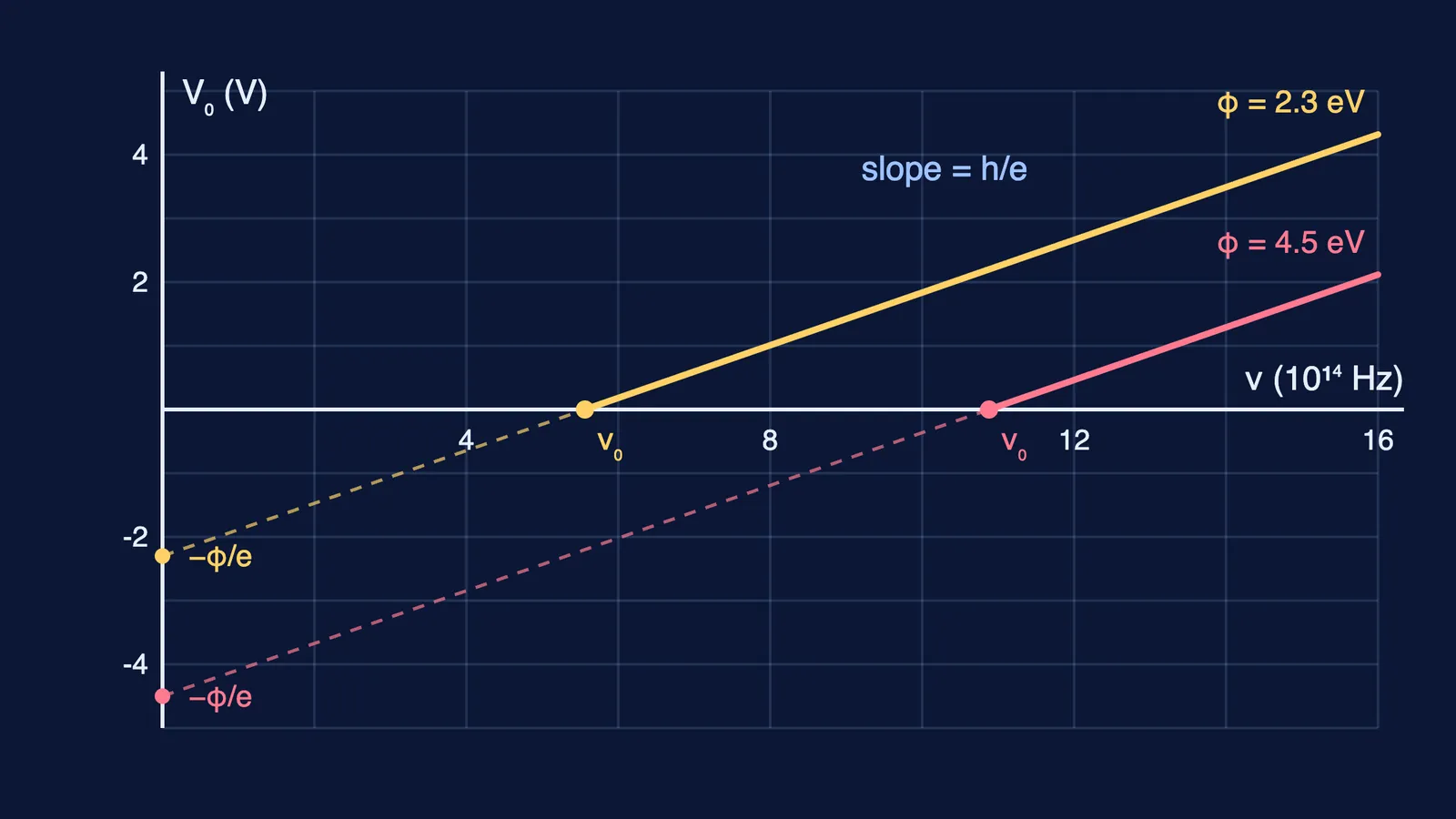
Einstein's equation: K(max) = hν − φ = eV₀, with threshold frequency ν₀ = φ/h.
de Broglie wavelength: λ = h/p = h/√(2mK); for an electron accelerated through V volts, λ ≈ 1.227/√V nm.
Worked examples with our own numbers
1. Stopping potential and threshold. Light of 275 nm falls on a metal with work function 2.9 eV. Photon energy = 1240/275 = 4.51 eV, so K(max) = 4.51 − 2.9 = 1.61 eV and the stopping potential is 1.61 V. The threshold wavelength is 1240/2.9 ≈ 428 nm, so any longer wavelength ejects nothing. Double the intensity and the saturation photocurrent doubles, but the stopping potential stays 1.61 V.
2. Reading h and φ from two readings. A student measures V₀ = 0.92 V at 7.5 × 10¹⁴ Hz and V₀ = 1.54 V at 9.0 × 10¹⁴ Hz. The slope is 0.62/(1.5 × 10¹⁴) ≈ 4.13 × 10⁻¹⁵ V s, which equals h/e, so h ≈ 6.62 × 10⁻³⁴ J s. Extend the line to V₀ = 0: ν₀ = 7.5 × 10¹⁴ − 0.92/(4.13 × 10⁻¹⁵) ≈ 5.27 × 10¹⁴ Hz, and φ = (h/e)ν₀ ≈ 2.18 eV.
3. Matter waves. An electron is accelerated from rest through 60 V. λ ≈ 1.227/√60 ≈ 0.158 nm. To halve the wavelength you need four times the voltage, 240 V, because λ goes as 1/√V.
Stuck on a step? The Fermi Problem Library has worked problems with a step-by-step solver that explains the reasoning rather than printing an answer.
What are the common traps in NEET Dual Nature?
Thinking brighter light gives faster electrons: intensity changes the photocurrent, not the stopping potential.
Using λ in metres with hc = 1240 eV nm, or mixing joules and electronvolts.
Forgetting that below the threshold frequency there is no emission at any intensity.
Squaring the wrong thing in λ = h/√(2mK): wavelength goes as 1/√K, so four times the kinetic energy halves it.
If the current-voltage curves are hard to picture, the Fermi Simulation Lab has interactive simulations for the ideas that are easier to see than to read.
A one-week practice plan
Day 1: read Chapter 11 line by line; write the three relations and the units of each term.
Day 2: sketch the photocurrent-potential and stopping-potential-frequency graphs from memory, and say what each intercept means.
Day 3: 15 Einstein-equation MCQs, timed at one minute each.
Day 4: de Broglie problems for electrons, protons and everyday objects; compare orders of magnitude.
Day 5: write ten true-or-false statements from the chapter text and test yourself on them.
Days 6-7: 20 mixed MCQs in 20 minutes; log each unit or concept error and redo the log.
Quick check
Light of 400 nm falls on a metal with work function 2.25 eV. What is the stopping potential?
On a 2.5 eV metal, photon energy is raised from 4.0 eV to 5.0 eV. By what factor does the maximum electron speed change?
A particle's kinetic energy becomes nine times larger. What happens to its de Broglie wavelength?
Answers: 1. About 0.85 V. 2. About 1.29 times, since √(2.5/1.5) ≈ 1.29. 3. It becomes one-third.
For the JEE angle, see how to prepare Dual Nature of Matter for JEE Main and, for boards, the Dual Nature of Radiation and Matter Class 12 board-exam guide.