On this page
The CBSE Class 12 Physics curriculum for 2026-27 prints this chapter's marks in a merged cell: Unit VII (Dual Nature of Radiation and Matter) and Unit VIII (Atoms and Nuclei) share 12 marks out of 70 for theory (CBSE Physics curriculum 2026-27). CBSE prints no separate chapter figure, so distrust single-chapter numbers online. For JEE, see our JEE Main guide to dual nature of matter; this post is about board answers.
What does the Class 12 board syllabus cover in this chapter?
The CBSE syllabus covers the photoelectric effect (Hertz and Lenard's observations, Einstein's equation, the experiment) and matter waves with the de Broglie relation (CBSE Physics curriculum 2026-27). In NCERT (Chapter 11, Reprint 2026-27) that means:
Sections 11.3 and 11.4: the observations, the apparatus (Fig. 11.1) and the graphs in Figs 11.2 to 11.5.
Section 11.5: where wave theory fails.
Section 11.6: Einstein's equation, Kmax = hν − φ0, and its graph form V0 = (h/e)ν − φ0/e, a straight line of slope h/e.
Section 11.7: the photon picture.
Section 11.8: the de Broglie relation, λ = h/p = h/mv.
The Davisson-Germer experiment is not in the chapter's 2026-27 NCERT reprint, so skip it.
How should you write 2-, 3- and 5-mark answers?
The 2026-27 sample paper puts 1-mark MCQs and assertion-reason questions in Section A, 2-mark questions in B, 3-mark questions in C, 4-mark case studies in D and 5-mark long answers in E, and calculators are not allowed (CBSE Sample Question Paper 2026-27).
2 marks: a law plus one line of reasoning or a sketch. Why does stopping potential ignore intensity? Kmax = hν − φ0 has no intensity term; intensity only sets photons per second.
3 marks: a derivation or numerical in visible steps: formula, substitution, answer with unit.
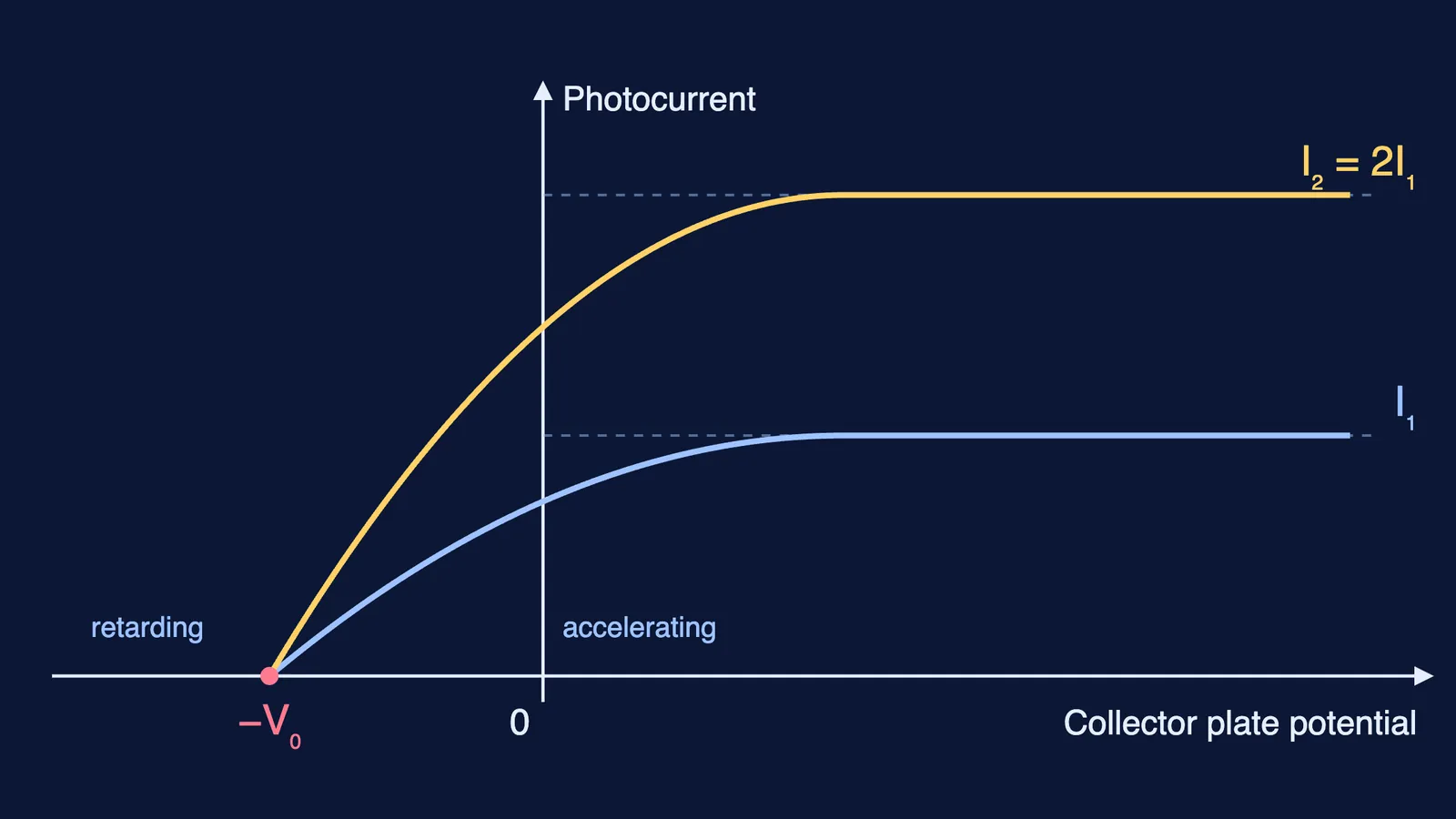
5 marks: long answers come in parts (2+2+1 or 3+2). Draw Fig. 11.3 or 11.4 with labelled axes and −V0 on the negative side, plus a one-line caption.
A worked board-style numerical, checked twice
Question (3 marks). Photons of energy 4.5 eV fall on a metal of work function 2.5 eV. Find (a) the stopping potential, (b) the threshold wavelength, (c) the maximum speed of the photoelectrons. Use h = 6.63 × 10⁻³⁴ J s, c = 3 × 10⁸ m/s, e = 1.6 × 10⁻¹⁹ C, m = 9.1 × 10⁻³¹ kg.
First pass, in eV.
Kmax = 4.5 − 2.5 = 2.0 eV. Since eV0 = Kmax, V0 = 2.0 V.
φ0 = 2.5 × 1.6 × 10⁻¹⁹ = 4.0 × 10⁻¹⁹ J. With hc = 6.63 × 10⁻³⁴ × 3 × 10⁸ = 19.89 × 10⁻²⁶ J m, λ0 = hc/φ0 ≈ 4.97 × 10⁻⁷ m, about 497 nm.
Kmax = 3.2 × 10⁻¹⁹ J; v = √(2K/m) = √(6.4 × 10⁻¹⁹ / 9.1 × 10⁻³¹) ≈ √(70 × 10¹⁰) ≈ 8.4 × 10⁵ m/s.
Second pass, in joules and backwards.
4.5 eV = 7.2 × 10⁻¹⁹ J. Subtract 4.0 × 10⁻¹⁹ J, divide by e: 3.2/1.6 = 2.0 V. Same.
hc/λ0 = (19.89 × 10⁻²⁶)/(4.97 × 10⁻⁷) ≈ 4.0 × 10⁻¹⁹ J = 2.5 eV, the work function. Same.
½mv² = 0.5 × 9.1 × 10⁻³¹ × 70.56 × 10¹⁰ ≈ 3.2 × 10⁻¹⁹ J. Same.
Which assertion-reason and case-study traps catch students?
Each follows from NCERT Sections 11.4 to 11.8 (NCERT Chapter 11):
Intensity versus frequency. At fixed frequency, brighter light raises the saturation current but not the stopping potential (Fig. 11.3, and the graph above). At equal intensity, higher frequency makes the stopping potential more negative; the saturation current stays the same (Fig. 11.4).
Below threshold, nothing. If ν is below ν0, no electrons come out however intense the light.
No time lag. Emission starts in about 10⁻⁹ s or less, even in dim light.
Same slope, different metals. Every V0-ν line has slope h/e; only the threshold frequency changes.
Momentum decides λ. The de Broglie wavelength does not depend on charge, so an electron and a proton with equal momentum have equal λ.
Part II of sample case study Q30 asks, for 1 mark, why intensity leaves Kmax unchanged (CBSE marking scheme 2026-27); practise a two-sentence answer.
If the graphs still blur, the Fermi Simulation Lab has interactive simulations for the ideas that are easier to see than to read.
What is a good revision plan for this chapter?
Four one-hour sittings:
Day 1: NCERT Sections 11.2 to 11.4. Draw Figs 11.2 to 11.5 from memory.
Day 2: Sections 11.5 to 11.7. Derive V0 = (h/e)ν − φ0/e, then list the three features wave theory could not explain.
Day 3: Section 11.8, then NCERT Exercises 11.2 to 11.11 by hand, each with a second-pass check.
Day 4: Timed: the sample case study, three assertion-reason items written from the trap list, and one 5-mark answer, marked against the scheme.
For pacing the whole paper, see our 20-minute triage plan for running out of time. If you cannot find where a numerical went wrong, the Fermi Problem Library has worked problems with a step-by-step solver that explains the reasoning rather than printing an answer.