On this page
Chemical Thermodynamics rewards students who read signs quickly. Most questions on it are one equation plus a sign or unit check, so learn a short list of relations cold and spot the trap before you calculate.
What does the NEET-UG syllabus include in Chemical Thermodynamics?
In the NEET (UG) syllabus notified by the National Medical Commission (dated 22 December 2025, the latest published version), Chemical Thermodynamics is Unit 4 under Physical Chemistry. It lists:
Fundamentals: system and surroundings, extensive and intensive properties, state functions, types of processes.
The first law: work, heat, internal energy and enthalpy, heat capacity, molar heat capacity; Hess's law of constant heat summation; enthalpies of bond dissociation, combustion, formation, atomization, sublimation, phase transition, hydration, ionization and solution.
The second law: spontaneity of processes; ΔS of the universe and ΔG of the system as criteria for spontaneity; ΔG° (standard Gibbs energy change) and equilibrium constant.
All of this is in NCERT Class 11 Chemistry Part I, Unit 5 Thermodynamics (Reprint 2026-27), from thermodynamic terms (5.1) to Gibbs energy change and equilibrium (5.7). We found no listed sub-topic missing from the current chapter. NCERT writes the first law as ΔU = q + w, with w the work done on the system; keep that convention.
How are NEET thermodynamics questions different from JEE Main?
As in NEET-UG 2026, the NTA information bulletin sets 180 compulsory multiple-choice questions in 180 minutes, each with four options and one correct or best answer, marked +4 for correct, −1 for incorrect and 0 if left blank. That is about a minute a question, with no numerical-value section. So:
Recall formulas exactly: ΔH = ΔU + Δn(g)RT, ΔG = ΔH − TΔS, ΔG° = −2.303RT log K.
Expect NCERT-statement and assertion-reason items ("the standard enthalpy of formation of an element in its reference state is zero").
Use units and signs to eliminate options before you finish the arithmetic.
Sitting JEE Main too? Our Chemical Thermodynamics guide for JEE Main covers longer problems.
Three worked examples, solved the NEET way
Example 1 (ΔH from ΔU). For 2X(g) + Y(g) → 2Z(g) at 300 K, ΔU = −150.0 kJ. Find ΔH.
Δn(g) = 2 − 3 = −1. ΔH = ΔU + Δn(g)RT = −150.0 + (−1)(8.314 × 10⁻³)(300) = −150.0 − 2.49 = −152.5 kJ. Fewer gas moles, so ΔH is more negative than ΔU.
Example 2 (Hess's law). Given A + B → C, ΔH₁ = −120 kJ, and C + B → D, ΔH₂ = +45 kJ. Find ΔH for D → A + 2B.
Add the two equations: A + 2B → D, ΔH = −120 + 45 = −75 kJ. Reverse it and the sign flips: ΔH = +75 kJ.
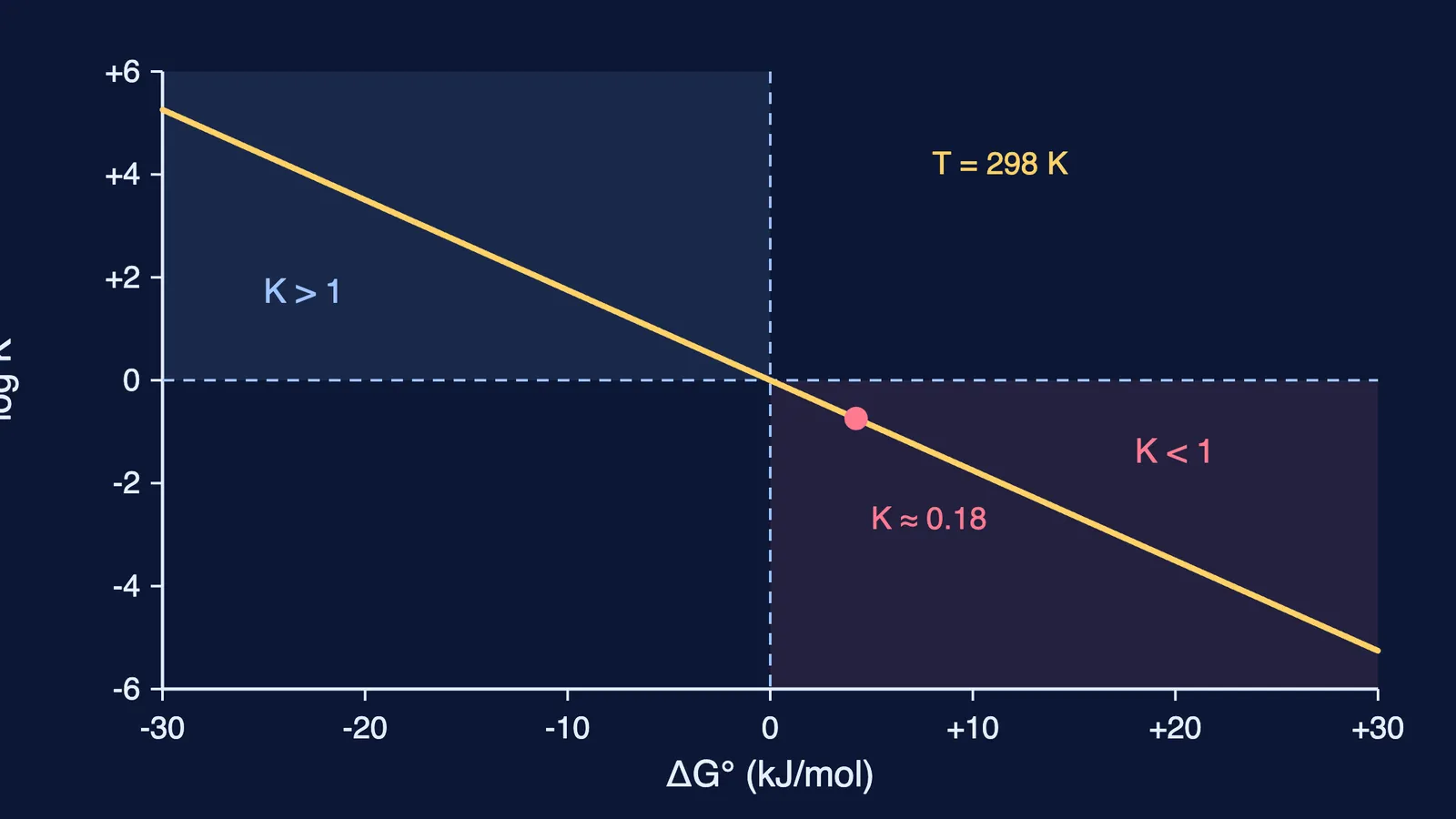
Example 3 (Gibbs energy and K). A reaction has ΔH° = +40.0 kJ mol⁻¹ and ΔS° = +120 J K⁻¹ mol⁻¹. Spontaneous at 298 K? What is K?
Convert ΔS° to 0.120 kJ K⁻¹ mol⁻¹ first. ΔG° = 40.0 − 298 × 0.120 = +4.24 kJ mol⁻¹, so it is not spontaneous under standard conditions. At 298 K, 2.303RT ≈ 5.71 kJ mol⁻¹, so log K = −4.24/5.71 = −0.74 and K ≈ 0.18. It turns spontaneous above T = ΔH°/ΔS° = 40.0/0.120 ≈ 333 K.
What are the common traps?
J vs kJ. ΔS comes in J K⁻¹, ΔH in kJ; convert first.
Counting liquids in Δn(g). Only gaseous moles count.
Sign of work. With ΔU = q + w, work done by the gas is negative.
"Exothermic means spontaneous." NCERT says a decrease in enthalpy may help spontaneity but does not decide it in all cases; check ΔG.
State functions. q and w depend on the path; ΔU, ΔH, ΔS and ΔG do not.
Stuck on a step? The Fermi Problem Library has worked problems with a step-by-step solver that explains the reasoning rather than printing an answer.
A seven-day practice plan
Day 1: NCERT 5.1–5.2; one line per definition.
Day 2: ΔH vs ΔU, calorimetry, ten Δn(g) checks.
Day 3: Hess's law and the named enthalpies.
Day 4: entropy and the four ΔH/ΔS sign cases.
Day 5: ΔG° and K, using the 5.71 shortcut.
Day 6: 20 mixed questions, one minute each.
Day 7: redo every wrong answer; name its trap.
Try these original questions in four minutes:
ΔH = −20 kJ mol⁻¹ and ΔS = −80 J K⁻¹ mol⁻¹. Below what temperature is the reaction spontaneous?
ΔG° = +5.7 kJ mol⁻¹ at 298 K. K is closest to: 0.01, 0.1, 10 or 100?
A gas is compressed: 250 J of work is done on it while it gives out 100 J of heat. What is ΔU?
Assertion: an exothermic reaction is always spontaneous. Reason: a negative ΔH always makes ΔG negative.
Answers: 1. 250 K. 2. 0.1. 3. +150 J. 4. Both assertion and reason are false.
For the board-exam angle, see Thermodynamics Class 11 chemistry: signs, Hess's law, Gibbs energy, and for pacing, read which NEET section to attempt first in 180 minutes.