On this page
p-Block questions in JEE Main reward reasoning over recall: if you know why an element behaves as it does, you can rank a series you have never seen.
Is p-Block Elements in the JEE Main 2027 syllabus?
Yes. The NTA Syllabus for JEE (Main) 2027, linked from jeemain.nta.nic.in, lists "p-Block Elements" (Group 13 to Group 18) as Unit 10 of Inorganic Chemistry. Its scope: electronic configuration, trends across periods and down groups, and the unique behaviour of the first element in each group.
It names no individual compounds, so treat hydrides, oxides and halides as evidence for trends. Unit 20 (practical chemistry) adds the salt-analysis anions: carbonate, sulphide, sulphate, nitrate, nitrite, chloride, bromide, iodide.
Which NCERT chapters cover p-block elements now?
None of the current NCERT Chemistry books (Reprint 2026-27) has a p-block chapter. The contents pages of Class 11 Part I, Class 11 Part II, Class 12 Part I and Class 12 Part II show no unit for any group from 13 to 18; the only block unit left is the d- and f-block in Class 12.
What remains covers NTA's wording:
Class 11 Unit 3, Classification of Elements: section 3.6.2 introduces the p-block (valence configuration ns2np1 to ns2np6), and section 3.7.2 explains why each group's first member differs: small size, high electronegativity and only four valence orbitals, so its maximum covalency is 4 and it forms pπ–pπ multiple bonds readily.
Class 11 Unit 4, Chemical Bonding: VSEPR for every shape.
Class 11 Unit 7, Redox Reactions: oxidation states.
Older guides still carry full group chapters; our guide on how to check the deleted NCERT syllabus helps you spot them.
What trends should you know for groups 13 to 18?
Group 13 (ns2np1): +3 is usual, but +1 grows more stable down the group (inert pair effect), so Tl+ is more stable than Tl3+. Gallium's atomic radius is slightly smaller than aluminium's: its 3d electrons shield poorly.
Group 14 (ns2np2): +4 and +2, with +2 gaining down the group. So PbO2 is an oxidising agent and SnCl2 a reducing agent.
Group 15 (ns2np3): N2 is held by a triple bond, and nitrogen cannot go beyond covalency four. Hydride basicity falls from NH3 to BiH3.
Group 16 (ns2np4): oxygen is almost always −2 and positive only with fluorine, as in OF2, where it is +2 (NCERT Unit 3); sulphur reaches +4 and +6. Hydride acid strength rises from H2O to H2Te.
Group 17 (ns2np5): fluorine shows only −1; the others also show +1, +3, +5 and +7.
Group 18 (ns2np6, helium 1s2): xenon forms XeF2, XeF4 and XeF6, with xenon at +2, +4 and +6.
How do you solve p-block questions? Three worked examples
1. Why does PCl5 exist but not NCl5? Nitrogen has only four valence orbitals (2s, 2p), so it cannot hold five bond pairs; phosphorus has 3d orbitals available. Likewise, boron stops at BF4− while aluminium forms AlF6 3− (NCERT Unit 3).
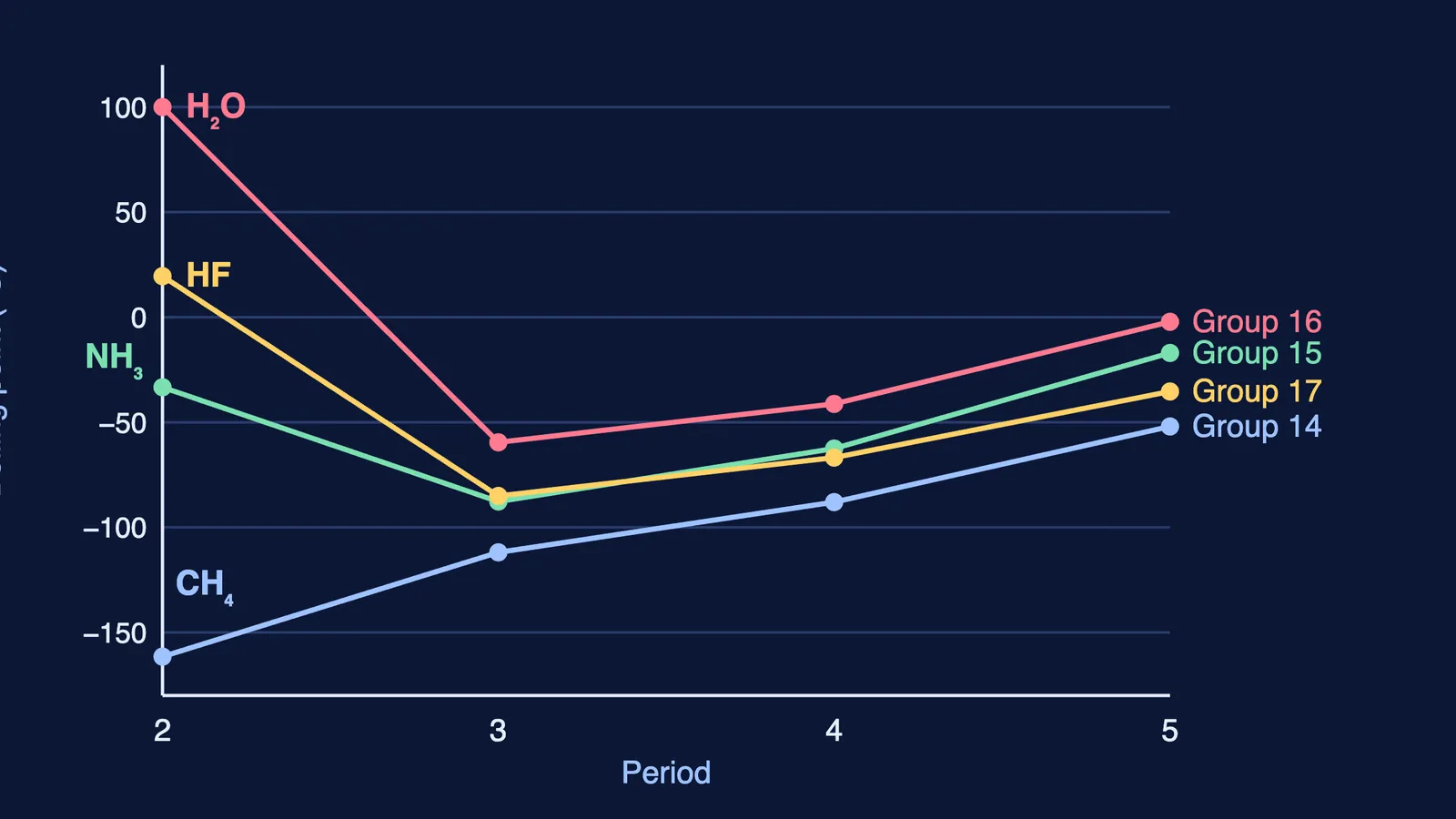
2. Rank NH3, PH3, AsH3 and SbH3 by boiling point. Dispersion forces grow with size, raising boiling point from PH3 to SbH3; hydrogen bonding lifts NH3 out of line. Boiling points are about −17 °C for stibine, −33 °C for ammonia, −62.5 °C for arsine and −88 °C for phosphine. Answer: SbH3 > NH3 > AsH3 > PH3. The diagram above shows the same jump for HF and H2O, but not CH4.
3. How many protons can H3PO3 donate? Phosphorus carries one H directly, one double-bonded O and two OH groups. Only O–H hydrogens ionise, so it is dibasic; H3PO2, with two P–H bonds and one OH, is monobasic.
If a step does not click, the Fermi Problem Library has worked problems with a step-by-step solver that explains the reasoning rather than printing an answer.
What are the common p-block traps?
Chlorine, not fluorine, has the most negative electron gain enthalpy, because an extra electron in fluorine's small 2p shell meets more repulsion (NCERT Unit 3).
Halogen bond enthalpy runs Cl2 > Br2 > F2 > I2, not F2 first: lone pairs on two close fluorine atoms repel.
Lewis acidity runs BF3 < BCl3 < BBr3: fluorine back-bonds most into boron's empty p orbital.
Diborane is not ethane-like: it has two three-centre, two-electron B–H–B bridges.
Count lone pairs before naming shapes: XeF4 is square planar, ClF3 T-shaped, SF4 see-saw. Our chemical bonding guide has the full VSEPR routine.
A 10-day plan for p-block
Days 1-2: Class 11 Unit 3 on blocks, trends and first members; one cause per group.
Days 3-4: groups 13 and 14, boron halides, diborane.
Days 5-6: groups 15 and 16, hydrides, phosphorus oxoacids.
Days 7-8: groups 17 and 18, interhalogen and xenon fluoride shapes.
Day 9: the chemistry behind each Unit 20 anion.
Day 10: a timed mixed set from past papers, logging errors by cause, as in our guide to using previous year questions.
When a trend still feels arbitrary, the Fermi Concept Library gives every chemistry concept its own lesson and its place in the map.