On this page
In the CBSE Class XII Physics curriculum for 2026-27, the theory marks table (70 marks) prints one shared cell, 12, across "Unit–VII Dual Nature of Radiation and Matter" and "Unit–VIII Atoms and Nuclei", which holds "Chapter–12: Atoms" and "Chapter–13: Nuclei". Nuclei has no separate figure. If you are also preparing for JEE, our Atoms and Nuclei guide for JEE Main covers exam speed; this post is about board answers.
What does the Nuclei syllabus include for 2026-27?
CBSE's Chapter–13 list covers nuclear size and composition, nuclear force, mass-energy, mass defect, binding energy per nucleon and its variation with A, fission and fusion. Radioactivity is not on it. The NCERT Chapter 13 (Reprint 2026-27) names alpha, beta and gamma decay in Section 13.6 but gives no decay law.
What NCERT does teach:
Size: R = R0A^(1/3), with R0 = 1.2 fm. Volume and mass both grow with A, so density is the same for every nucleus, about 2.3 × 10^17 kg/m³ (prove it: Exercise 13.10).
Mass-energy: E = mc², and 1 u = 931.5 MeV/c² (Example 13.3).
Mass defect and binding energy: ΔM = [Zmp + (A − Z)mn] − M, and Eb = ΔMc².
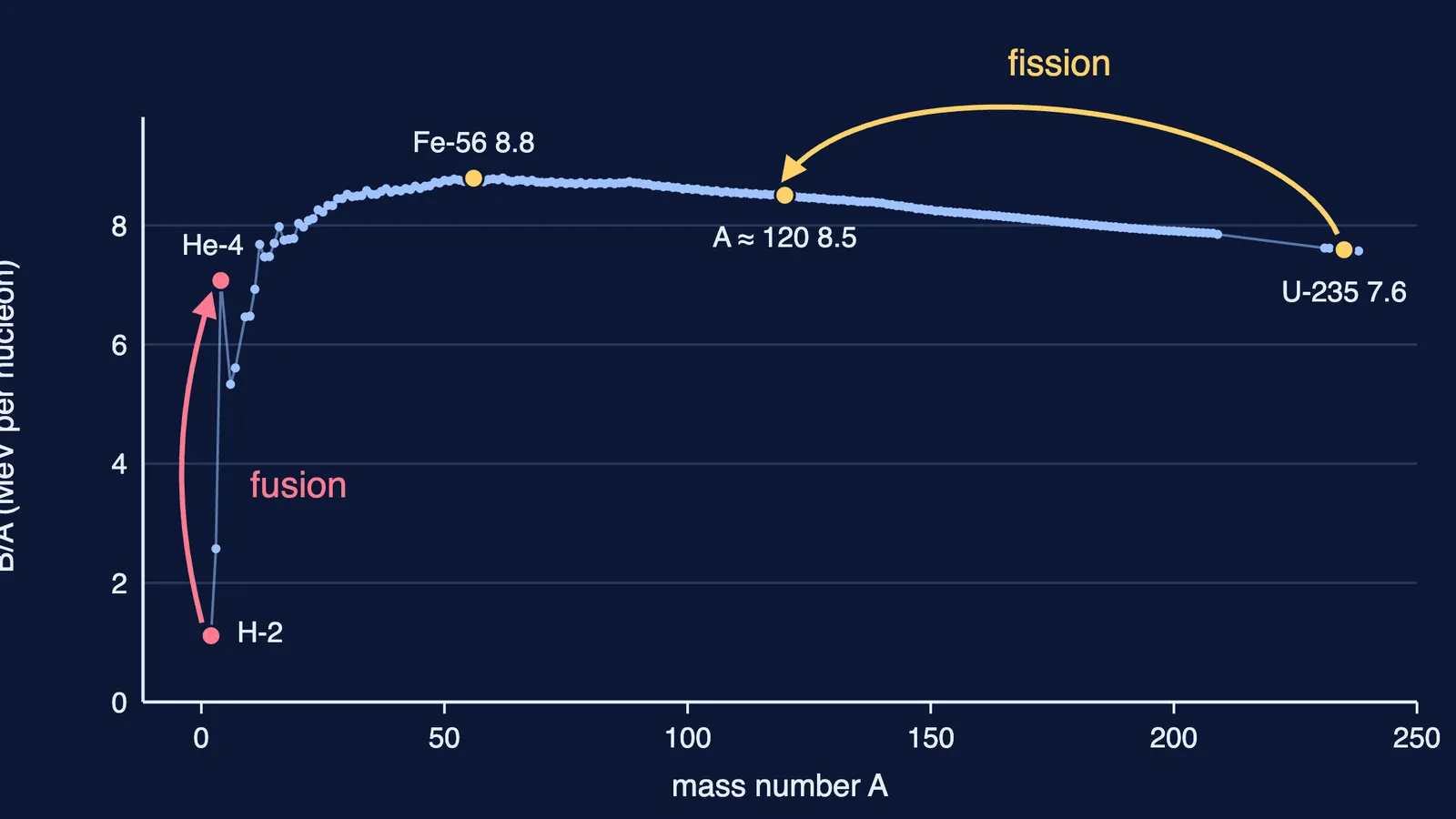
The B/A curve: nearly flat for 30 < A < 170, a maximum of about 8.75 MeV near A = 56, and 7.6 MeV at A = 238.
Nuclear force: much stronger than Coulomb, short-ranged, charge-independent; repulsive below about 0.8 fm.
Fission and fusion: A = 240 splitting into two A = 120 nuclei gains about 0.9 MeV per nucleon: 240 × 0.9 ≈ 216 MeV, roughly 200 MeV per fission.
Our binding energy per nucleon curve explainer goes deeper into the curve.
How should you set out 2-, 3- and 5-mark answers?
The 2026-27 sample paper says calculators are not allowed. Its 3-mark Q24 asks for the binding energy per nucleon of oxygen-16 and the marking scheme gives one mark each for the sum of nucleon masses, the binding energy and the binding energy per nucleon.
2 marks: formula, substitution, answer with unit; or a definition plus one reason.
3 marks: three visible steps, units on every line.
5 marks: sketch the labelled B/A curve, explain fission and fusion from it, then a short numerical.
NCERT removes 8 electron masses and gets ΔM = 0.13691 u, or 127.5 MeV (about 7.97 MeV per nucleon). The marking scheme subtracts the atomic mass, 15.99493 u, from 16.12744 u directly, giving 0.13251 u and 7.71 MeV per nucleon. Show the electron line.
Worked numerical: binding energy of helium-4, done twice
Data given with the NCERT chapter's exercises: m(He-4) = 4.002603 u, mH = 1.007825 u, mn = 1.008665 u, 1 u = 931.5 MeV/c².
Pass 1, in u. Using mH, electrons cancel. Constituents: 2 × (1.007825 + 1.008665) = 2 × 2.016490 = 4.032980 u. ΔM = 4.032980 − 4.002603 = 0.030377 u. Split it: 0.03 × 931.5 = 27.945 and 0.000377 × 931.5 ≈ 0.351, so Eb ≈ 28.3 MeV, or 7.07 MeV per nucleon.
Pass 2, in joules, without 931.5. Take 1 u ≈ 1.66 × 10⁻²⁷ kg, c = 3 × 10⁸ m/s and 1 MeV = 1.6 × 10⁻¹³ J. ΔM ≈ 0.0304 × 1.66 × 10⁻²⁷ ≈ 5.05 × 10⁻²⁹ kg. E = 5.05 × 10⁻²⁹ × 9 × 10¹⁶ ≈ 4.54 × 10⁻¹² J, and 4.54 × 10⁻¹² ÷ 1.6 × 10⁻¹³ ≈ 28.4 MeV. The passes agree within rounding.
7.07 MeV sits below the 8 MeV plateau, as a light nucleus should. For more problems in the same steps, the Fermi Problem Library has worked problems with a step-by-step solver that explains the reasoning rather than printing an answer. Our deuterium fusion numerical applies this to a reaction.
Where do assertion-reason and case-study questions trick you?
The sample paper has four assertion-reason questions and two case studies. Its Q7 says the B/A maximum near A = 56 marks the most tightly bound nuclei. Traps, our own examples checked against NCERT:
True reason, wrong link. A: B/A is nearly constant for 30 < A < 170. R: the nuclear force does not depend on charge. Both true, but R does not explain A: the flat curve comes from the force's short range.
False assertion. "Heavier nuclei are more tightly bound" fails: B/A falls after A ≈ 56.
Density. "Nuclear density increases with A" is false; R = R0A^(1/3) makes it constant.
Case-study arithmetic. Multiply the per-nucleon gain by all 240 nucleons, not by the two fragments.
Fusion. The high temperature is needed to overcome Coulomb repulsion.
A seven-day Nuclei revision plan
Day 1: composition, R = R0A^(1/3), density proof from memory.
Day 2: E = mc², the 931.5 MeV conversion, the mass defect definition.
Day 3: NCERT Exercises 13.1 and 13.2 plus helium-4 above, twice each.
Day 4: sketch the B/A curve from memory.
Day 5: nuclear force properties and the potential-energy graph.
Day 6: the fission estimate and NCERT Example 13.4.
Day 7: sample paper Q7 and Q24 timed; write two assertion-reason pairs.