On this page
Most questions in this chapter turn on one small step: a ligand name, an oxidation state, a count of unpaired electrons. Make those steps automatic and the chapter gets quick.
What does the NEET syllabus include in Coordination Compounds?
In the NMC's updated NEET (UG) 2026 syllabus, Unit 12 of Chemistry, Co-ordination Compounds, lists: introduction to coordination compounds, Werner's theory, ligands, coordination number, denticity, chelation, IUPAC nomenclature of mononuclear coordination compounds, isomerism, bonding by the valence bond approach and basic ideas of crystal field theory, colour and magnetic properties, and the importance of coordination compounds in qualitative analysis, extraction of metals and biological systems.
In the 2026-27 reprint of NCERT Class 12 Chemistry Part I, this is Unit 5. Its sections: Werner's theory (5.1), definitions (5.2), nomenclature (5.3), isomerism (5.4), bonding, magnetism, crystal field theory and colour (5.5), metal carbonyls (5.6) and applications (5.7). Every NMC sub-topic is still in the current NCERT unit. The NMC list does not name metal carbonyls separately, so read 5.6 once and spend your hours on the listed items.
How are NEET questions on this chapter asked?
In NEET-UG 2026, Chemistry had 45 multiple-choice questions with four options and one correct answer, and the paper had 180 questions in 180 minutes, according to the NTA information bulletin. A correct answer earned +4 and a wrong one cost 1 mark. That is about a minute per question and no numerical-value section, so expect NCERT statements, assertion-reason pairs and quick calculations. NEET 2027 is not yet notified; check the official site.
Eliminate fast. A tetrahedral complex never shows geometric isomerism, and a spin-only moment must equal the square root of n(n+2) for a whole number n, so options like 4.2 BM can go.
Worked examples, solved the NEET way
Example 1: Werner's test. You dissolve 1.342 g of a cobalt(III) compound with the composition CoCl3·5NH3·H2O (molar mass 268.4 g/mol, so 0.00500 mol) and add excess AgNO3. You collect 2.149 g of AgCl (143.3 g/mol), which is 0.0150 mol. That is 3 mol of AgCl per mole of complex, so all three chlorides sit outside the bracket and water is a ligand: [Co(NH3)5(H2O)]Cl3, pentaammineaquacobalt(III) chloride. Its hydrate isomer [Co(NH3)5Cl]Cl2·H2O would give only 2 mol.
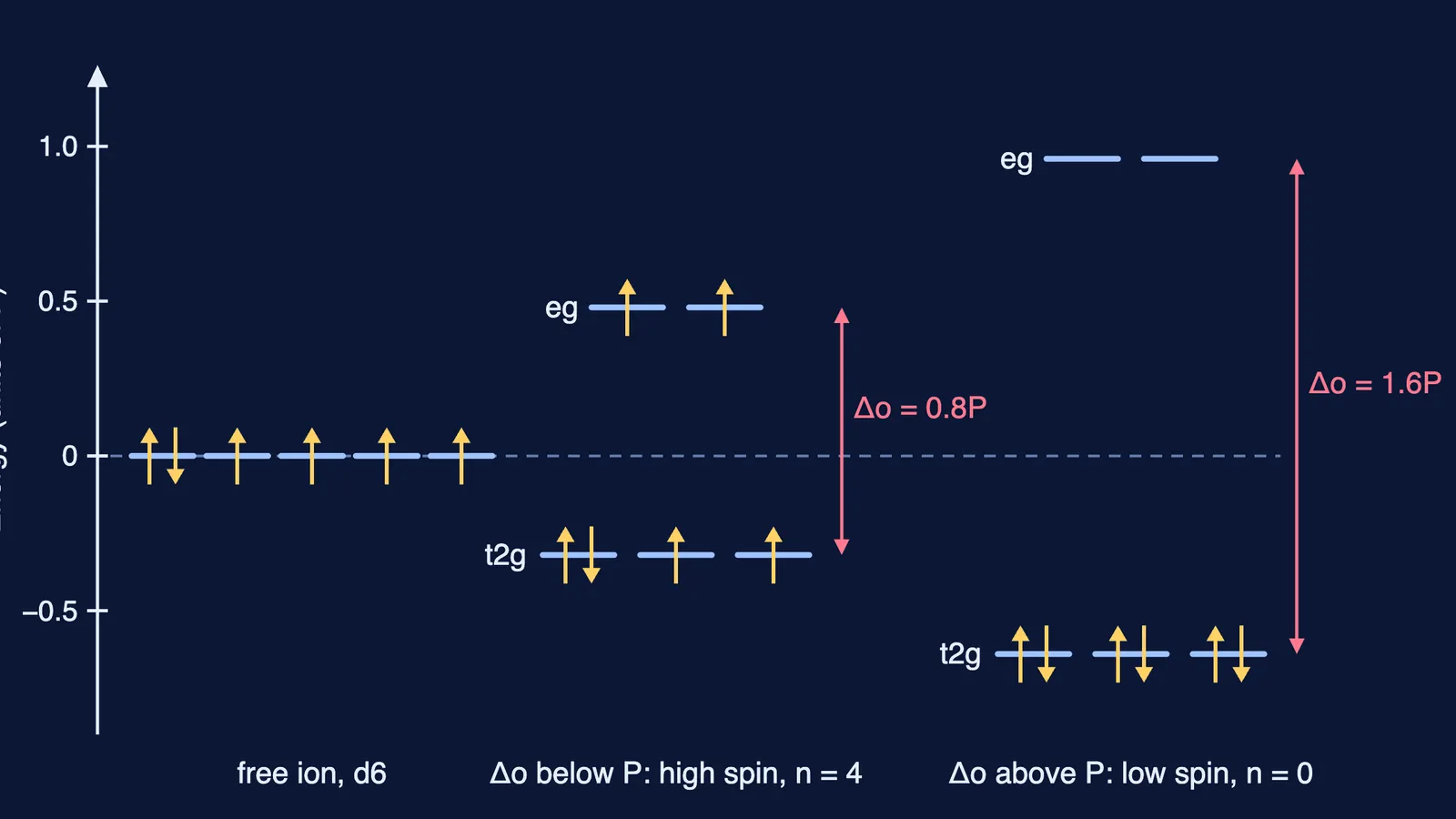
Example 2: name, oxidation state, magnetism. Na3[CoF6] is sodium hexafluoridocobaltate(III), and Na3[Co(CN)6] is sodium hexacyanidocobaltate(III). In both, cobalt is +3 (3d6). NCERT reports [four unpaired electrons for [CoF6]3-](https://ncert.nic.in/textbook/pdf/lech105.pdf), an outer orbital (sp3d2) complex. CN- sits near the strong end of the spectrochemical series, so in [Co(CN)6]3- all six electrons pair in t2g: zero unpaired, an inner orbital (d2sp3) complex. With the spin-only formula μ = √(n(n+2)) BM, that is √24 = 4.90 BM and 0 BM (diamagnetic).
Example 3: count the isomers. [Cr(NH3)4Cl2]Br is tetraamminedichloridochromium(III) bromide. Chromium: x + 4(0) + 2(-1) = +1, so x = +3. It is octahedral [MX2L4], so it has two geometric isomers, cis and trans. Swapping Br- and one Cl- gives the ionisation isomer [Cr(NH3)4BrCl]Cl. Trap: the original salt gives AgBr, not AgCl, with AgNO3.
Which traps cost marks in this chapter?
Writing "amine" for NH3: the ligand is "ammine", and water is "aqua".
Ordering ligands by charge instead of alphabetically, as in triamminetriaquachromium(III) chloride.
Forgetting "-ate" and Latin names in anionic complexes: ferrate, not ironate.
Using total d electrons in √(n(n+2)) instead of unpaired electrons.
Expecting low spin in tetrahedral complexes: NCERT gives Δt = (4/9)Δo, too small to force pairing.
Mixing up uses: chlorophyll is a magnesium complex, haemoglobin iron, vitamin B12 cobalt; EDTA estimates water hardness; gold is extracted as [Au(CN)2]- and recovered with zinc; cisplatin inhibits tumours.
Forgetting the series ends: I- is the weakest ligand, CO the strongest.
A seven-day plan and practice set
Day 1: Werner's theory, AgCl and conductivity logic, 5.2 definitions.
Day 2: naming both ways, 20 formulas and 20 names.
Day 3: isomerism; draw every pair you name.
Day 4: VBT, hybridisation, spin-only moments.
Day 5: crystal field splitting, spectrochemical series, colour.
Day 6: section 5.7 and NCERT in-text questions.
Day 7: 45 timed mixed MCQs, then review every miss.
Stuck on a step? The Fermi Problem Library has worked problems with a step-by-step solver that explains the reasoning rather than printing an answer. If a term itself is the gap, the Fermi Concept Library covers every concept in physics, chemistry, biology, mathematics and computing, each with its own lesson and its place in the map.
Try these (one minute each):
How many moles of AgCl does 0.05 mol of [Pt(NH3)4Cl2]Cl2 give with excess AgNO3?
What is the oxidation state of chromium in Na3[CrF6]?
What is the spin-only moment of a complex with three unpaired electrons?
What is the coordination number of nickel in [Ni(en)3]2+?
Which can show geometric isomerism: square planar [Pd(NH3)2Br2] or tetrahedral [Zn(NH3)2Br2]?
Answers: 0.10 mol; +3; 3.87 BM; six (three en, two N each); the square planar palladium one.
For a deeper drill, see our Coordination Compounds guide for JEE Main. For written answers, use the Class 12 board exam plan for Coordination Compounds, and practise how to find the oxidation state and coordination number in a complex.