On this page
Coordination Compounds rewards students who practise a few fixed routines: work out the oxidation state, count d electrons, decide the field strength, then fill orbitals. Most lost marks come from skipping one of those steps, not from missing theory.
Is Coordination Compounds in the JEE Main syllabus?
Yes. The NTA syllabus for JEE (Main) 2027 lists Coordination Compounds as Unit 12 of Chemistry, under inorganic chemistry. It names Werner's theory, ligands, coordination number, denticity, chelation, IUPAC names of mononuclear compounds, isomerism, valence bond theory, basic crystal field theory, colour, magnetic properties, and uses in qualitative analysis, metal extraction and biology. The syllabus lists topics only; it gives no marks or question counts per unit, so treat any weightage figure you see online as someone's estimate.
The matching textbook chapter is Unit 5, Coordination Compounds, in NCERT Class 12 Chemistry Part I, according to the contents page of the 2026-27 reprint. Older editions numbered it Unit 9, so check the number before you buy a guide or solution set.
How should you study the chapter, in what order?
Vocabulary first. Ligand, denticity, coordination sphere, homoleptic, heteroleptic. You cannot name or count isomers without these.
Nomenclature. Learn the rules once, then write ten names a day for three days.
Isomerism. Structural types first (ionisation, linkage, coordination, solvate), then geometrical and optical.
Bonding. Valence bond theory, then crystal field theory, then colour and magnetism as consequences.
Uses. A short list from the NCERT section, revised by reading.
Keep NCERT as your base text. Expect to apply its ideas to compounds the book never names, so practise on new examples.
How do you name and count isomers without guessing?
Name a compound in three moves: find the metal's oxidation state from the charges, list ligands alphabetically ignoring the multiplying prefixes, and add "-ate" to the metal if the complex is an anion. Two worked examples:
[CrCl2(H2O)4]Cl: the complex carries +1, the two chlorides give -2, so chromium is +3. Name: tetraaquadichloridochromium(III) chloride ("aqua" comes before "chlorido").
Na3[Co(NO2)6]: the anion is -3, six nitrites give -6, so cobalt is +3. Name: sodium hexanitrito-N-cobaltate(III).
For isomer counts, draw before you count. These are worth knowing cold:
Square planar [MA2B2], for example [Pt(NH3)2Cl2]: two geometrical isomers (cis, trans), neither optically active.
Tetrahedral [MA2B2]: no geometrical isomers, because every position is next to every other.
Octahedral [MA4B2] and [MA3B3]: two geometrical isomers each (cis/trans; fac/mer).
[M(AA)2B2], for example [CrCl2(en)2]+: cis and trans, and the cis form is chiral, so three stereoisomers in all.
[MA2B2C2]: five geometrical isomers; only the all-cis one is chiral, so six stereoisomers.
If a chatbot hands you a different count, draw the isomers yourself before you trust it; our post on counting organic structural isomers before checking an AI's list shows the same habit for organic compounds.
How do you get hybridisation and magnetic moment right?
The NCERT chapter gives the spectrochemical series, an experimental ordering of ligands from weak field (iodide, bromide, chloride, fluoride) to strong field (ammonia, en, cyanide, carbon monoxide). Use it with this routine:
Find the oxidation state and the d-electron count.
Decide weak or strong field from the ligand.
For an octahedral complex, fill t2g then eg; for d4 to d7, pair up in t2g only if the field is strong.
Count unpaired electrons n, then spin-only moment = square root of n(n+2) in BM.
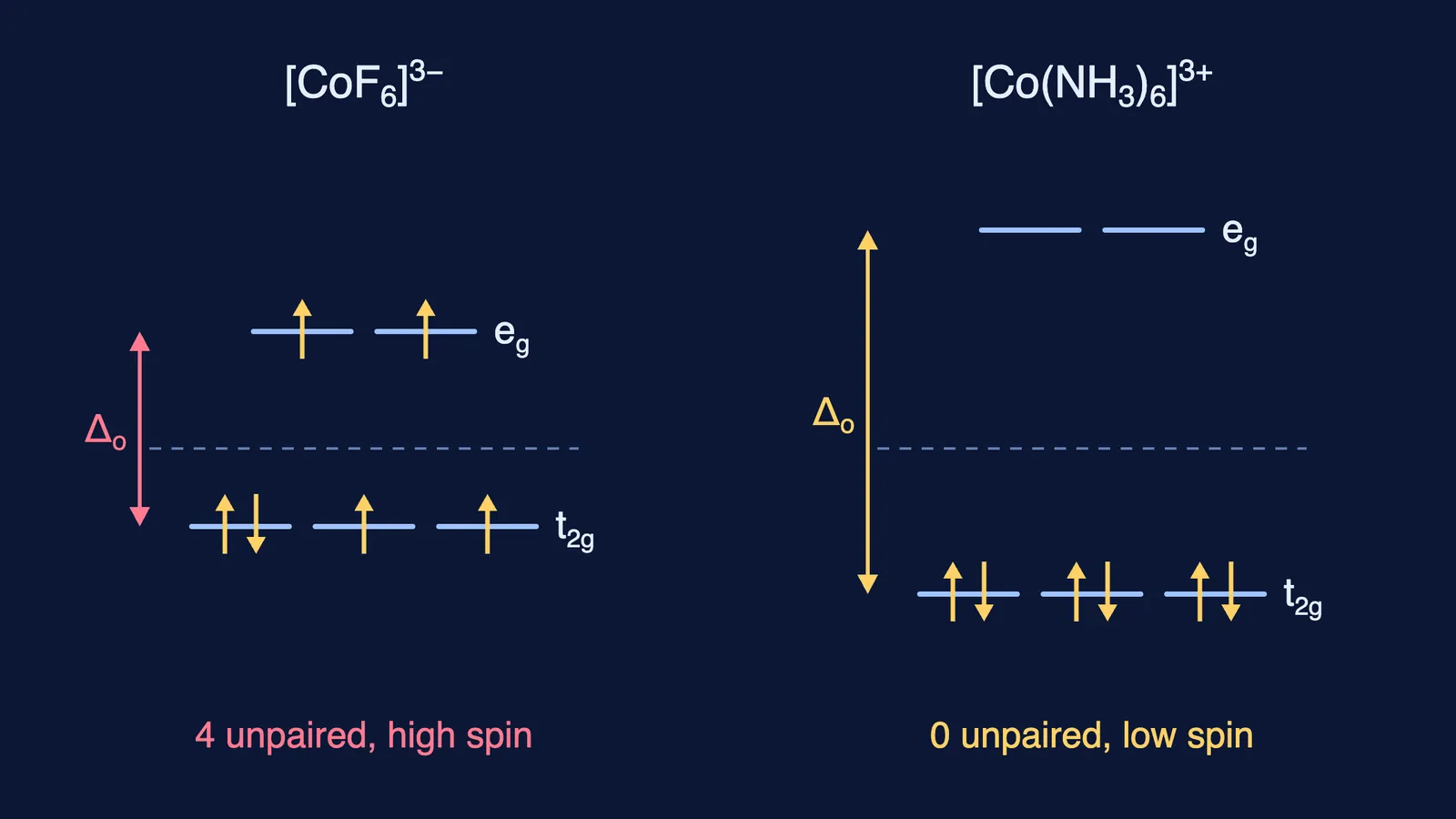
Worked through, matching the diagram above:
[CoF6]3-: Co3+ is d6; fluoride is weak field, so t2g4 eg2, four unpaired electrons, moment square root of 24 = 4.90 BM, outer orbital sp3d2.
[Co(NH3)6]3+: also d6, but ammonia pairs the electrons, so t2g6, zero unpaired, diamagnetic, inner orbital d2sp3.
[Fe(CN)6]3-: Fe3+ is d5; cyanide gives t2g5, one unpaired, 1.73 BM.
[NiCl4]2-: Ni2+ is d8; tetrahedral sp3 with two unpaired electrons, 2.83 BM.
[Ni(CN)4]2-: also d8, but square planar dsp2 and diamagnetic.
NCERT reports the same unpaired-electron counts for [CoF6]3- and [Fe(CN)6]3- in its section on magnetic properties.
If you keep reaching the wrong electron count, the Fermi Problem Library has worked problems with a step-by-step solver that explains the reasoning rather than printing an answer, so you can see the step where yours went off.
What does a one-week practice plan look like?
Day 1: read the NCERT unit start to finish and list every term you could not define.
Day 2: twenty names and twenty formulas, half each way.
Day 3: isomer drawings for each pattern above, then mixed counting questions.
Day 4: the four-step magnetism routine on fifteen complexes.
Day 5: colour, the spectrochemical series and the uses section.
Day 6: a timed set of past JEE Main questions on this unit; our guide to using previous year questions well explains how to log mistakes.
Day 7: redo every wrong question without notes.
If you are preparing at home, fold this week into a self-study plan for JEE without coaching, and revisit the unit every few weeks so the naming rules stay fresh.