On this page
You can prepare for JEE Main and JEE Advanced at home, but only if you rebuild the three things a coaching centre quietly does for you: it sets the pace, it answers doubts, and it tests you every week.
Can you crack JEE without coaching?
Yes, but not by reading alone. The honest test is whether you can keep a replacement for each of the three going for months, with nobody checking on you.
If one is missing, self-study tends to stall quietly. Still undecided? Read our guide on running a two-week trial before you pay for coaching.
What does coaching give you that you must replace?
Structure. A batch moves through the syllabus on a fixed calendar. Replace it with the official syllabus and a written weekly plan. Download the syllabus and the current information bulletin from the NTA's JEE Main website, not from a forwarded copy, because details can change from year to year.
Doubt solving. In a class, someone answers you the same day. Replace it with a doubt log: write each stuck point in one line, retry it a day later, then take what is left to a teacher, a friend or an AI tutor.
Tests. Coaching gives you a weekly paper and a rank. Replace it with free official papers and a fixed test slot every Sunday.
When you are stuck on a method, the Fermi Problem Library has worked problems with a step-by-step solver that explains the reasoning rather than printing an answer, so you can see where your working went wrong. Our post on how many doubts to ask an AI in one session helps keep that habit short and useful.
Which free official resources can you use?
Abhyas AI (formerly National Test Abhyas). The National Testing Agency's own app is free, and its App Store listing describes full-length mock tests, subject tests and chapter-wise practice for JEE (Main and Advanced), on the same computer-based test interface used in the actual exam.
JEE Advanced past papers. The official JEE (Advanced) archive has Paper 1 and Paper 2 for every year from 2007 to 2025, in English and Hindi from 2019. That page does not carry answer keys, so mark any answer you cannot verify and take it to your doubt log.
SWAYAM Prabha. SWAYAM Prabha runs free educational DTH channels, with a Competitive Exams category, useful when a chapter needs a second explanation.
How should you study so that it sticks?
Method matters more when nobody is setting your homework. A 2013 review of ten study techniques by John Dunlosky and colleagues in Psychological Science in the Public Interest rated practice testing and distributed practice (spreading study over time) as high utility, and rated rereading and highlighting as low utility.
In two 2006 experiments, Henry Roediger and Jeffrey Karpicke found that students who took recall tests on a passage retained substantially more after two days and after a week than students who restudied it, even though restudying made students feel more confident. Restudying won only on a test five minutes later.
For JEE: close the book and solve, return to old chapters on a schedule, and treat the weekly test as study, not a verdict.
Practice cannot fix an idea you never understood. The Fermi Concept Library covers every concept in physics, chemistry, biology, mathematics and computing, each with its own lesson and its place in the map, so you can find the earlier idea a chapter assumes you already know.
A weekly self-study plan you can start on Monday
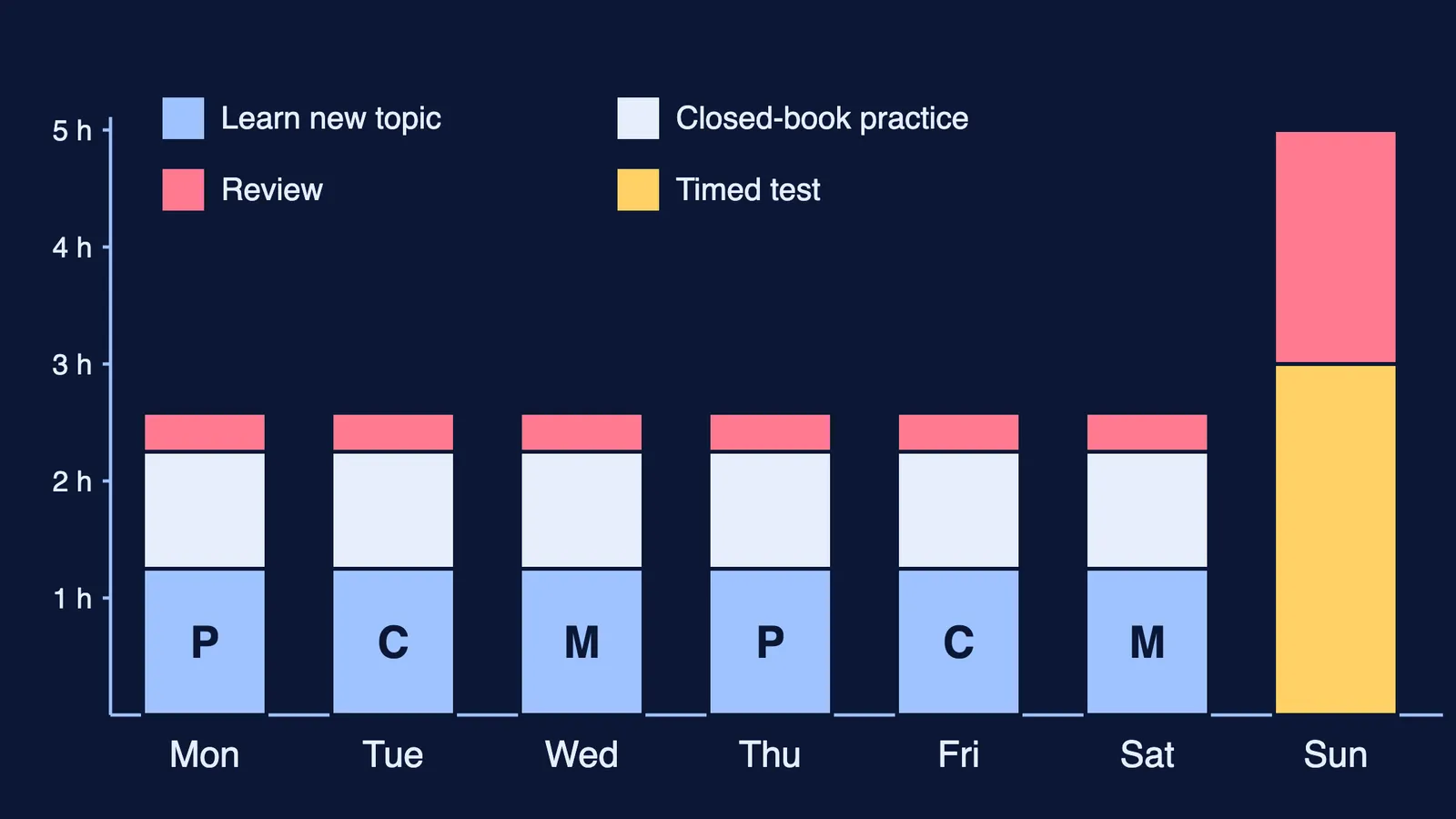
It fits around school: about two and a half hours a day from Monday to Saturday, a longer Sunday, and two learning days per subject.
Monday, Physics: 75 minutes learning a new topic, 60 minutes solving its problems with the book closed, 20 minutes of mixed problems from older chapters.
Tuesday, Chemistry: the same three blocks.
Wednesday, Maths: the same three blocks.
Thursday, Physics: the next topic, same blocks.
Friday, Chemistry: the next topic, same blocks.
Saturday, Maths: the next topic, same blocks.
Sunday: a three-hour timed test in the morning (a mock from Abhyas AI or a JEE Advanced past paper), then two hours reviewing every wrong, skipped and lucky answer.
Closer to the exam, see our guide on how many JEE Main mocks to take each week.
How do you know self-study is working?
Every four weeks, check three things:
Did you finish the topics your plan listed? If not, shrink the plan rather than dropping the Sunday test.
Are the same mistakes repeating in your error log? Send those chapters back into the mixed-problems slot.
Is your doubt log getting shorter, week on week?
Parents help most by asking about these, not the score.
If studying alone feels heavy or lonely for days at a stretch, talk to someone you trust. Tele MANAS, the government's 24x7 tele-mental health service, answers on the toll-free number 1800-89-14416 or the short code 14416, according to the Directorate General of Health Services.
Pick your Monday topic tonight and write it at the top of your plan.