On this page
When most of your class joins coaching in Class 10 or 11, staying out can feel like falling behind. But "everyone is going" tells you about your friends, not about you. The better question: what would coaching give you that you can't get alone, and can you test that before paying a year's fees?
How many students actually take coaching?
Fewer than it feels like from inside your group. In the government's Comprehensive Modular Survey: Education 2025, 27.0% of school students were taking or had taken private coaching during the academic year (PIB, Ministry of Statistics and Programme Implementation). The same release puts the share at 30.7% in urban areas and 25.5% in rural areas. These figures cover all school levels.
So the choice is yours to make on evidence, not momentum. If the pressure is mostly comparison, see our guide to handling peer pressure about coaching choices.
What does coaching actually add?
A coaching class gives you four things:
Pace: the syllabus split into weeks, so someone else decides what comes next.
Explanation: a teacher who can show a method you couldn't work out from the textbook.
Tests: graded problem sets and regular tests that tell you where you stand.
Company: a room of people aiming at the same exam, which motivates some students and drains others.
What it does not add is the practice itself. That still happens at your desk.
What does self-study need to work?
Self-study usually fails from missing structure, not missing ability. It needs a fixed daily slot, one main source (NCERT first), a way to clear doubts, and the habit of testing yourself instead of rereading.
A 2013 review of ten study techniques by John Dunlosky and colleagues rated practice testing and spaced (distributed) practice as high utility, and rereading and highlighting as low utility (Psychological Science in the Public Interest). In an earlier experiment, students who were tested on prose passages remembered more two days and a week later than students who restudied them, even though restudying made them feel more confident (Roediger and Karpicke, Psychological Science).
The hard part alone is the doubt at 9 pm. The Fermi Problem Library has worked problems with a step-by-step solver that explains the reasoning, and the Fermi Concept Library gives each concept in physics, chemistry, biology and mathematics its own lesson, so a gap doesn't have to wait for a class. Parents can use our guide to helping a teen plan a self-study day.
How can I test which suits me in two weeks?
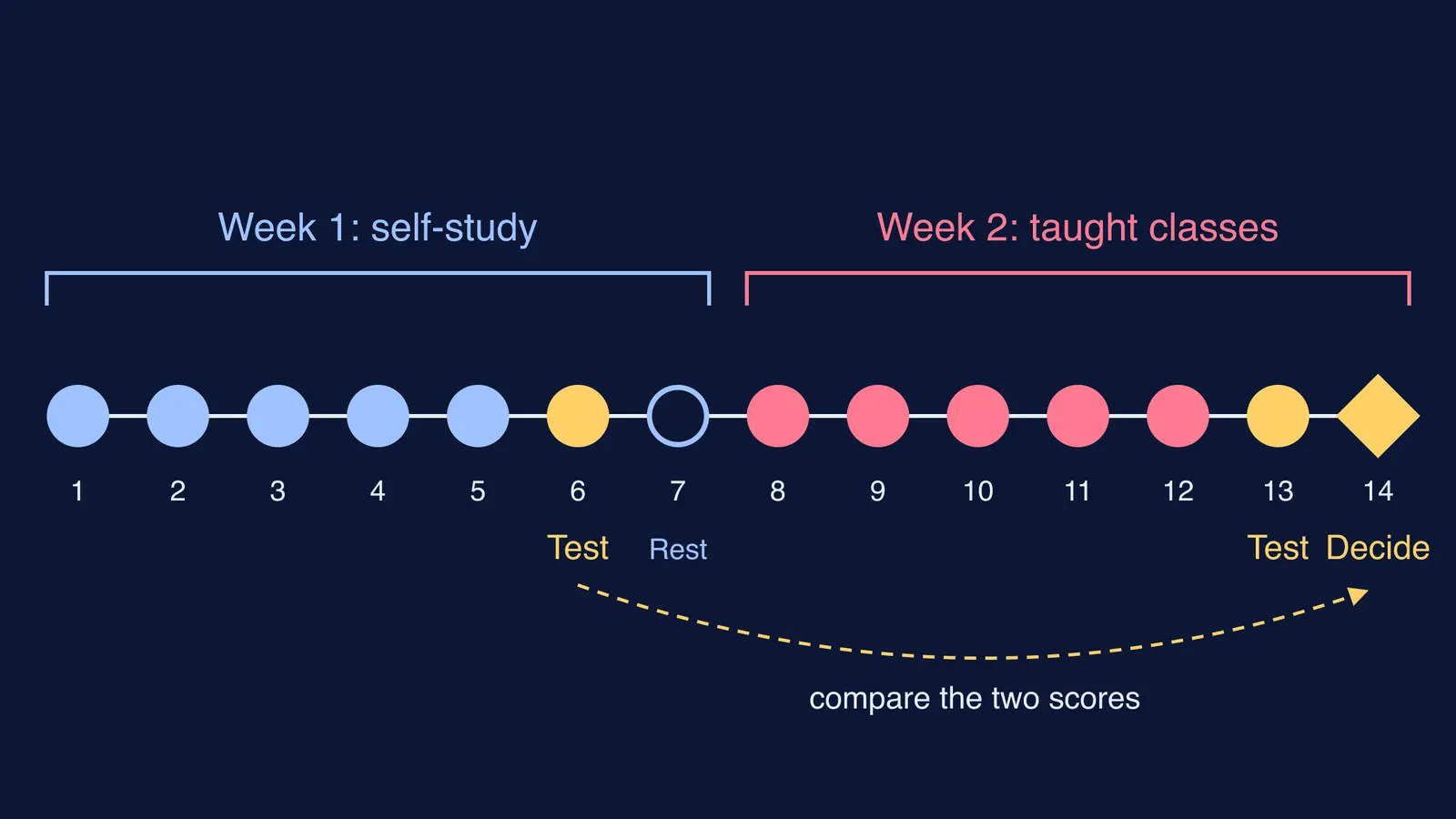
Pick two chapters you haven't studied yet, one in maths and one in science. Use the same 90-minute daily slot both weeks.
Week 1, self-study only:
Days 1 to 5: read one section, close the book, write down what you remember, then do the NCERT exercise. Note every doubt in a doubt log.
Day 6: a 30-minute self-test of 10 questions you haven't seen, from the exemplar or back exercises.
Day 7: count cleared and uncleared doubts, then rest.
Week 2, taught input:
Days 8 to 12: the same routine on the second chapter, plus a taught session each day: a demo class at your friends' centre, if it offers one, or a free online lecture.
Day 13: the same kind of 30-minute self-test.
Day 14: score both weeks.
Should I join coaching? Use this Day 14 scorecard
Taught week scored clearly higher (our rule of thumb: 2 or more marks out of 10): coaching is likely adding explanation you need.
You skipped days in Week 1 but showed up every day in Week 2: you need outside pace. Coaching can give you that, and so might a fixed study partner.
Most Week 1 doubts stayed uncleared: you need explanation. That could be coaching, one subject tuition or better resources.
Scores were close and Week 2 cost you travel and evenings: structured self-study with a weekly test is probably enough for now.
What should I check before paying fees?
Central guidelines circulated to states in January 2024 ask coaching centres to have a website listing their fees, an easy exit policy and a fee refund policy, and several states have since made their own rules (PIB, Rajya Sabha reply, August 2026). Read the refund terms before you sign; our guide on how to read a coaching fee refund policy shows what to look for.
Then show your parents your scores, doubt log and the hours each week took, and tell them what you think you need.
Tele MANAS details: Ministry of Health and Family Welfare, PIB. Start your trial this Monday and decide on Day 14.