
On this page
By 4 pm on a free day, it is easy for a Class 11 or 12 student to have spent it rereading one chapter, scrolling, and feeling guilty. The fix is not more hours. It is a day with a shape your teenager chooses in the morning, plus a few house rules from you.
What does a good self-study day look like for Class 11 and 12?
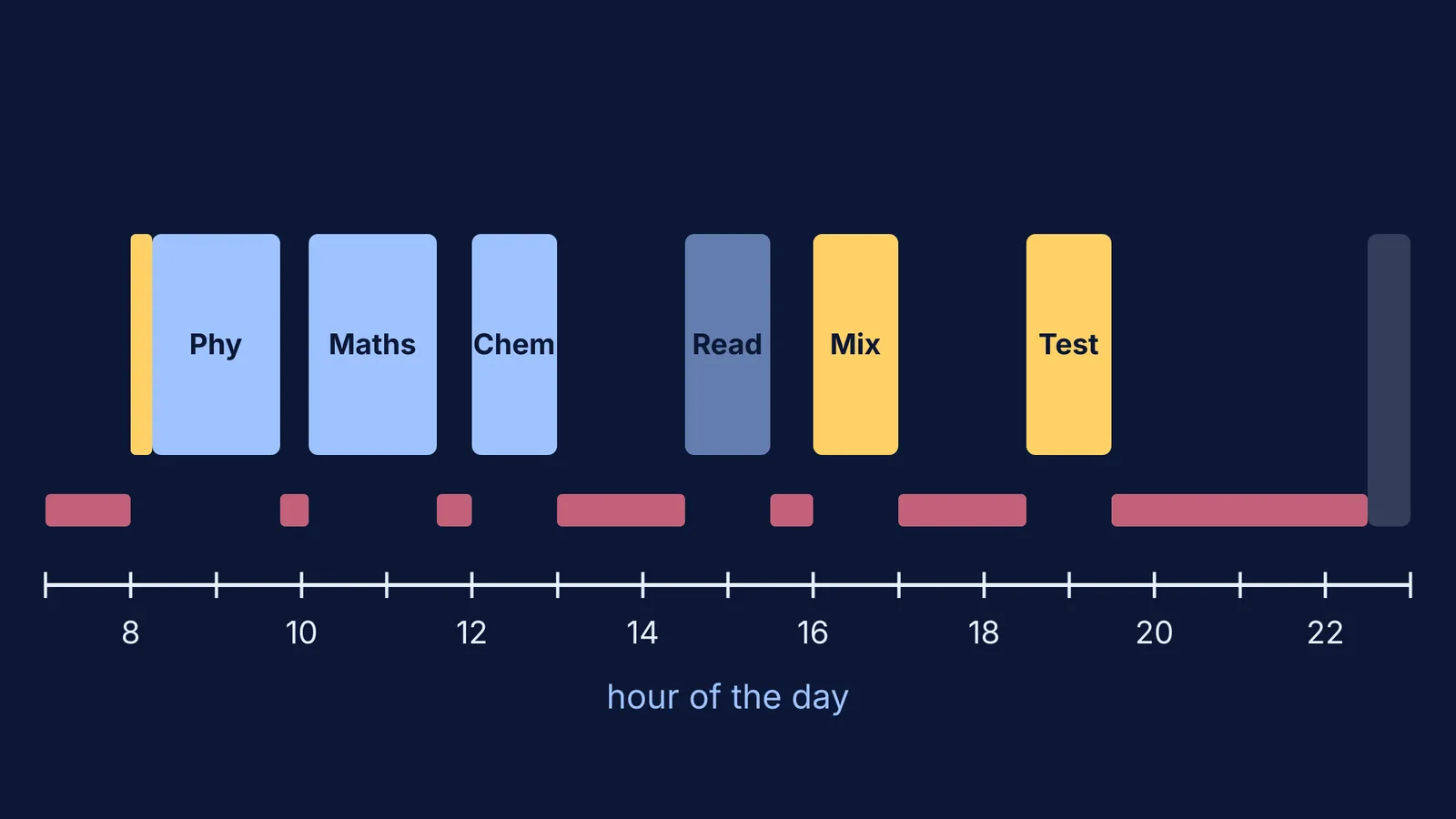
Here is a sample holiday or weekend day for a PCM student, with about seven hours of focused work. Swap Biology in for Maths for NEET-UG.
7:00 Wake up, breakfast, no phone for the first half hour.
8:00 to 8:15 Plan: write the day's blocks and one goal for each on a sheet of paper.
8:15 to 9:45 Physics, new topic: read and derive for 50 minutes, then solve problems.
10:05 to 11:35 Maths problem practice.
12:00 to 1:00 Chemistry, one sub-topic only.
1:00 to 2:30 Lunch and real rest.
2:30 to 3:30 Lighter work: NCERT reading, notes or school homework.
4:00 to 5:00 Mixed problem set from all three subjects.
5:00 to 6:30 Outdoors, sport or anything away from a screen.
6:30 to 7:30 Closed-book review of the day.
After dinner: free time, no new study after 9:30, lights out by 10:30 to 11.
The last line is part of the plan. The American Academy of Sleep Medicine recommends that teenagers aged 13 to 18 sleep 8 to 10 hours in every 24, and links enough sleep to better attention and learning. More in our guide on how much sleep teenagers need. On a school day, keep the same shape with two or three blocks.
How should your teen split subjects across the day?
Hardest first. The weakest or most demanding subject goes in the first block.
Alternate the kind of work. Follow a problem-heavy block with a reading-heavy one.
End with mixing and recall. The 4 pm and 6:30 blocks check learning, not just do it.
Real exams do not say which chapter a question is from. In a classroom study of 126 seventh-grade students over three months, Doug Rohrer and colleagues found that interleaved practice, mixing different kinds of problems in one set, produced higher scores than practising one kind at a time, on a test given either 1 or 30 days later.
The evening review should be done with books closed. In Henry Roediger and Jeffrey Karpicke's 2006 experiments, students who took recall tests remembered more after two days and after a week than students who restudied the same passage, even though restudying made them feel more confident. In practice: write everything you remember from the morning's Physics on a blank page, then open the book and mark what you missed.
If your teen sits down and does not know where to begin, Fermi's AI tutor works out what they already know and builds a plan for the session. For the mixed block, the Fermi Problem Library has a step-by-step solver that explains the reasoning rather than printing an answer.
How long should study breaks be?
The sample day uses 20 to 30 minute breaks between blocks, a longer one at lunch, and a five-minute stretch halfway through each 90-minute block. In a University of Illinois study of 84 people doing a repetitive task for about an hour, only the group that switched away from the task for two brief breaks showed no drop in performance over time.
Water, a walk, a chat in the kitchen: yes. A short-video app that turns 15 minutes into 50: no. See what to do in a study break, according to the research.
How can parents help without supervising?
A research synthesis by Erika Patall, Harris Cooper and Jorgianne Robinson found that, for students' achievement-related outcomes, parents setting rules had a stronger association than other forms of homework involvement. It is a link, not proof of cause, but it suggests putting your energy into the frame of the day rather than the content of each hour:
Keep meals and lights out at fixed times.
Keep the house quiet during blocks, including siblings and the TV.
Hold the agreed phone rule calmly, every day.
Stay out of the room unless asked.
What to say, in two minutes from the doorway:
Morning: "What are your blocks today, and what will you do first?"
Dinner: "What could you remember without your notes? What is tomorrow's first block?"
Avoid "How many hours did you study?" It rewards sitting, not learning. Let your teenager choose the order of subjects; our piece on choice and autonomy in parenting explains why.
What if the plan falls apart by lunch?
Some days it will. Skip the missed block rather than squeezing it into the evening, keep the 6:30 review, and adjust tomorrow's plan.
Tonight, sit down together for ten minutes and write tomorrow's blocks on one sheet of paper.