On this page
You ask a chatbot for the isomers of C5H12 and it gives you four, one of them called 3-methylbutane. Or you ask about C4H9Cl and it lists three, forgetting one. Both mistakes are easy to catch if you count first and read the AI's list second.
Why does AI get the number of isomers wrong?
Structural (constitutional) isomers are molecules with the same molecular formula but atoms joined in a different order, so they need different line formulae, as the IUPAC Gold Book defines constitutional isomerism.
Counting them tests structure, not memory, and chatbots do not always reason about the molecule behind the text. The ChemBench study tested leading language models on more than 2,700 chemistry questions (Mirza et al., Nature Chemistry, 2025). It found that the best models, on average, beat the best human chemists in the study, but still struggled with some basic tasks and gave overconfident answers.
One task in the preprint version of ChemBench is related to isomer counting: predicting how many signals a molecule shows in an NMR spectrum, which needs reasoning about its symmetry. Even the best models found this hard; o1, for example, got 22 percent of these right. Because scores did not track how complex the molecules were, the authors write that the models "may not be able to reason about the structures of the molecules" and instead "rely on the proximity of the molecules to the training data".
In practice that shows up as two errors:
Double counting: the same skeleton drawn or numbered from the other end, such as "3-methylbutane", which is just 2-methylbutane.
Missing ones: the list stops at the familiar structures, or mixes stereoisomers into a question that asked only for structural isomers.
How does the chain-shortening method work?
You build skeletons from the longest chain down, so nothing is skipped or repeated.
Draw the longest possible straight chain using all the carbons.
Shorten the chain by one carbon and attach that carbon as a branch. Try every position, but never on an end carbon (that just makes the chain longer again), and only up to the middle (positions past the middle repeat earlier ones from the other end).
Shorten again and place two carbons, as two methyls or one ethyl. An ethyl is allowed only if it does not create a longer chain.
Stop when no branch can fit without making a longer chain.
For a substituted formula like C4H9Cl, find the carbon skeletons first, then put the substituent on each distinct kind of carbon in each skeleton.
How many isomers does C5H12 have?
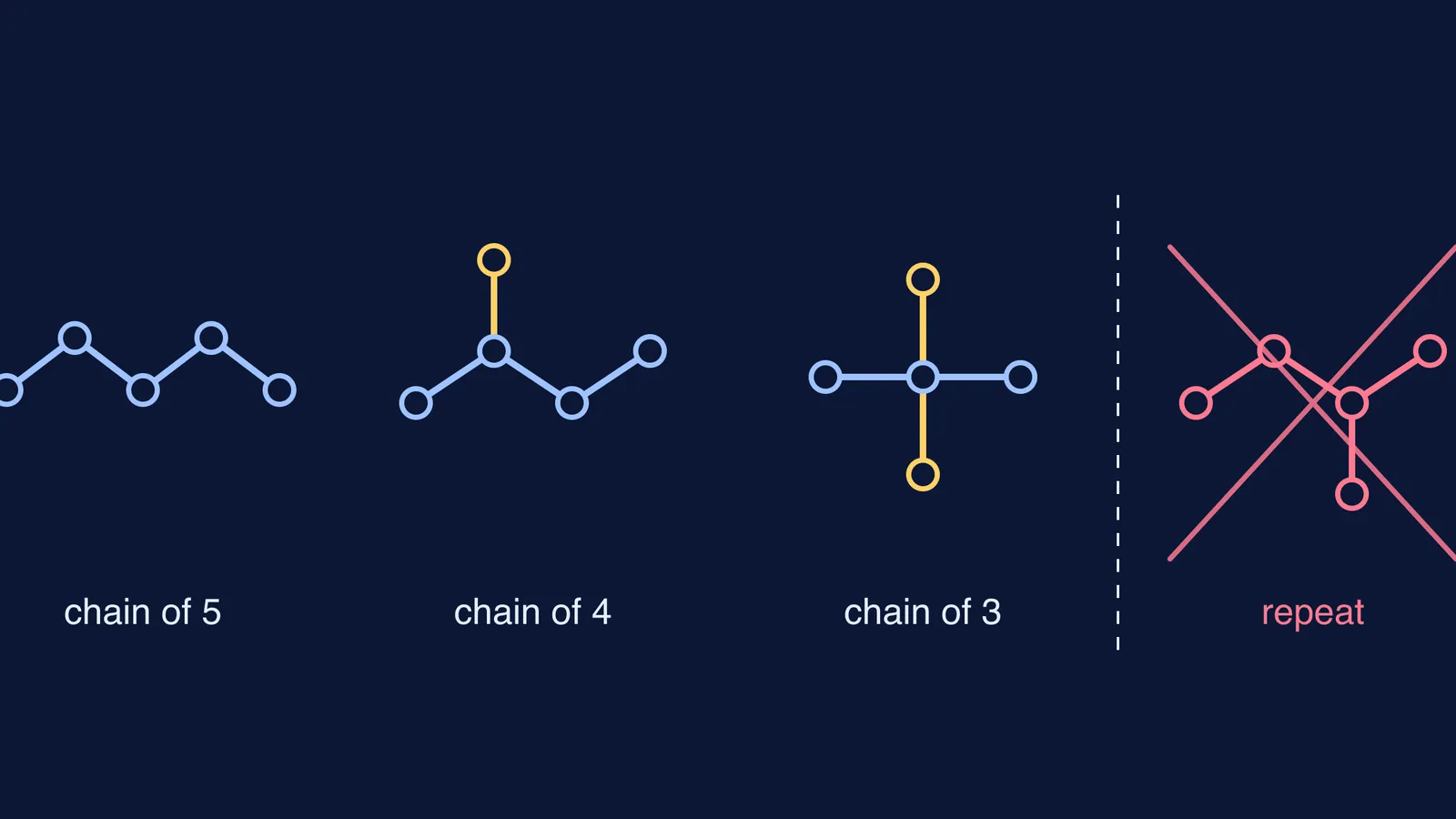
Work through the chain lengths:
Chain of 5: pentane.
Chain of 4, one methyl: a methyl on C2 gives 2-methylbutane. On C3 it is the same molecule counted from the other end. On C1 it makes a chain of 5 again.
Chain of 3, two carbons: only C2 is not an end carbon, so both methyls go there: 2,2-dimethylpropane. An ethyl on C2 would create a chain of 4, so it is a repeat.
Chain of 2: nothing fits. Stop.
That gives 3 isomers, matching the OEIS count of alkanes CnH2n+2, which lists 3 for five carbons, 5 for six and 9 for seven. If you want to practise on the next size up, our guide to hexane's five structural isomers uses the same approach.
How many isomers does C4H9Cl have?
Four carbons give two skeletons: butane and 2-methylpropane. Place Cl on each distinct kind of carbon:
Butane: an end carbon gives 1-chlorobutane; an inner carbon gives 2-chlorobutane. C3 and C4 repeat these.
2-Methylpropane: any of the three CH3 carbons gives 1-chloro-2-methylpropane; the central carbon gives 2-chloro-2-methylpropane.
That gives 4 structural isomers. It matches the OEIS count of alkyl groups CnH2n+1, which lists 4 for four carbons and 8 for five; see our walk-through of all eight C5H11Cl isomers.
How do you check the AI's list against yours?
With your count written down, paste it in and make the chatbot justify its list. A prompt you can copy:
"My isomers of C5H12: pentane, 2-methylbutane, 2,2-dimethylpropane. For each structure in your list, give the longest chain length and branch positions, and say which of mine it matches."
Then check:
Does every name use the lowest locants? 3-methylbutane signals a repeat.
Does the AI's longest chain match the one you trace?
Did it answer the question asked, structural only or including stereoisomers?
Names are a weak spot of their own; see where chatbots slip on IUPAC naming. If you still disagree, the Fermi Problem Library has worked problems with a step-by-step solver that explains the reasoning rather than printing an answer. If the trouble is the idea of isomerism itself, the Fermi Concept Library gives each concept its own lesson.
Count first, compare second, and trust the longest-chain test over any confident list.