

On this page
Ask a chatbot for an IUPAC name and you will almost always get something that looks right: locants, hyphens, a sensible suffix. That is the trap. A well-formatted name can still describe a different molecule, or the right molecule in a form your examiner will not accept. The fix takes two minutes and a pencil: draw the structure back from the name.
Can AI name organic compounds correctly?
Not reliably yet. In a 2023 NeurIPS benchmark, Guo and colleagues found that the best set-up they tested, GPT-4 with worked examples, converted IUPAC names into correct structures with an accuracy of just 0.014. No LLM set-up turned a structure into a correct name, and the authors concluded that the models "lack basic chemical name understanding ability".
Reasoning models have improved on that. A University of Oxford team tested models on 100 molecules in their ChemIQ study in the Journal of Chemical Information and Modeling (open-access full text).
GPT-4o gave no correct names.
o3-mini scored 10%, 18% and 29% at low, medium and high reasoning effort.
Gemini 2.5 Pro reached 35-44% in its highest reasoning modes.
For o3-mini-high, accuracy fell from 39.2% to 9.1% on molecules with a fused ring system.
The models were given SMILES strings (a text code for structures), not drawings, so results on a textbook question may differ. The useful part is the marking: a name counted as correct only if the OPSIN name parser turned it back into the intended molecule. OPSIN, hosted by EMBL-EBI, is free software that converts systematic IUPAC names into structures. Most model names were not the "preferred IUPAC names", so "correct" meant the right molecule, not the recommended form. You can run the same check on paper.
Where do chatbots go wrong on IUPAC names?
For Class 11 and 12 compounds, a wrong name usually breaks one of three rules. All three are in IUPAC's own Brief Guide to the Nomenclature of Organic Chemistry, published in Pure and Applied Chemistry in 2020.
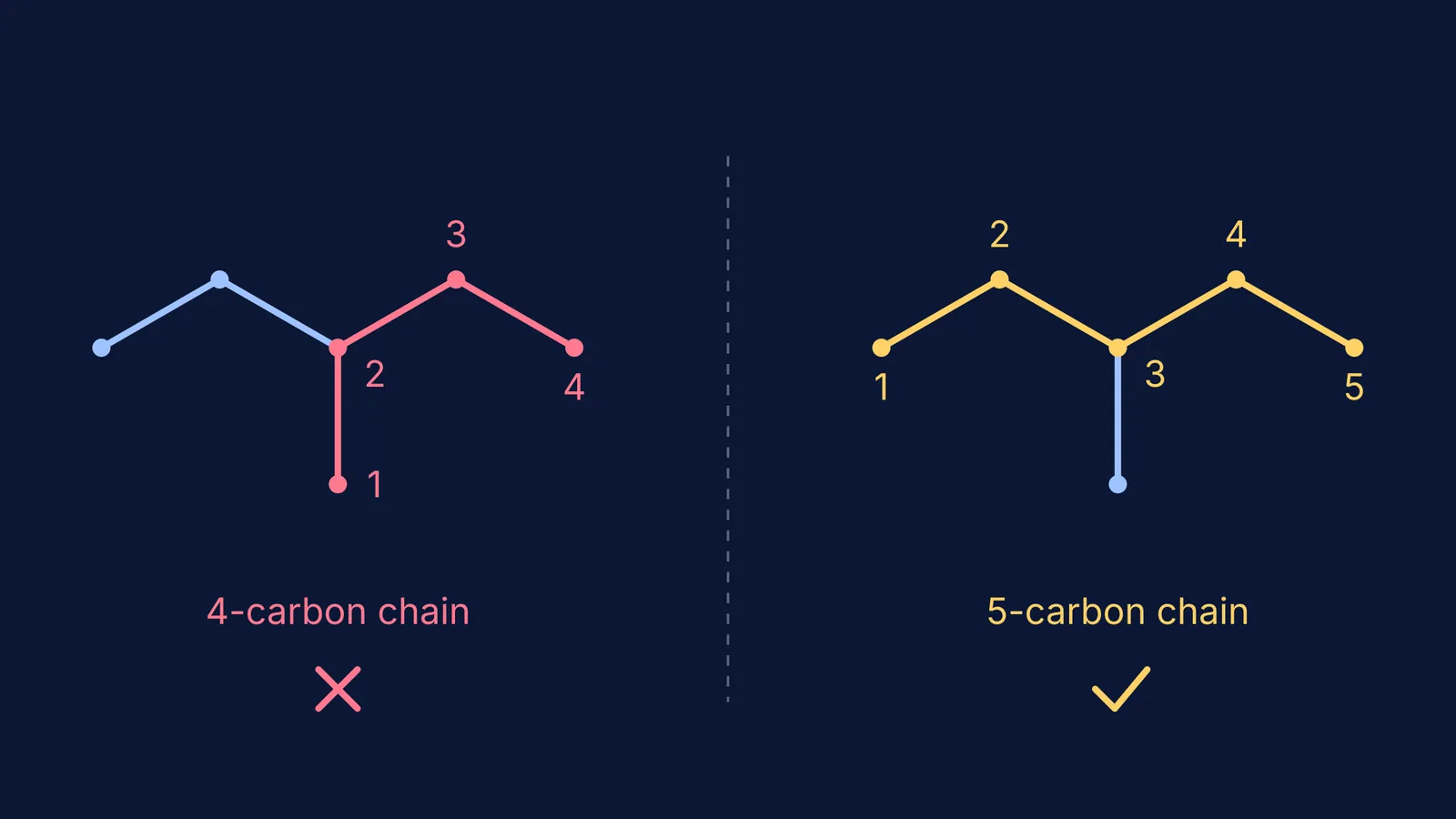
Chain choice. Among the chains carrying the suffix group, the parent chain is the one with more carbon atoms. The guide notes that "in earlier recommendations unsaturation was senior to chain length"; the 2013 recommendations (P-44.3) reversed that order. Chatbots and answer keys can mix the two, so check which convention your textbook and board use.
Numbering. Number the chain so the principal characteristic group, the one named as the suffix, gets the lowest locant. Double and triple bonds, and then prefixes, are only considered after that.
Priority of groups. Only one group can be the suffix. The guide's seniority table puts acids above esters, amides, nitriles, aldehydes, ketones, alcohols and amines, in that order. Every lower-ranked group becomes a prefix: hydroxy, oxo, amino.
For the full rule set with practice examples, see our guide to IUPAC naming rules, priorities and common slips.
How do you check an AI's IUPAC name by drawing the structure back?
Read the root and draw that many carbons in a zigzag: meth 1, eth 2, prop 3, but 4, pent 5, hex 6.
Read -ane, -ene or -yne and put any multiple bonds at their locants.
Put the suffix group (-ol, -al, -one, -oic acid) on its locant.
Add each prefix group at its locant.
Compare with the structure you started from. Same carbon count, same atoms, same connections? If not, the name is wrong.
If they match, name your drawing yourself using the three rules. If your name differs from the chatbot's, find out which rule decides it.
Step 6 matters because drawing back catches a wrong molecule, but not a wrong name for the right molecule.
Three worked checks
Chain choice: "2-ethylbutane". Draw butane and hang an ethyl on C2. Now trace from the far end of the ethyl, through C2, to C4: that is five carbons in a row. The parent should be pentane, with a methyl on the middle carbon: 3-methylpentane.
Numbering: "2-methylpentan-4-ol". Draw pentane, OH on C4, methyl on C2. Number from the other end and the OH sits on C2, the methyl on C4. The suffix group must get the lower locant, so the name is 4-methylpentan-2-ol.
Priority: "3-oxopropan-1-ol". Your structure is OHC-CH2-CH2-OH, and drawing the name back gives the same molecule. But the aldehyde outranks the alcohol and must be the suffix: 3-hydroxypropanal. Only step 6 catches this one.
What should you ask a chatbot instead?
Ask for the reasoning, not the name. Try: "Don't name this yet. Show me the longest chain and how many carbons it has, number it, tell me which group is the suffix and why, and then give the name." Each step is now something you can check against the rules, the same habit as our five-step way to check an AI's maths.
If the rules themselves feel shaky, the Fermi Concept Library has its own lesson for every chemistry concept. And Fermi's AI tutor works through problems alongside you, drawing the figure and checking understanding as it goes, so you can ask it to draw the chain first.
Next time a chatbot hands you a name, draw it back before it goes into your notes.


