

On this page
How do you find all structural isomers of C5H11Cl?
Structural isomers, or constitutional isomers, share the same molecular formula but have their atoms connected in a different order, as detailed in OpenStax Organic Chemistry. When students sketch monochlorinated pentanes at random, they frequently duplicate structures or miss isomers entirely.
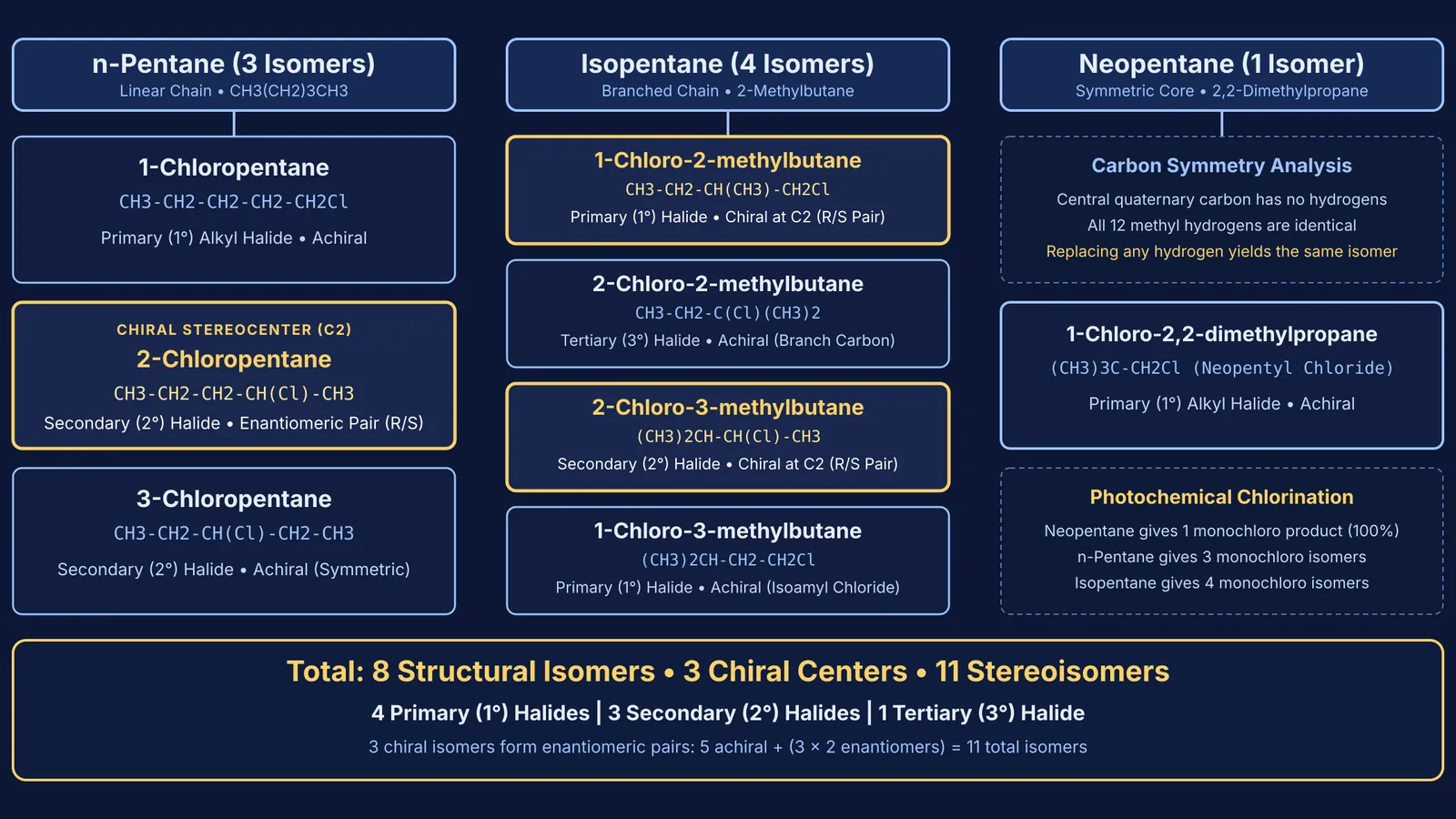
A reliable method starts with the parent alkane. As shown when drawing the structural isomers of butane and pentane, pentane (C₅H₁₂) has three skeletal isomers: normal pentane (n-pentane), isopentane (2-methylbutane), and neopentane (2,2-dimethylpropane). Every structural isomer of C₅H₁₁Cl forms by replacing one hydrogen atom with chlorine on one of these three backbones.
Examining carbon symmetry reveals every non-equivalent substitution site. The Fermi Concept Library maps every concept in physics, chemistry, biology, mathematics and computing, each with its own lesson and its place in the map, clarifying how substituents attach to carbon skeletons.
Which chloropentanes come from n-pentane and isopentane?
Normal pentane is a linear five-carbon chain: CH₃–CH₂–CH₂–CH₂–CH₃. An internal plane of symmetry passes through carbon 3, making carbon 1 equivalent to carbon 5, and carbon 2 equivalent to carbon 4. Substituting chlorine yields three distinct constitutional isomers:
1-Chloropentane (CH₃CH₂CH₂CH₂CH₂Cl): chlorine on a terminal carbon forms a primary (1°) alkyl halide cataloged as CID 10977 in PubChem.
2-Chloropentane (CH₃CH₂CH₂CHClCH₃): chlorine on carbon 2 creates a secondary (2°) alkyl halide cataloged as CID 12245.
3-Chloropentane (CH₃CH₂CHClCH₂CH₃): chlorine on carbon 3 yields an achiral secondary (2°) alkyl halide.
Isopentane (2-methylbutane) has a branched chain: CH₃–CH(CH₃)–CH₂–CH₃. Because the branch breaks symmetry, all four carbon positions are unique, giving four constitutional isomers:
1-Chloro-2-methylbutane (ClCH₂CH(CH₃)CH₂CH₃): a primary (1°) halide formed at the terminal carbon adjacent to the branch.
2-Chloro-2-methylbutane (CH₃CCl(CH₃)CH₂CH₃): a tertiary (3°) halide where chlorine attaches to the branch point, cataloged as CID 61143.
2-Chloro-3-methylbutane (CH₃CHClCH(CH₃)CH₃): a secondary (2°) halide numbered from the chlorine-bearing end.
1-Chloro-3-methylbutane ((CH₃)₂CHCH₂CH₂Cl): a primary (1°) halide formed at the methyl-capped tail.
This systematic branch audit mirrors the classification used for the isomers of C4H10O.
Why does neopentane produce only one monochloro isomer?
Neopentane (2,2-dimethylpropane) consists of a quaternary central carbon surrounded by four methyl groups: C(CH₃)₄. Because the central carbon has no attached hydrogen atoms, substitution cannot occur there.
All twelve hydrogen atoms across the four methyl groups are chemically equivalent. Replacing any hydrogen yields the same compound: 1-chloro-2,2-dimethylpropane, commonly called neopentyl chloride, cataloged as CID 12956. Because its chlorinated carbon attaches to only one other carbon, it is a primary (1°) alkyl halide.
Summing across all three skeletons gives 3 from n-pentane, 4 from isopentane, and 1 from neopentane, establishing exactly 8 structural isomers for C₅H₁₁Cl.
Which structural isomers of C5H11Cl are chiral?
A molecule is chiral when it cannot be superimposed on its mirror image, as outlined in OpenStax Organic Chemistry. In alkyl halides, chirality typically arises at an sp³-hybridised carbon bonded to four distinct groups.
Among the eight structural isomers, exactly three possess a chiral stereocenter:
2-Chloropentane: Carbon 2 is bonded to –H, –Cl, –CH₃, and –CH₂CH₂CH₃, forming an enantiomeric pair: (2R)-2-chloropentane and (2S)-2-chloropentane.
1-Chloro-2-methylbutane: Carbon 2 is bonded to –H, –CH₃, –CH₂Cl, and –CH₂CH₃, forming (2R) and (2S) enantiomers.
2-Chloro-3-methylbutane: Carbon 2 is bonded to –H, –Cl, –CH₃, and –CH(CH₃)₂, forming another enantiomeric pair.
The remaining five isomers are achiral. For instance, 3-chloropentane has two identical ethyl groups on carbon 3, and 2-chloro-2-methylbutane has two identical methyl groups on carbon 2. For stereoisomer counting formulas, consult our guide to counting stereoisomers from chiral centres.
Because the three chiral structural isomers each exist as a pair of enantiomers, the total count of isomers including stereoisomers is 5 + (3 × 2) = 11.
How do exam questions test C5H11Cl isomers?
Exams like JEE Main and NEET-UG regularly test three specific angles of this family:
Halide classification: The eight structural isomers divide into 4 primary (1°), 3 secondary (2°), and 1 tertiary (3°) alkyl halides. Questions often ask for the count of secondary isomers or the ratio of primary to secondary halides.
Monochlorination yield: A classic question asks which C₅H₁₂ alkane gives a single monochloro product upon photochemical chlorination. As detailed in OpenStax Organic Chemistry on radical halogenation, alkane chlorination produces product mixtures when non-equivalent hydrogens exist. Neopentane yields only one monochloro derivative because all twelve hydrogens are equivalent, whereas n-pentane produces 3 monochloro isomers and isopentane produces 4.
Total isomer traps: Always check whether a question asks for structural isomers (8) or total isomers including stereoisomers (11).
The Fermi Problem Library has worked problems with a step-by-step solver that explains the reasoning rather than printing an answer, guiding you through symmetry checks and stereocenter rules.


