On this page
Most board questions on Coordination Compounds test naming, isomerism, bonding or colour. This guide is for the board paper; for the entrance exam, see how to prepare Coordination Compounds for JEE Main.
How many marks is Coordination Compounds in CBSE Class 12 2026-27?
In the Class XII theory table of the CBSE Chemistry curriculum for 2026-27, Unit 5, Coordination Compounds, carries 7 marks out of 70. The same document says "No chapter wise weightage is provided", so treat 7 as a guide, not a promise.
The 2026-27 sample paper has 33 questions: 1-mark MCQs (including assertion-reason), 2- and 3-mark short answers, 4-mark case studies and 5-mark long answers. Log tables and calculators are not allowed. This unit appears there as an MCQ, an assertion-reason item and a 5-mark question split into five 1-mark parts.
The NCERT chapter (Reprint 2026-27) keeps Werner's theory, key terms, nomenclature, isomerism, valence bond theory (VBT), magnetic properties, crystal field theory (CFT), colour, metal carbonyls and applications.
How do you write the IUPAC name of a coordination compound?
NCERT's rules, as five steps:
Name the cation first.
List ligands alphabetically. Anionic ligands end in -o (chlorido, cyanido); water is aqua, NH3 is ammine, CO is carbonyl.
Use di, tri, tetra; use bis, tris, tetrakis when the ligand name already has a number, as in ethane-1,2-diamine.
Find the metal's oxidation state from the counter ions and ligand charges; write it in Roman numerals.
If the complex is an anion, the metal takes -ate (cobaltate; ferrate for iron).
Which isomerism questions come in the board exam?
Geometrical isomerism appears in square planar [MX2L2] (cis/trans), octahedral [MX2L4] and [MX2(L-L)2], and as fac/mer forms of [Ma3b3]. Tetrahedral complexes with unidentate ligands cannot show it: every position is equivalent. Optical isomers are non-superimposable mirror images, common in octahedral complexes with didentate ligands such as en; of [PtCl2(en)2]2+, only the cis form is optically active. For structural isomers, see our worked examples of coordination isomerism.
How do you predict hybridisation, magnetism and colour?
Here is [Co(NH3)6]Cl3, solved twice.
Route 1: name and VBT. Three Cl⁻ outside the bracket make the complex +3; NH3 is neutral, so cobalt is +3. The complex is a cation, so the metal keeps its name: hexaamminecobalt(III) chloride. Co3+ is 3d6. NH3 pairs the electrons into three 3d orbitals, freeing two for d2sp3 hybridisation: octahedral, inner orbital (low spin), no unpaired electrons, diamagnetic.
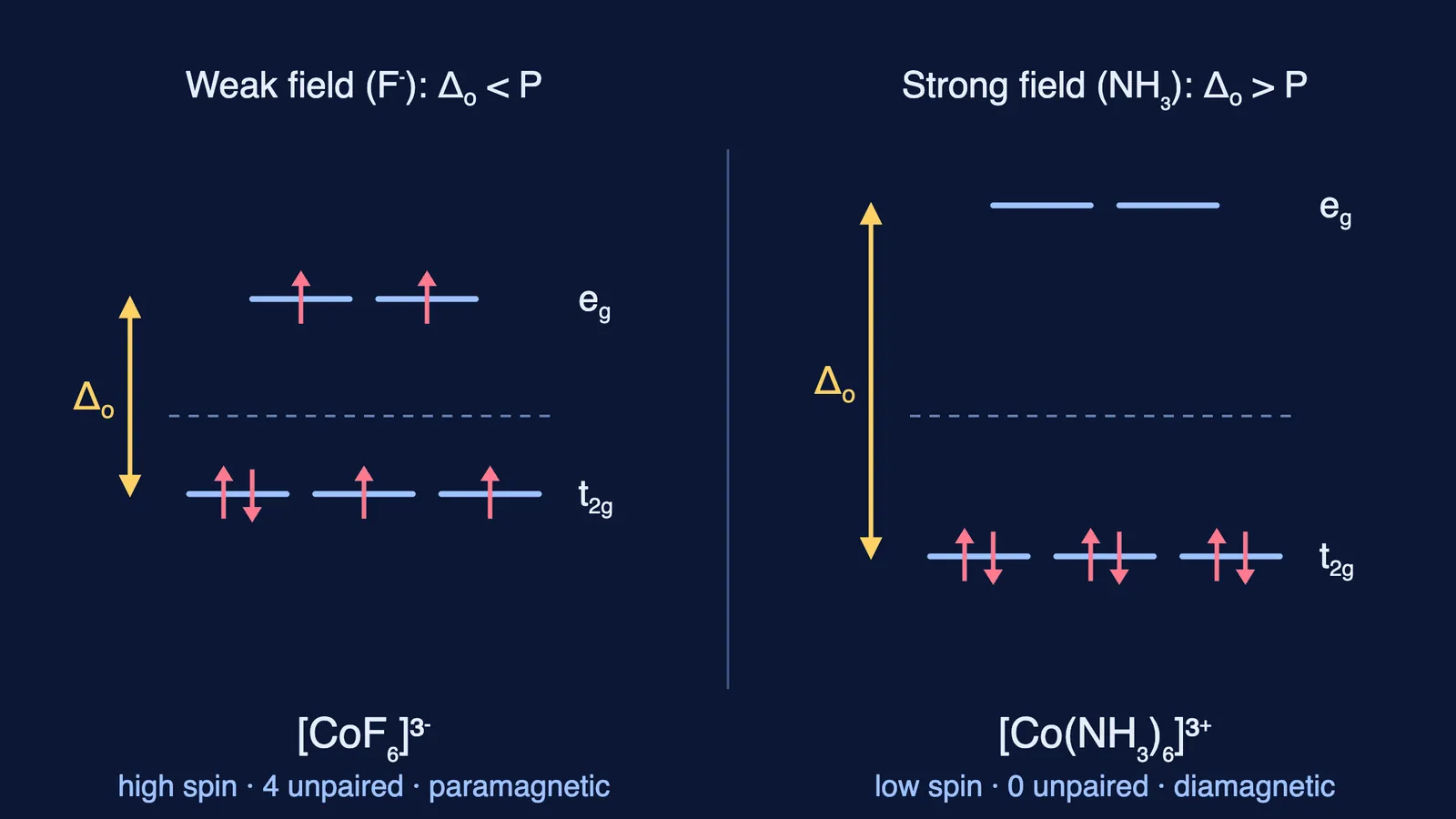
Route 2: CFT. In an octahedral field the d orbitals split into a lower t2g set (three orbitals, 2/5 Δo down) and a higher eg set (two orbitals, 3/5 Δo up). NH3 is a strong field ligand, so Δo > P and all six electrons pair in t2g: t2g6 eg0. Zero unpaired electrons, matching Route 1.
Contrast [CoF6]3-, hexafluoridocobaltate(III). F⁻ is weak field, so Δo < P: t2g4 eg2, four unpaired electrons. VBT calls it outer orbital, sp3d2, high spin. Same ion, opposite magnetism: the ligand decides. Our post on the spectrochemical series and ligand strength shows how to rank ligands.
Colour comes from the same diagram. [Ti(H2O)6]3+ absorbs blue-green light as its one electron jumps from t2g to eg, so it looks violet, the complementary colour. No ligand means no splitting: anhydrous CuSO4 is white, CuSO4·5H2O blue.
How should you set out 2-, 3- and 5-mark answers?
The 2026-27 marking scheme splits several 1-mark parts of Q32 into ½ + ½: one half for the claim, one for the reason. Write both.
2 marks: a claim and a reason. "[NiCl4]2- is paramagnetic because Ni2+ is d8 and the weak-field Cl⁻ ligands give sp3 (tetrahedral), leaving two unpaired electrons."
3 marks: oxidation state, d configuration, hybridisation or CFT configuration, geometry and magnetism, one line each.
5 marks: five small answers. Number each part and answer in one or two lines.
Traps to watch:
Assertion-reason: in sample paper Q16, A says [Co(NH3)6]3+ is diamagnetic and R says strong-field NH3 pairs the electrons. Answer A: both true, R explains A. Judge each statement before asking whether R explains A.
"Anionic ligands split most": false. Point-charge CFT predicts this, but halide ions sit at the low end of the series, a known limit of CFT (anionic CN⁻ is near the top).
Case studies: answer from the data given. If a table gives the colour absorbed, the complex shows its complement.
Spelling: hexaammine has two a's; ammine (NH3) is not amine.
What is a good revision plan for this unit?
Day 1: Werner's theory and terms; name ten NCERT complexes and write ten formulas.
Day 2: draw every isomer figure in the chapter from memory.
Day 3: VBT boxes for [Co(NH3)6]3+, [CoF6]3-, [NiCl4]2-, [Ni(CN)4]2- and [Ni(CO)4].
Day 4: CFT configurations for d4 to d6 in weak and strong fields, plus colour.
Day 5: carbonyl bonding, applications, all NCERT intext and exercise questions.
Day 6: sample paper questions, timed and marked against the scheme.
If a VBT step keeps going wrong, the Fermi Problem Library has worked problems with a step-by-step solver that explains the reasoning rather than printing an answer. For a concept gap, the Fermi Concept Library covers every concept in physics, chemistry, biology, mathematics and computing, each with its own lesson.