On this page
If you are revising coordination compounds for CBSE boards, JEE Main or JEE Advanced, one line keeps coming back: the spectrochemical series. It decides whether a complex is high spin or low spin, how many unpaired electrons it has, and roughly what colour it is. The order has a shape you can rebuild in the exam hall.
What is the spectrochemical series order of ligands?
The spectrochemical series is a list of ligands ranked by how large a gap, called the crystal field splitting Δo, they open between a metal's d orbitals in an octahedral complex. It was first proposed by the Japanese chemist Ryutaro Tsuchida in 1938, from the absorption spectra of coordination compounds (Tsuchida, Bulletin of the Chemical Society of Japan).
The version most students need, from weak field to strong field, is a shortened form of the longer lists in LibreTexts, High Spin and Low Spin Complexes/4:_Crystal_Field_Theory/4.3:_High_Spin_and_Low_Spin_Complexes) and Wikipedia, Spectrochemical series:
I⁻ < Br⁻ < Cl⁻ < F⁻ < OH⁻ < H₂O < NH₃ < en < NO₂⁻ < CN⁻ < CO
Longer lists slot in extra ligands such as S²⁻, SCN⁻ (S-bonded), oxalate, NCS⁻ (N-bonded), pyridine, bipy, phen and PPh₃. Sources disagree on close neighbours such as water and oxalate, so learn the far-apart positions first.
How do you remember the spectrochemical series?
Group the ligands by the atom that actually bonds to the metal. Read left to right, the donor atom moves roughly from halogen to oxygen to nitrogen to carbon:
Halides, weakest: I⁻ < Br⁻ < Cl⁻ < F⁻. Inside this block the order runs up group 17, so the smallest halide is the strongest.
Oxygen donors: OH⁻ < H₂O.
Nitrogen donors: NH₃ < en. Ethylenediamine binds through two nitrogens, so it sits just above ammonia.
Strong field: NO₂⁻ (N-bonded) < CN⁻ < CO. The two carbon donors close the list.
One mnemonic we use: "I Brought Clean Fish On Water, Now Eat Nicely, Cook Carefully" for I⁻, Br⁻, Cl⁻, F⁻, OH⁻, H₂O, NH₃, en, NO₂⁻, CN⁻, CO.
Why is CO a stronger ligand than F⁻?
Fluoride carries a full negative charge, so a simple electrostatic picture says it should split more than neutral CO. It does not, because bonding is more than charge.
Halides and OH⁻ are π-donors: they give electron density from filled p orbitals to the metal as well as their σ pair, and this lowers Δo (Wikipedia, Spectrochemical series). Ammonia is a σ-donor only, with no orbitals set up for π bonding. CN⁻ and CO are π-acceptors: their empty π* orbitals take electron density back from the metal (back-bonding), which raises Δo. Weak to strong, then, is π-donor, σ-only, π-acceptor. If a concept like back-bonding is the gap, the Fermi Concept Library has a lesson for each idea in chemistry with its place in the map, so you can see what it builds on.
How do you use the series to predict splitting and spin?
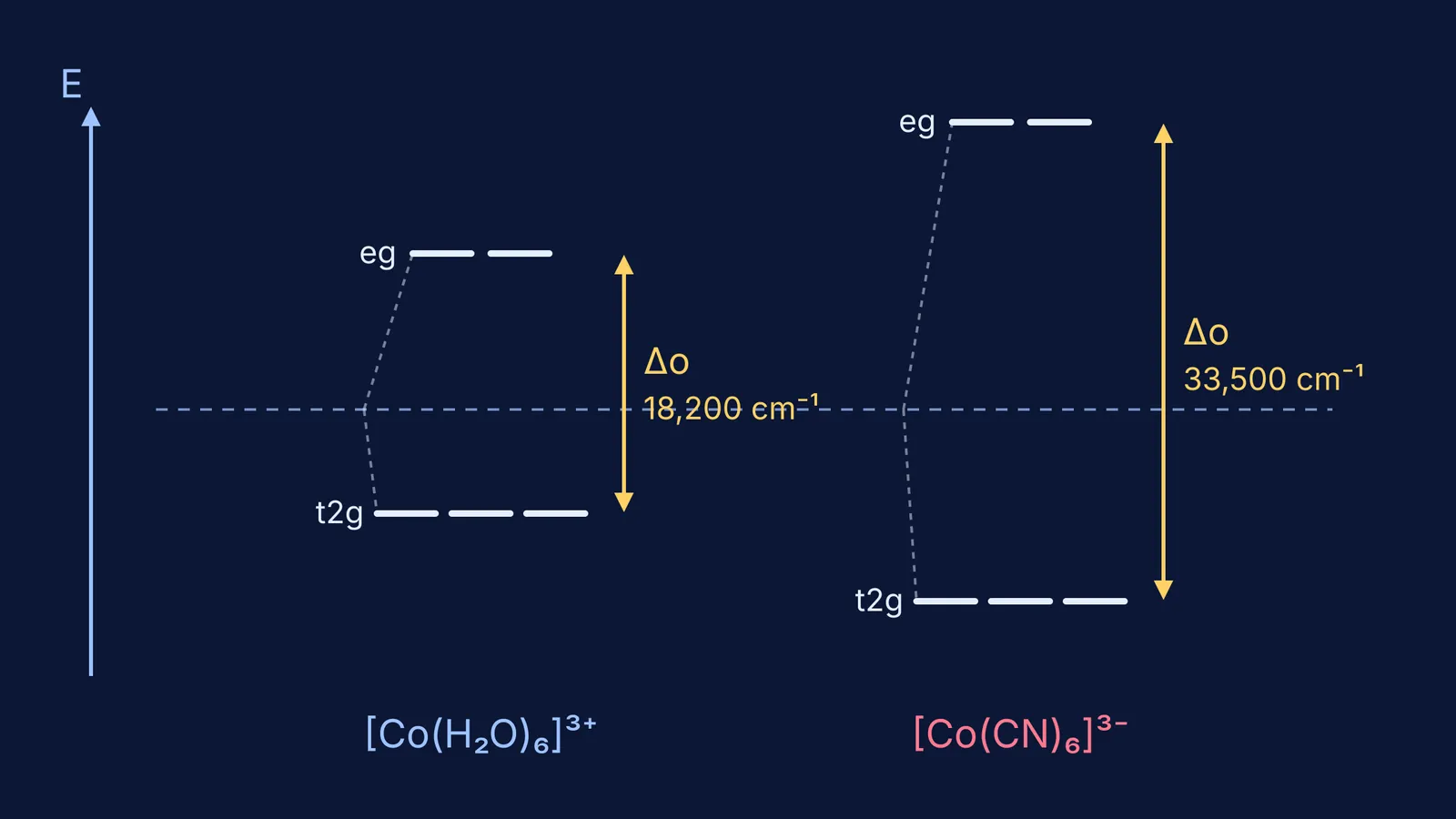
The ligand changes Δo a lot. For cobalt(III), Δo is 18,200 cm⁻¹ with six water ligands and 33,500 cm⁻¹ with six cyanides, nearly double (LibreTexts, Spectrochemical Series/05:_Coordination_Chemistry_and_Crystal_Field_Theory/5.04:_Spectrochemical_Series)). The same source shows that oxidation state and the metal matter too: [Co(H₂O)₆]²⁺ has Δo of only 9,300 cm⁻¹, while [Rh(CN)₆]³⁻ reaches 45,500 cm⁻¹.
The spin rule: if Δo is smaller than the pairing energy the complex is high spin, and if Δo is larger it is low spin (LibreTexts, Introduction to Crystal Field Theory/Crystal_Field_Theory/Introduction_to_Crystal_Field_Theory)). Colour follows Δo as well: strong-field ligands absorb higher-energy, shorter-wavelength light, so swapping water for cyanide on cobalt(III) shifts the absorbed light towards the violet end and changes the colour you see (LibreTexts, Colors of Coordination Complexes/Crystal_Field_Theory/Colors_of_Coordination_Complexes)).
Is [CoF₆]³⁻ or [Co(NH₃)₆]³⁺ high spin? A worked example
Oxidation state: both have Co³⁺. Cobalt is [Ar]3d⁷4s², so Co³⁺ is d⁶.
Place the ligand: F⁻ is in the halide block (weak field); NH₃ is in the nitrogen block (stronger field).
Compare Δo with pairing energy: for F⁻, Δo is smaller, so electrons spread out as t2g⁴eg²; for NH₃, Δo is larger, so all six pair up as t2g⁶.
Read off the answer: [CoF₆]³⁻ is high spin with 4 unpaired electrons and is paramagnetic; [Co(NH₃)₆]³⁺ is low spin with 0 unpaired electrons and is diamagnetic. This matches the classification in the LibreTexts high and low spin notes/4:_Crystal_Field_Theory/4.3:_High_Spin_and_Low_Spin_Complexes).
For practice, read our guides on deciding high spin or low spin with exam examples, calculating CFSE for octahedral and tetrahedral complexes and finding crystal field splitting energy from an absorption wavelength. When a coordination problem goes wrong at step 2 or 3, the Fermi Problem Library has worked problems with a step-by-step solver that explains the reasoning rather than printing an answer.
Tonight, write the four blocks from memory, then run the four-step method on [Fe(CN)₆]⁴⁻ and [Fe(H₂O)₆]²⁺ and check whether your spin answers differ.