On this page
Board questions on this chapter ask you to account for a fact, balance one reaction or count unpaired electrons. For the competitive-exam side, see our d- and f-block guide for JEE Main.
How many marks is d and f block in CBSE Class 12?
The CBSE Chemistry curriculum for 2026-27 gives Unit 4, d- and f-Block Elements, 7 of the 70 theory marks. Its listed topics: position, electronic configuration, general properties of transition elements, some important compounds, lanthanoids, actinoids and applications. The textbook is NCERT Class 12 Chemistry Part I, Unit 4.
In the 2026-27 sample paper, the unit appears as an MCQ, an assertion-reason, a 2-mark and a 3-mark question. No 5-mark answer comes from it.
Which "give reasons" questions should you learn?
Learn each as a fact plus its cause, from Unit 4:
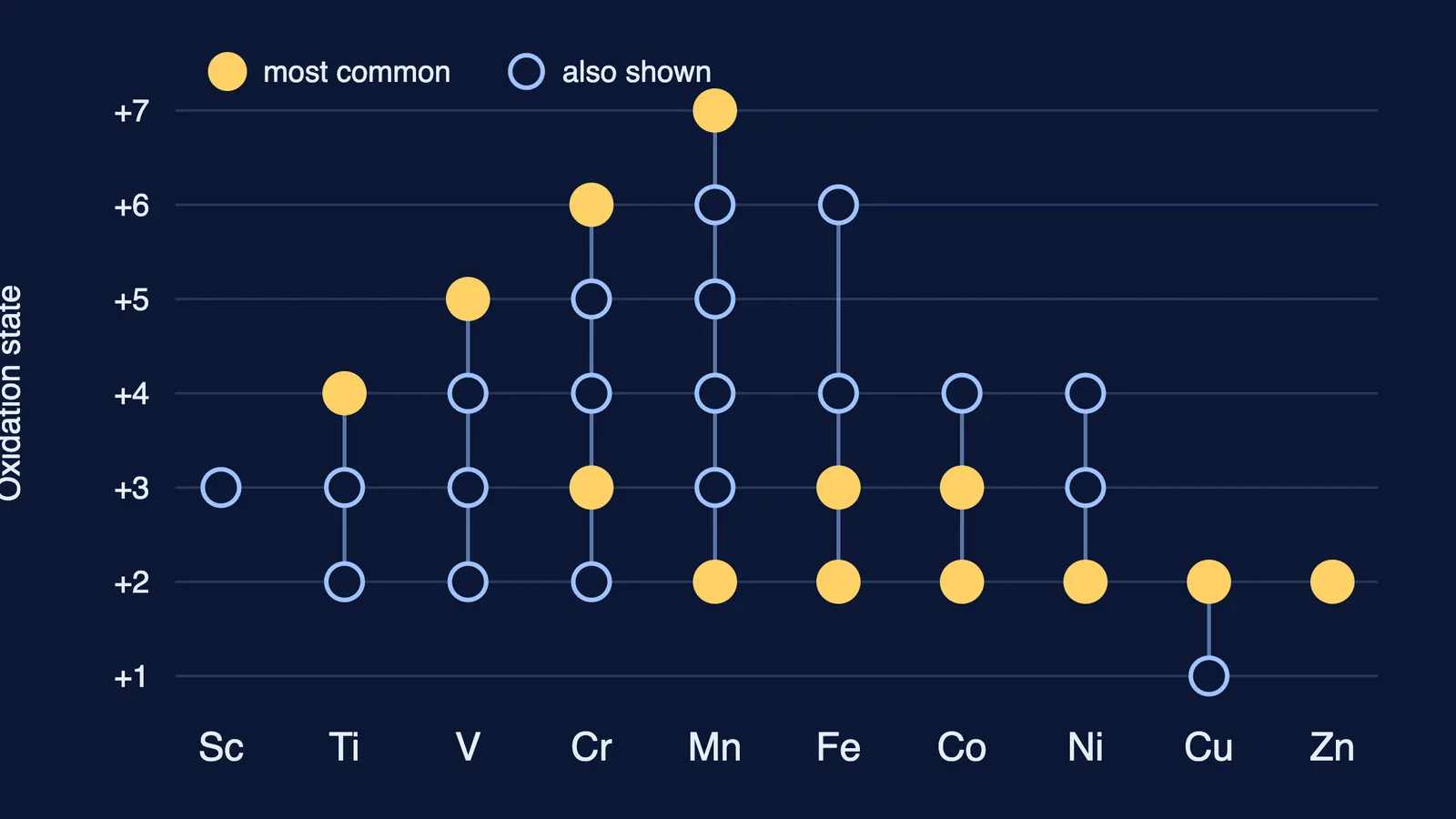
Variable oxidation states: d orbitals fill incompletely, so states differ by one (V²⁺, V³⁺, V⁴⁺, V⁵⁺). Mn shows every state from +2 to +7.
Colour: an electron jumps from a lower to a higher d orbital and absorbs visible light; you see the complementary colour. Sc³⁺, Ti⁴⁺ (d⁰) and Zn²⁺ (d¹⁰) are colourless.
Magnetic moment: paramagnetism comes from unpaired electrons; more unpaired electrons, higher moment.
Catalysis: they adopt multiple oxidation states and form complexes. Examples: V₂O₅ (Contact process), iron (Haber process), nickel (hydrogenation).
Interstitial compounds: small atoms such as H, C or N get trapped in the metal lattice. They are very hard, high-melting, conducting and chemically inert.
Complex formation: small ions, high charge and available d orbitals.
Zn, Cd and Hg are not transition elements: their d orbitals are full, (n−1)d¹⁰ns², in the ground state and in their common oxidation states.
Cr²⁺ is reducing, Mn³⁺ is oxidising, though both are d⁴: Cr²⁺ becomes Cr³⁺ (d³, half-filled t₂g level); Mn³⁺ becomes Mn²⁺ (d⁵, half-filled and extra stable).
Lanthanoid contraction: 4f electrons shield each other poorly, so radii shrink from La to Lu. Consequence: Zr (160 pm) and Hf (159 pm) have almost the same radius, occur together in nature and are hard to separate.
How do you calculate spin-only magnetic moment?
NCERT gives μ = √[n(n+2)] BM for n unpaired electrons. Take Co²⁺ (Z = 27), the NCERT intext question.
Method 1, fill the boxes. Co is [Ar]3d⁷4s². Remove the two 4s electrons first: Co²⁺ is 3d⁷. Put seven electrons in five d boxes: five single, then two pair up. That leaves 3 unpaired. μ = √(3 × 5) = √15 = 3.87 BM.
Method 2, check from the other end. For d⁵ to d⁹ ions (high spin, as in NCERT's table), unpaired electrons = 10 − d count. For d⁷, 10 − 7 = 3. Same answer, matching NCERT Table 4.7.
Doing both catches a common slip: removing 3d electrons before 4s. The Fermi Problem Library has worked problems with a step-by-step solver that explains the reasoning rather than printing an answer.
How should you set out 2-, 3- and 5-mark answers?
The marking scheme splits marks by point: in the 3-mark question, naming Fe²⁺ (4 unpaired electrons) earns half a mark and the justification another half.
2 marks: usually two 1-mark parts. For an equation, write it balanced, with charges. The sample paper's 2-mark question offers a choice of two NCERT reactions: 5SO₃²⁻ + 2MnO₄⁻ + 6H⁺ → 2Mn²⁺ + 5SO₄²⁻ + 3H₂O, and Cr₂O₇²⁻ + 14H⁺ + 6Fe²⁺ → 2Cr³⁺ + 6Fe³⁺ + 7H₂O.
3 marks: state the answer, show the configuration or count, then give the reason, each on its own line.
5 marks: treat a 5 × 1 question as five numbered 1-mark reasons.
Short of time? Use our 20-minute triage plan for board papers.
What are the assertion-reason and case-study traps?
In the sample paper's permanganate question, the assertion (permanganate and manganate ions are tetrahedral) is true, but the reason is false: the π bonding uses oxygen p orbitals and manganese d orbitals, not p with p (marking scheme). Read the reason word by word.
The sample paper's case-based questions are on phenols and carbohydrates, so a d-block case is possible but unseen. With a data table, watch two things: a calculated spin-only value can differ from the observed one (NCERT Table 4.7 lists 4.90 BM calculated and 5.3–5.5 BM observed for Fe²⁺), and E° data must be read with the configuration of the product ion.
What is a good 7-day revision plan?
Day 1: configurations Sc to Zn, plus Cr and Cu exceptions.
Day 2: oxidation states table and the Cr²⁺/Mn³⁺ reason.
Day 3: colour, magnetic moment, five spin-only problems.
Day 4: catalysis, interstitial compounds, complexes, alloys.
Day 5: K₂Cr₂O₇ and KMnO₄ preparation and NCERT ionic equations.
Day 6: lanthanoids, actinoids, contraction and its consequences.
Day 7: timed NCERT exercises, marked against the sample scheme.
If a reason does not click, the Fermi Concept Library covers every concept in physics, chemistry, biology, mathematics and computing, each with its own lesson. Next, our Coordination Compounds guide builds on the same d orbitals.