On this page
d- and f-Block Elements looks like a list of facts, but most of it comes down to a few rules: how electrons fill, how many are unpaired, and what KMnO₄ and K₂Cr₂O₇ do in acid. Below: the syllabus, worked examples, traps and a two-week plan.
What does the JEE Main 2027 syllabus include in d- and f-Block Elements?
This topic is Unit 11 of the Chemistry section of the NTA's Syllabus for JEE (Main) - 2027. It lists:
transition elements: configuration and first-row trends in ionisation enthalpy, oxidation states, radii, colour, catalysis, magnetism, complexes, interstitial compounds and alloys
preparation, properties and uses of K₂Cr₂O₇ and KMnO₄
lanthanoids: configuration, oxidation states and lanthanoid contraction
actinoids: configuration and oxidation states only
Your textbook is Unit 4, The d- and f-Block Elements, in NCERT Class 12 Chemistry Part I (Reprint 2026-27).
How do you write configurations and oxidation states?
The general pattern is (n−1)d¹⁻¹⁰ ns¹⁻², but NCERT Unit 4 gives two exceptions you must know in the 3d series: chromium is 3d⁵ 4s¹ and copper is 3d¹⁰ 4s¹, since half-filled and filled d sets are extra stable.
For ions, take electrons from 4s before 3d. Iron (Z = 26) is [Ar] 3d⁶ 4s², so Fe²⁺ is 3d⁶ and Fe³⁺ is 3d⁵. Writing Fe²⁺ as 3d⁴ 4s² is the classic slip.
In K₂Cr₂O₇: 2(+1) + 2x + 7(−2) = 0, so x = +6. In KMnO₄: +1 + x + 4(−2) = 0, so x = +7. Manganese shows every state from +2 to +7, and zinc, cadmium and mercury are not counted as transition metals because their d subshell is full in the atom and in their common ions (NCERT Unit 4).
How do you calculate the spin-only magnetic moment?
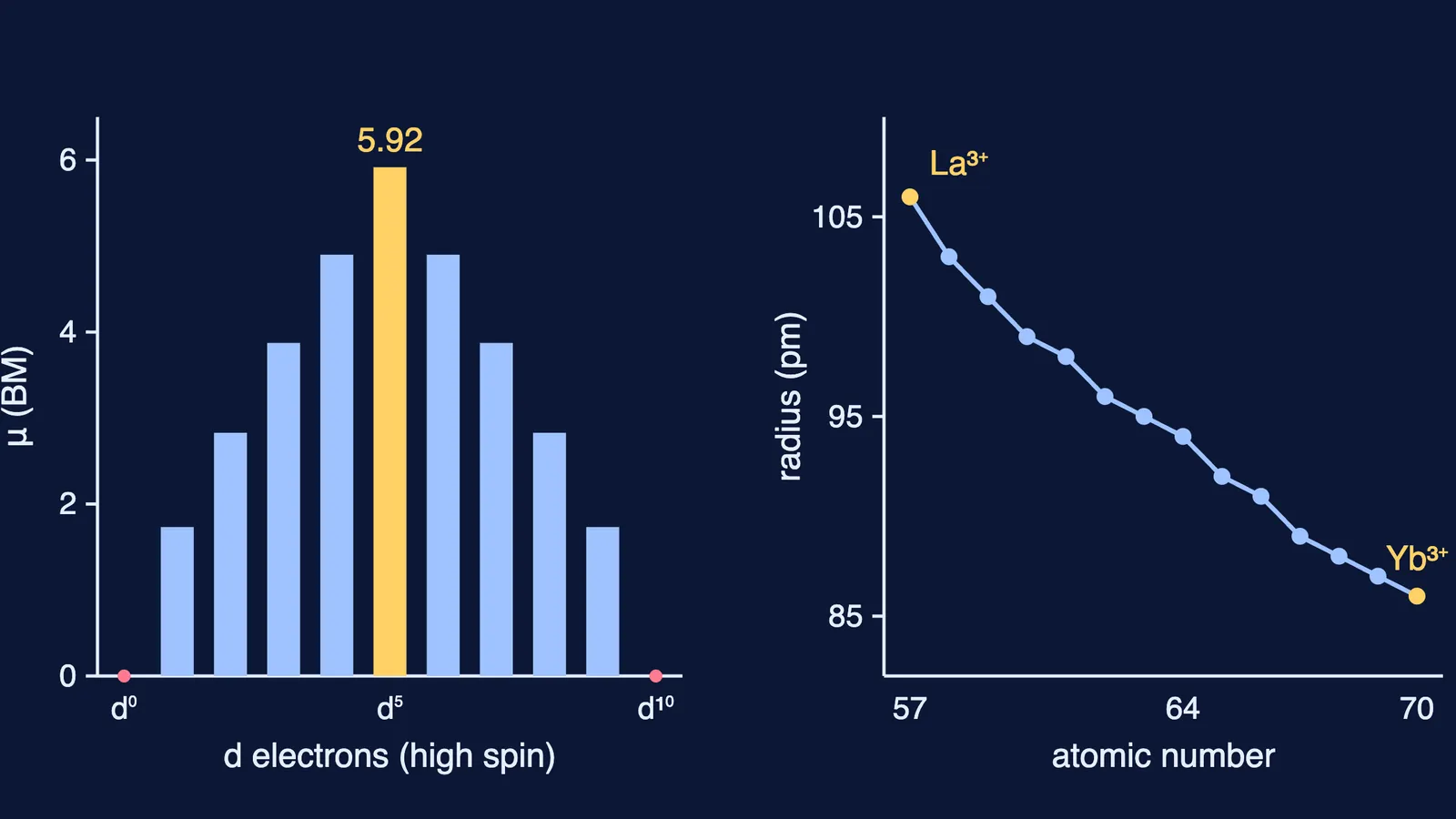
The spin-only magnetic moment is μ = √(n(n+2)) BM, where n is the number of unpaired electrons (NCERT Unit 4). For hydrated first-row ions, place one electron in each d orbital before pairing, count n, then substitute.
Fe³⁺: 3d⁵, n = 5, μ = √35 = 5.92 BM.
Co²⁺ (Z = 27): 3d⁷, n = 3, μ = √15 = 3.87 BM.
V³⁺ (Z = 23): 3d², n = 2, μ = √8 = 2.83 BM.
Reverse: μ = 4.90 BM means n(n+2) = 24, so n = 4. Fe²⁺ (3d⁶) and Cr²⁺ (3d⁴) both fit.
Keep 1.73, 2.83, 3.87, 4.90 and 5.92 BM ready for n = 1 to 5. Cr³⁺ (3d³) and Co²⁺ (3d⁷) give the same 3.87 BM, so a moment alone cannot name the ion. Strong-field ligands can pair electrons and change n; see our guide to preparing Coordination Compounds for JEE Main.
Why are transition metal ions coloured, and what is lanthanoid contraction?
When an electron jumps from a lower to a higher d orbital it absorbs visible light, and you see the complementary colour (NCERT Unit 4). So d⁰ and d¹⁰ ions such as Sc³⁺, Ti⁴⁺ and Zn²⁺ are colourless.
The trap: permanganate (Mn +7) and dichromate (Cr +6) are both d⁰ yet strongly coloured. Their colour comes from a charge-transfer band (oxygen to metal), not a d–d jump (Wikipedia on charge-transfer bands).
Lanthanoid contraction is the steady fall in size from lanthanum to lutetium, because 4f electrons shield each other poorly (NCERT Unit 4). So Zr (160 pm) and Hf (159 pm) are almost the same size and hard to separate. Lanthanoids mostly show +3; Ce⁴⁺ is a strong oxidant and Eu²⁺ a strong reductant. For actinoids, the highest state rises from +4 in Th to +5, +6 and +7 in Pa, U and Np.
What should you know about KMnO₄ and K₂Cr₂O₇?
From NCERT Unit 4:
K₂Cr₂O₇: chromite (FeCr₂O₄) fused with Na₂CO₃ in air gives chromate; acid gives dichromate; KCl gives the potassium salt.
KMnO₄: MnO₂ fused with KOH and an oxidant gives green K₂MnO₄, which disproportionates in neutral or acid solution to permanganate and MnO₂.
In acid, MnO₄⁻ gains 5 electrons to become Mn²⁺; in neutral or faintly alkaline solution it gains 3 to become MnO₂.
In acid, Cr₂O₇²⁻ gains 6 electrons to give 2Cr³⁺.
Permanganate titrations avoid HCl, which gets oxidised to chlorine.
Worked example: each Fe²⁺ gives up one electron, so one mole of MnO₄⁻ in acid oxidises 5 moles of Fe²⁺, and one mole of Cr₂O₇²⁻ oxidises 6. For balancing half-reactions, see Electrochemistry for JEE Main.
If your electron counts keep going wrong, the Fermi Problem Library has worked problems with a step-by-step solver that explains the reasoning rather than printing an answer.
How should you plan two weeks for this chapter?
Days 1-2: configurations of Sc to Zn and their ions.
Days 3-4: oxidation states and trends.
Days 5-6: magnetic moments and colour; ten ions by hand.
Days 7-8: write each KMnO₄ and K₂Cr₂O₇ equation from memory.
Day 9: lanthanoids and actinoids.
Days 10-12: timed past questions, using our guide on how to use previous year questions.
Days 13-14: a mixed set with Coordination Compounds; redo every miss.
If a whole idea feels shaky, open it in the Fermi Concept Library, which has every concept in chemistry, each with its own lesson.