On this page
NEET Hydrocarbons questions rarely ask you to recite a reaction. They hand you a reagent and a condition, then check whether you can follow one rule to the right product. This set has 8 original single-correct questions, easy to hard, and every wrong option is a slip students really make.
The questions stay inside Unit 15, Hydrocarbons, of the NEET (UG)-2026 syllabus notified by the National Medical Commission, and inside NCERT Class 11 Chemistry, Unit 9 Hydrocarbons (Reprint 2026-27). Every answer was checked with a short Python script.
How should you use this Hydrocarbons practice set?
As in NEET-UG 2026, the NTA information bulletin gave 180 minutes for 180 questions, marked +4 for a correct answer and −1 for a wrong one. So:
Give each question one minute, with the solutions covered.
Before reading the options, write the intermediate or the count you will use: carbocation, radical, π electrons, moles.
Check the trap line on every question, including the ones you got right.
Log every miss with the rule you broke, and redo it three days later.
For the full chapter plan and a reaction map, start with Hydrocarbons for NEET: how to prepare.
Easy: do you know the core NCERT facts?
Q1 (easy). Which alkene shows geometrical (cis-trans) isomerism?
(A) 2-methylpropene (B) 2-methylbut-2-ene (C) pent-2-ene (D) pent-1-ene
Answer: (C). Each doubly bonded carbon must carry two different groups. In pent-2-ene, C2 has CH3 and H, and C3 has C2H5 and H, so the molecule has two geometrical isomers. Trap: (B) looks similar, but its C2 carries two methyl groups, so swapping them gives the same molecule.
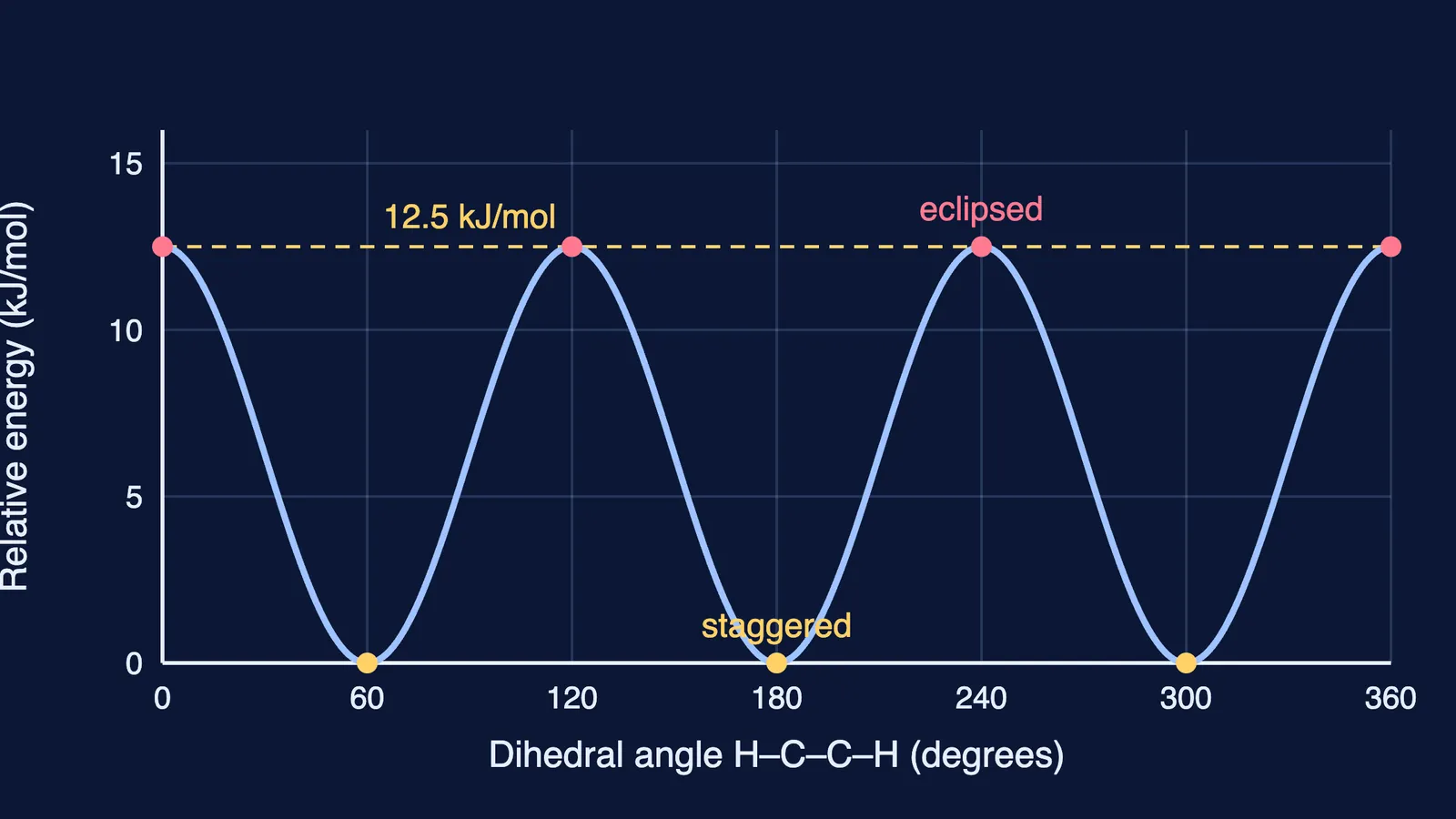
Q2 (easy). NCERT puts the energy difference between the staggered and eclipsed forms of ethane at about 12.5 kJ mol⁻¹. Which statement follows?
(A) The eclipsed form is more stable because its hydrogens are closer. (B) Rotation about the C–C bond is almost free at room temperature. (C) The two conformers can be separated at room temperature. (D) The two forms differ in bond lengths, so they are structural isomers.
Answer: (B). The barrier is small, and collisions at ordinary temperatures give molecules enough energy to cross it. Torsional strain is lowest in the staggered form and highest in the eclipsed form. Trap: (C) reads "different energies" as "separable", but NCERT notes that the conformers of ethane have not been separated and isolated. The diagram at the top plots this barrier.
Q3 (easy). An aqueous solution of sodium propanoate, CH3CH2COONa, is electrolysed (Kolbe's method). Which alkane forms at the anode?
(A) ethane (B) propane (C) butane (D) hexane
Answer: (C). Each propanoate ion loses CO2 at the anode and leaves an ethyl radical; two ethyl radicals join to give butane, while hydrogen gas forms at the cathode. Trap: (A) is the soda-lime product, which removes one carbon but does not join two radicals.
Medium: can you predict the product?
Q4 (medium). Which alkene reacts with HBr in the presence of benzoyl peroxide to give 1-bromo-2-methylbutane, BrCH2CH(CH3)CH2CH3, as the major product?
(A) 2-methylbut-1-ene (B) 2-methylbut-2-ene (C) 3-methylbut-1-ene (D) pent-1-ene
Answer: (A). With peroxide, a bromine radical adds to the CH2 end of CH2=C(CH3)CH2CH3, leaving the more stable tertiary radical on C2, which then takes a hydrogen from HBr. Trap: (B) has the same skeleton, but gives 2-bromo-3-methylbutane. (C) gives 1-bromo-3-methylbutane, and (D) has no branch.
Q5 (medium). Pent-1-yne is warmed with mercuric sulphate and dilute sulphuric acid at 333 K. The main product is
(A) pentanal (B) pent-1-en-2-ol (C) pentan-2-ol (D) pentan-2-one
Answer: (D). Water adds by Markovnikov's rule, putting OH on C2. The enol CH2=C(OH)CH2CH2CH3 then isomerises to the ketone, as propyne gives propanone in NCERT. Trap: (A) is the anti-Markovnikov product; only ethyne gives an aldehyde here. (B) is the enol, which does not survive, and (C) would need a further reduction.
Q6 (medium). Using Hückel's rule (planar ring, complete delocalisation, 4n + 2 π electrons), which species is aromatic?
(A) cyclopropenyl anion (B) cyclopenta-1,3-diene (C) cyclopropenyl cation (D) cyclohepta-1,3,5-triene
Answer: (C). The cyclopropenyl cation has three sp2 carbons in a planar ring, and its 2 π electrons fit 4n + 2 with n = 0. Trap: (A) has the same ring but 4 π electrons, which fails the rule. (B) and (D) each have a CH2 carbon that is sp3 and breaks the ring of overlap.
Hard: can you combine data with reactions?
Q7 (hard). 1.40 g of an alkene X decolourises exactly 3.20 g of Br2 (molar mass 160 g mol⁻¹). On ozonolysis (O3, then Zn and water), X gives propanone and ethanal. X is
(A) 2-methylbut-2-ene (B) pent-2-ene (C) 2-methylbut-1-ene (D) 3-methylbut-1-ene
Answer: (A). 3.20/160 = 0.0200 mol Br2, which equals the moles of X for one C=C. So the molar mass is 1.40/0.0200 = 70 g mol⁻¹, and CnH2n gives n = 5. Splitting (CH3)2C=CHCH3 at the double bond gives (CH3)2C=O and CH3CHO. Trap: (C) is also C5H10 with a methyl branch, but it gives methanal and butanone.
Q8 (hard). 0.050 mol of an open-chain hydrocarbon X burns completely to give 13.2 g of CO2 and 4.5 g of H2O. X liberates H2 with sodium metal, and full hydrogenation gives 3-methylpentane. X is
(A) hex-1-yne (B) 3-methylpent-1-yne (C) 3-methylpenta-1,3-diene (D) 4-methylpent-1-yne
Answer: (B). CO2: 13.2/44 = 0.30 mol, so 6 C per molecule. H2O: 4.5/18 = 0.25 mol, so 10 H. C6H10 has two degrees of unsaturation. Reaction with sodium needs a hydrogen on a triply bonded carbon, and the skeleton must be 3-methylpentane: only HC≡C–CH(CH3)–CH2CH3 fits. Trap: (C) has the right formula and skeleton, but a diene has no acidic hydrogen. (D) hydrogenates to 2-methylpentane.
What next, based on your score?
Scored 7 or 8: move to timed mixed sets across the organic units.
Scored 4 to 6: solve each missed question again the next day without the options, naming the intermediate first.
Scored 3 or fewer: reread NCERT sections 9.3 to 9.5, then our Hydrocarbons Class 11 chemistry guide, and retry the set in a week.
Hybridisation drives Q6 and Q8; if it feels shaky, try the chemical bonding NEET practice questions.
For more problems like Q7 and Q8, the Fermi Problem Library has worked problems with a step-by-step solver that explains the reasoning rather than printing an answer.