On this page
Eight original Biomolecules questions in JEE Main style, easy to hard, each with a worked solution and a trap line naming the most tempting wrong answer. Q5 and Q8 are numerical-value questions: the answer is a whole number.
Which parts of Biomolecules does this set cover?
Biomolecules is Unit 19 of the chemistry section in the NTA's Syllabus for JEE (Main) - 2027: carbohydrates, proteins and enzymes, vitamins, nucleic acids and a general introduction to hormones. Every fact and data value below comes from Unit 10, Biomolecules, of NCERT Class 12 Chemistry Part II, 2026-27 reprint. We checked every numerical answer in Python.
If the theory is still shaky, start with our guide on how to prepare Biomolecules for JEE Main, then come back.
How should you use this practice set?
Give yourself 16 minutes, on paper, with no notes.
For every sugar question, write which carbon is free or bonded before you look at the options.
Read all eight trap lines, even for the questions you got right.
Redo every missed question in three days.
Easy: do you know the core facts?
Q1 (easy). Which vitamin is soluble in water yet can be stored in the human body?
(A) Vitamin A (B) Vitamin C (C) Vitamin B12 (D) Vitamin K
Answer: (C). NCERT says water-soluble vitamins (the B group and C) are readily excreted in urine and cannot be stored, with vitamin B12 as the one exception. Trap: (A) and (D) are stored in the liver and fat tissue, but they are fat-soluble, so they fail the first half of the stem.
Q2 (easy). Each observation on glucose is paired with the inference drawn from it. Which pair is wrongly matched?
(A) Prolonged heating with HI gives n-hexane: the six carbons form a straight chain
(B) Bromine water gives gluconic acid: the carbonyl group is an aldehyde
(C) Nitric acid gives saccharic acid: glucose has a primary alcohol group
(D) Glucose forms no addition product with NaHSO₃: glucose has fewer than five –OH groups
Answer: (D). The missing NaHSO₃ product is evidence that glucose has no free –CHO group most of the time, because it exists as a cyclic hemiacetal. The five –OH groups are shown by the pentaacetate. Trap: (C), but it is correctly matched; nitric acid turns the terminal, primary –CH₂OH into the second –COOH of saccharic acid.
Q3 (easy). Complete hydrolysis of a nucleic acid sample gives phosphoric acid, a pentose, adenine, guanine, cytosine and uracil. The sample is:
(A) DNA, with 2-deoxyribose as its sugar (B) RNA, with ribose as its sugar (C) DNA, with ribose as its sugar (D) RNA, with 2-deoxyribose as its sugar
Answer: (B). Uracil appears only in RNA, and RNA's sugar is β-D-ribose. Trap: (D) gets the nucleic acid right but swaps the sugar; 2-deoxyribose belongs to DNA.
Medium: can you link structure to behaviour?
Q4 (medium). Hydrolysis of a disaccharide X with dilute acid gives two different monosaccharides, both aldohexoses. X gives a silver mirror with Tollens' reagent. X is:
(A) Sucrose (B) Maltose (C) Lactose (D) Glycogen
Answer: (C). Lactose gives β-D-galactose and glucose, both aldohexoses, and its C1–C4 link leaves C1 of the glucose unit free, so it is reducing. Trap: (A) also gives two different units, but fructose is a ketose, and the C1–C2 link ties up both reducing groups.
Q5 (medium, numerical). NCERT gives the activation energy for acid hydrolysis of sucrose as 6.22 kJ mol⁻¹ and for hydrolysis by the enzyme sucrase as 2.15 kJ mol⁻¹. Assuming the same Arrhenius pre-exponential factor, by what factor is the enzyme route faster at 298 K? Use R = 8.314 J K⁻¹ mol⁻¹ and give the nearest integer.
Answer: 5. The ratio is exp(ΔEₐ/RT) = exp(4070 ÷ (8.314 × 298)) = exp(1.643) ≈ 5.17. Trap: 44, from writing 10 to the power 1.643 instead of e to that power. If that step felt new, our Chemical Kinetics for JEE Main guide works through the Arrhenius equation.
Q6 (medium). Consider these statements.
(i) D-fructose is laevorotatory.
(ii) The D in D-glucose is decided by the –OH on C5, its lowest asymmetric carbon.
(iii) α-D-glucose and β-D-glucose are enantiomers.
(iv) Drawn with –CHO at the top, D-(+)-glyceraldehyde has its –OH on the right.
(A) i, ii and iv (B) i and iii only (C) ii, iii and iv (D) all four
Answer: (A). Statement (iii) is false: the α and β forms differ only at C1, the anomeric carbon, so they are anomers, not mirror images. Trap: (C), which drops (i) on the assumption that D-sugars must be dextrorotatory; D gives configuration, and D-(–)-fructose is the standard example.
Hard: can you handle the numbers?
Q7 (hard). A linear pentapeptide contains three glycine and two alanine residues. Taking molar masses as glycine 75, alanine 89 and water 18 g mol⁻¹, its molar mass is:
(A) 403 g mol⁻¹ (B) 349 g mol⁻¹ (C) 331 g mol⁻¹ (D) 313 g mol⁻¹
Answer: (C). Five amino acids join through four peptide bonds, and each bond releases one water: 3 × 75 + 2 × 89 − 4 × 18 = 331. Trap: (D), from removing five waters, one per residue; a linear chain of n residues has n − 1 peptide bonds.
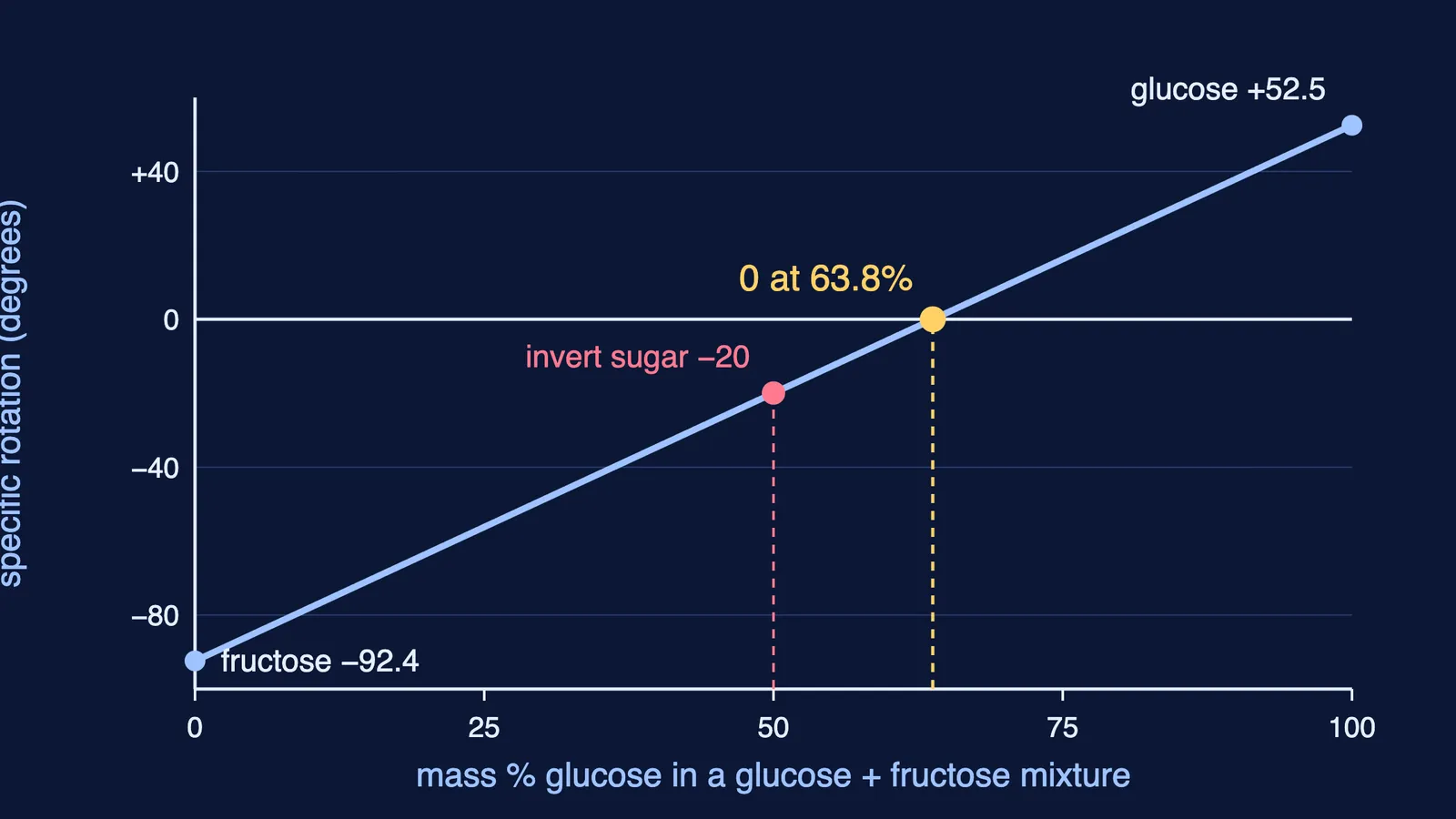
Q8 (hard, numerical). Using NCERT's specific rotations, glucose +52.5° and fructose −92.4°, and assuming rotations add in proportion to mass, what mass percentage of glucose makes a glucose and fructose mixture optically inactive? Give the nearest integer.
Answer: 64. Let w be the glucose fraction: 52.5w = 92.4(1 − w), so w = 92.4 ÷ 144.9 = 0.638. Invert sugar, the 50:50 mixture from sucrose, has less glucose than this, so it comes out at about −20°. Trap: 36, from dividing 52.5 by 144.9, which gives the fructose fraction instead.
What should you do after checking your answers?
Sort each miss into a bin: facts and labels (Q1, Q3, Q6), structure evidence (Q2, Q4), or calculation (Q5, Q7, Q8). Spend this week on the fullest bin. If you can follow a solution but could not have started it yourself, the Fermi Problem Library has worked problems with a step-by-step solver that explains the reasoning rather than printing an answer.
Next, try our aldehydes and ketones JEE Main practice questions.