On this page
These are eight Oscillations and Waves questions we wrote for JEE Main Physics: six single-correct MCQs and two numerical-value questions (Q5 and Q8). None is taken from NCERT, an exemplar or a past paper, and none repeats our NEET set on the same chapter. Each answer ends with the trap behind the most tempting wrong option.
What does JEE Main ask from Oscillations and Waves?
Unit 10 of NTA's Syllabus for JEE (Main) - 2027, linked from the JEE Main website, covers SHM and its equation, phase, spring oscillations and force constant, energy in SHM, the simple pendulum, travelling waves, superposition, standing waves in strings and organ pipes, harmonics and beats. The matching NCERT text, Reprint 2026-27, is Chapter 13, Oscillations, and Chapter 14, Waves. Every question below stays inside that list.
How should you use this question set?
Cover the answers. Allow about two minutes per question, three for Q7 and Q8.
Write the formula and its proportionality (T ∝ √L, f ∝ √T) before any numbers.
For strings, sketch the nodes; for collisions, split the event into "during" and "after".
Read every trap, including those for questions you got right.
New to the chapter? Start with our guide on how to prepare Oscillations for JEE Main.
Easy: SHM basics, pendulum and particle speed
Q1 (easy). A particle in SHM has a maximum speed of 0.60 m/s and a maximum acceleration of 7.2 m/s². What is its amplitude?
(A) 8.3 cm (B) 2.5 cm (C) 5.0 cm (D) 12 cm
Answer: (C). v_max = Aω and a_max = Aω², so ω = 7.2/0.60 = 12 rad/s and A = 0.60/12 = 0.050 m = 5.0 cm.
Trap: (A) divides v_max by a_max. That gives 0.083 s, a time, not a length.
Q2 (easy). A simple pendulum has a period of 1.80 s on Earth. It is taken to a planet where g is 0.81 times Earth's, and its bob is swapped for one of twice the mass. What is its period there?
(A) 2.00 s (B) 1.62 s (C) 2.83 s (D) 2.22 s
Answer: (A). T = 2π√(L/g) does not contain the mass. T ∝ 1/√g, and √0.81 = 0.9, so T = 1.80/0.9 = 2.00 s.
Trap: (C) also multiplies by √2 for the doubled mass. Mass cancels for a simple pendulum.
Q3 (easy). A transverse wave on a string is y = 0.025 sin(6.0x − 480t), in SI units. What is the ratio of the maximum speed of a particle of the string to the wave speed?
(A) 0.025 (B) 0.15 (C) 6.7 (D) 12
Answer: (B). Particle speed peaks at Aω = 0.025 × 480 = 12 m/s. Wave speed is ω/k = 480/6.0 = 80 m/s. The ratio is 12/80 = 0.15, which equals Ak.
Trap: (C) inverts the ratio, dividing wave speed by particle speed.
Medium: cut springs, harmonics and beats
Q4 (medium). A light spring 60 cm long has force constant 200 N/m. It is cut into pieces 20 cm and 40 cm long. A 1.2 kg block on a smooth floor is attached to the 40 cm piece and set oscillating. What is its period?
(A) 0.281 s (B) 0.487 s (C) 0.596 s (D) 0.397 s
Answer: (D). For pieces of one spring, k × length is constant, so k = 200 × 60/40 = 300 N/m. T = 2π√(1.2/300) = 0.397 s.
Trap: (C) assumes a longer piece is stiffer (k = 133 N/m). A shorter piece stretches less under the same force, so it is stiffer.
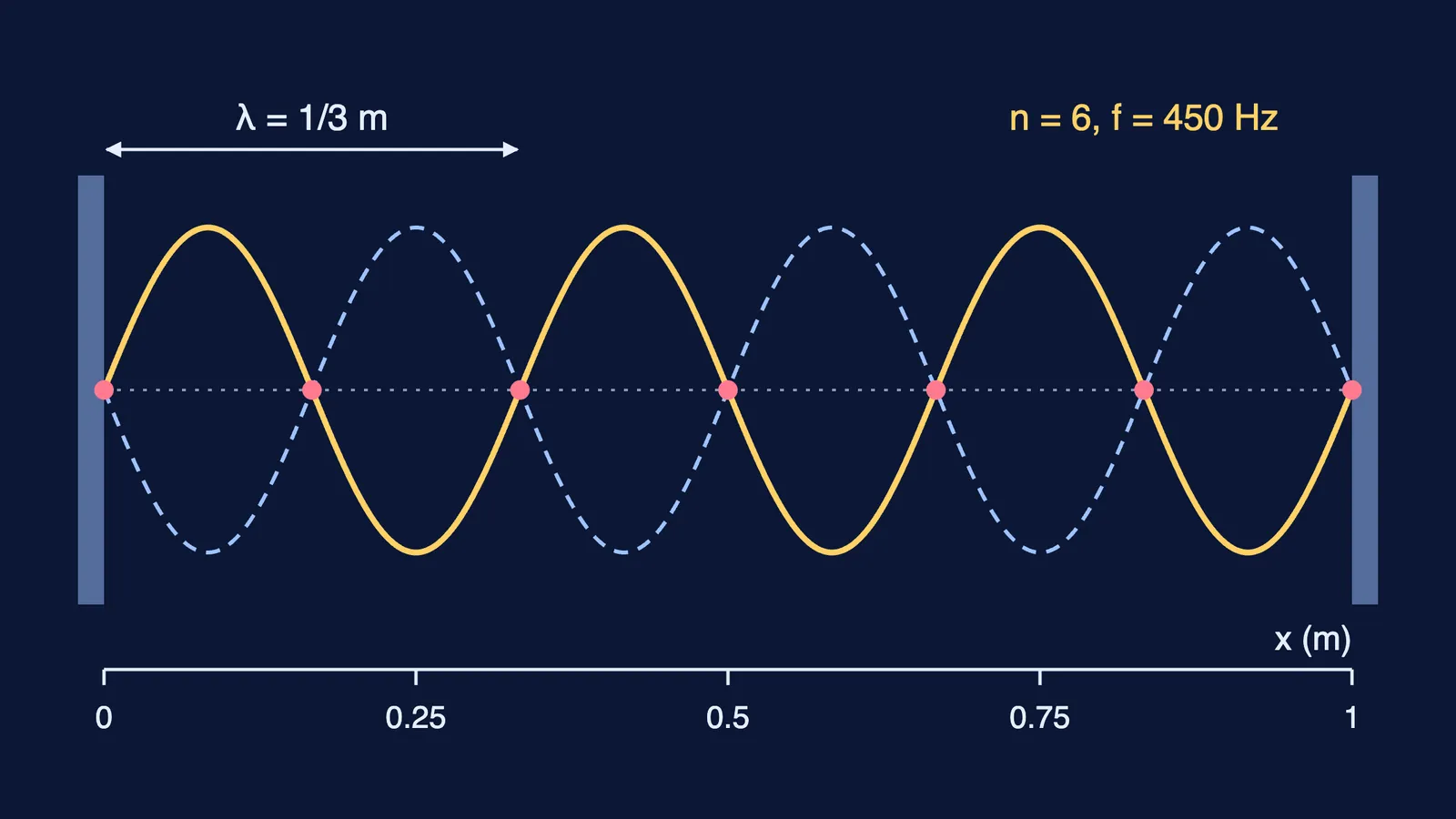
Q5 (medium, numerical). A string 1.0 m long, fixed at both ends, has linear mass density 8.0 g/m. Two successive resonant frequencies are 450 Hz and 525 Hz. Find the tension in newtons.
Answer: 180. Successive harmonics differ by the fundamental, so f₁ = 525 − 450 = 75 Hz and 450 Hz is the 6th harmonic. v = 2Lf₁ = 150 m/s, and T = μv² = 0.008 × 150² = 180 N. The diagram at the top draws this 6th harmonic to scale.
Trap: taking 450 Hz as the fundamental gives v = 900 m/s and 6480 N, an absurd tension for a thin string.
Q6 (medium). Two identical wires under equal tension each sound a fundamental of 300 Hz. The tension in one is increased by 2%. About how many beats per second are heard?
(A) 1.5 (B) 6.0 (C) 3.0 (D) 0.3
Answer: (C). f ∝ √T, so a 2% rise in tension raises f by about 1%: 300 × (√1.02 − 1) = 2.99, about 3 beats per second.
Trap: (B) treats f as proportional to T, so a 2% change in tension becomes a 2% change in frequency.
Hard: a collision in SHM and the velocity relation
Q7 (hard). A 3.0 kg block on a smooth floor oscillates on a horizontal spring with amplitude 8.0 cm. As it passes the mean position, a 1.0 kg lump of putty dropped vertically lands on it and sticks. What is the new amplitude?
(A) 6.0 cm (B) 6.93 cm (C) 8.0 cm (D) 9.24 cm
Answer: (B). Horizontal momentum is conserved: 3v = 4v′, so v′ = 0.75v. The new ω′ = √(k/4) = ω√(3/4). Amplitude is speed at the mean position over ω, so A′ = 8.0 × 0.75/√0.75 = 8.0 × √0.75 = 6.93 cm.
Trap: (A) cuts the speed to 0.75v but keeps the old ω. Adding mass also slows the oscillation, which raises the amplitude for a given speed.
Q8 (hard, numerical). A particle in SHM moves at 24 cm/s when 5 cm from the mean position and at 10 cm/s when 12 cm from it. Find the amplitude in centimetres.
Answer: 13. Use v² = ω²(A² − x²): 576 = ω²(A² − 25) and 100 = ω²(A² − 144). Subtracting, 476 = 119ω², so ω = 2 rad/s, and A² = 25 + 144 = 169, so A = 13 cm.
Trap: 17 assumes speed falls in a straight line with distance. It falls along an ellipse; see why the v–x graph in SHM is an ellipse.
If a trap caught you, the Fermi Problem Library has worked problems with a step-by-step solver that explains the reasoning rather than printing an answer. For a different set on the same chapter, try our Oscillations and Waves NEET practice questions.