On this page
Eight new JEE Main-style questions on alternating current only: rms values, reactance, phasors, power factor, transformers and resonance. Each answer shows the working and names the trap, the wrong option you are most likely to pick.
How should you use this AC question set?
The Syllabus for JEE (Main) - 2027 puts AC in Physics Unit 14, which lists peak and RMS values, reactance and impedance, the LCR series circuit, resonance, power in AC circuits, wattless current, the AC generator and the transformer. Every question here stays inside that list and NCERT Class 12 Physics Chapter 7, Alternating Current (Reprint 2026-27).
Allow 20 minutes, on paper, no calculator. Q6 needs a number, not an option.
For every circuit, sketch the phasors before you write a formula.
Read each trap line, even where you were right.
New to the chapter? Start with our guide on how to prepare Alternating Current for JEE Main.
Easy: do you know how reactance, rms and power factor behave?
Q1 (easy). A capacitor draws 0.50 A rms from a 220 V, 50 Hz supply. On a 220 V, 60 Hz supply it draws:
(A) 0.42 A (B) 0.50 A (C) 0.60 A (D) 0.72 A
Answer: (C). XC = 1/(2πfC) falls as f rises, so the current I = 2πfCV grows in proportion to f: 0.50 × 60/50 = 0.60 A. Trap: (A), which treats the capacitor like an inductor, whose reactance rises with frequency.
Q2 (easy). The current in a wire is i = 2 + 6 sin(ωt) A, a steady part plus a sinusoidal part. Its rms value is closest to:
(A) 4.2 A (B) 4.7 A (C) 6.3 A (D) 8.0 A
Answer: (B). Square and average over a cycle: 4 + 24⟨sin ωt⟩ + 36⟨sin² ωt⟩ = 4 + 0 + 18 = 22, so irms = √22 ≈ 4.7 A. Trap: (C), √(2² + 6²), which treats the peak 6 A as if it were an rms value.
Q3 (easy). A motor draws 10 A rms from a 200 V supply and uses 1.2 kW. The wattless component of its current is:
(A) 4 A (B) 6 A (C) 8 A (D) 10 A
Answer: (C). cos φ = P/(VI) = 1200/2000 = 0.6, so sin φ = 0.8 and the wattless current is I sin φ = 8 A. Trap: (B), I cos φ, which is the power component.
Medium: can you handle coils, phasors and real transformers?
Q4 (medium). A coil draws 4.0 A from a 24 V battery. On a 24 V rms, 50 Hz supply it draws 2.4 A. Its inductance is closest to:
(A) 25 mH (B) 32 mH (C) 0.16 H (D) 13 mH
Answer: (A). DC sees only resistance: R = 24/4.0 = 6 Ω. On AC, Z = 24/2.4 = 10 Ω, so XL = √(10² − 6²) = 8 Ω and L = 8/(100π) ≈ 25 mH. Trap: (D), which subtracts R from Z as plain numbers. Resistance and reactance add as phasors.
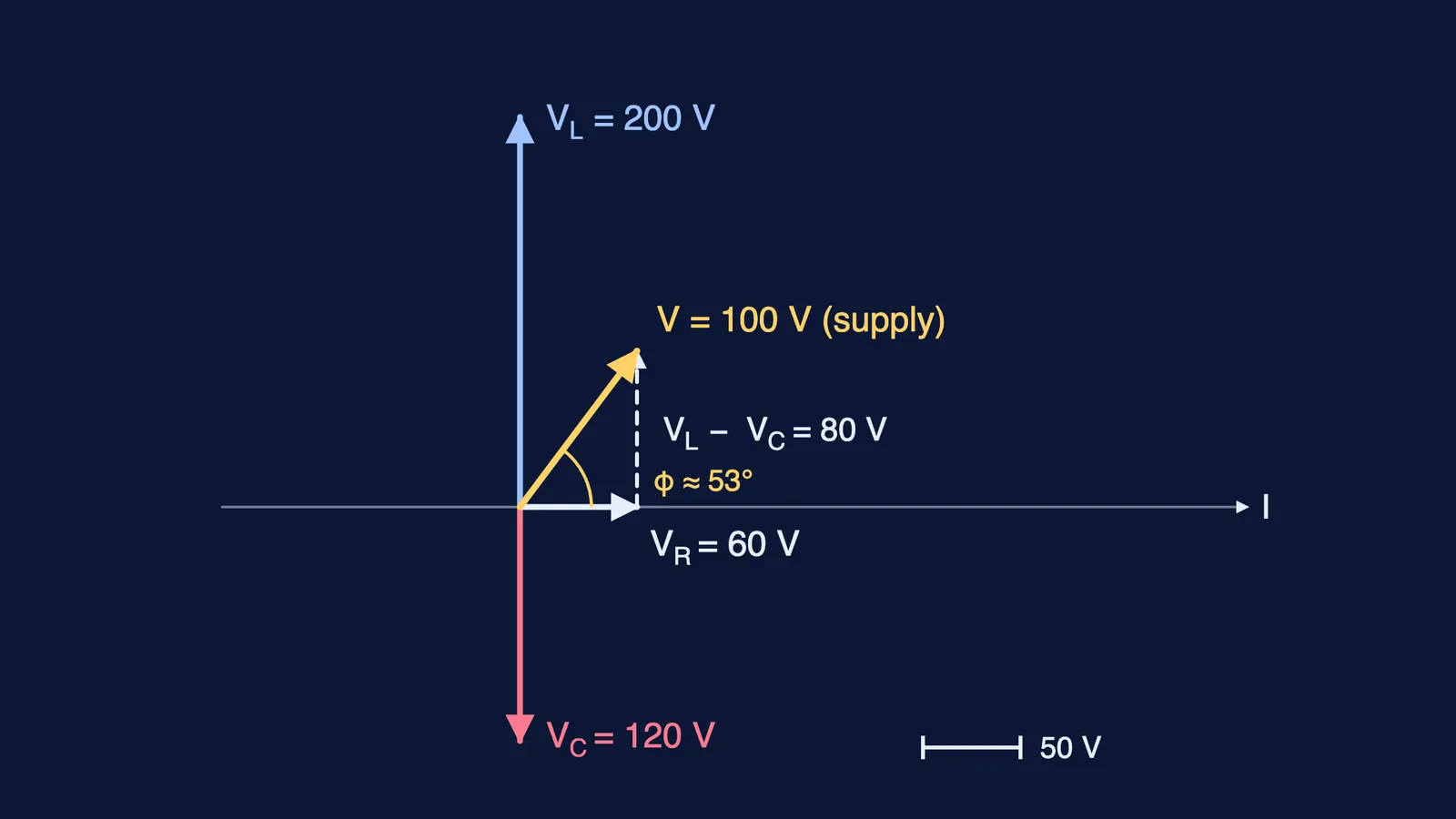
Q5 (medium). In a series LCR circuit on a 100 V rms supply, a voltmeter reads 60 V across the resistor and 120 V across the capacitor. The current lags the supply voltage. The reading across the (pure) inductor is:
(A) 40 V (B) 80 V (C) 160 V (D) 200 V
Answer: (D). V² = VR² + (VL − VC)² gives |VL − VC| = 80 V. A lagging current means the circuit is inductive, so VL = 120 + 80 = 200 V, as the diagram at the top shows. Trap: (A), the other root, 120 − 80, which would make the current lead.
Q6 (medium, numerical). A step-down transformer with efficiency 80% takes 4.0 A from 220 V mains and supplies a load at 11 V. Find the secondary current in amperes.
Answer: 64. Input power is 220 × 4.0 = 880 W, output is 0.80 × 880 = 704 W, so Is = 704/11 = 64 A. Trap: 80, the ideal-transformer answer that ignores the 20% loss.
Hard: can you design a circuit and use resonance?
Q7 (hard). A heating element rated 40 W at 110 V is to run at its rating from 230 V, 50 Hz mains through a series capacitor. Treat the element as a pure resistor. The capacitance needed is closest to:
(A) 5.0 μF (B) 5.7 μF (C) 9.6 μF (D) 36 μF
Answer: (B). The element needs I = 40/110 = 0.364 A, so R = 110²/40 = 302.5 Ω and Z = 230/0.364 = 632.5 Ω. Then XC = √(632.5² − 302.5²) ≈ 555 Ω and C = 1/(100π × 555) ≈ 5.7 μF. Trap: (C), which gives the capacitor the leftover 230 − 110 = 120 V. The two voltages are 90° apart, so VC is about 202 V.
Q8 (hard). A series LCR circuit with R = 60 Ω resonates at ω₀ = 1000 rad/s. At ω = 2000 rad/s its power factor is 0.8, with the current lagging. The inductance L is:
(A) 22.5 mH (B) 30 mH (C) 45 mH (D) 53 mH
Answer: (B). Power factor 0.8 means tan φ = 0.75, so XL − XC = 0.75 × 60 = 45 Ω. At resonance ω₀L = 1/(ω₀C). Doubling ω doubles XL to 2ω₀L and halves XC to ω₀L/2, so XL − XC = 1.5ω₀L = 45 Ω and L = 30 mH (C = 33 μF). Trap: (A), which sets 2ω₀L = 45 Ω and forgets the capacitor.
What should you do after marking this set?
Sort each miss into one bin: frequency and rms (Q1, Q2), phasor triangles (Q4, Q5, Q7) or power and resonance (Q3, Q6, Q8). Practise the fullest bin this week and redo those questions in two days without the solutions. For Q4-style coils, read how to find a coil's inductance from DC and AC readings. For Q3 and Q8, our explainer on power factor and why phase angle cuts real power draws the triangle behind them.
When a whole method breaks down rather than one step, the Fermi Problem Library has worked problems with a step-by-step solver that explains the reasoning rather than printing an answer.