On this page
NEET Experimental Skills questions test what each lab setup measures and which formula turns its readings into an answer. These eight original NEET-style MCQs skip the vernier and screw gauge and run from easy to hard, each with a worked solution and its most tempting wrong option explained.
The NMC syllabus for NEET (UG)-2026 puts these in Physics Unit 20, which asks for familiarity with the basic approach and observations of each experiment.
How should you use this practice set?
Cover the answers and give yourself about a minute per question.
Write the formula before the number, to tell a wrong method from a slip.
Mark each answer right, wrong or guessed; count a guess as wrong and read its trap note.
For NEET (UG)-2026, the NTA information bulletin gave +4 for a correct answer and -1 for a wrong one. For the full experiment list and how to revise it, start with our guide on how to prepare Experimental Skills for NEET.
Easy: do you know what each setup measures?
Q1 (easy). In a metre bridge, an unknown resistance X is in the left gap and a 6.0 Ω standard resistance is in the right gap. The null point is at 40.0 cm from the left end. What is X?
(A) 9.0 Ω (B) 4.0 Ω (C) 2.4 Ω (D) 15 Ω
Answer: (B). At balance, X/6.0 = 40.0/(100 - 40.0) = 40/60, so X = 4.0 Ω.
Trap: (A) puts the lengths the wrong way round. The resistance in the left gap goes with the length measured from the left end.
Q2 (easy). Using the parallax method with a concave mirror, a student places the object needle 30.0 cm in front of the mirror and finds no parallax when the image needle is 60.0 cm in front of it. What is the focal length?
(A) 60.0 cm (B) 45.0 cm (C) 20.0 cm (D) 90.0 cm
Answer: (C). With u = -30.0 cm and v = -60.0 cm, 1/f = 1/v + 1/u = -1/60 - 1/30 = -1/20, so f = -20.0 cm: a focal length of 20.0 cm.
Trap: (A) uses the lens formula, 1/v - 1/u, by mistake.
Q3 (easy). Two steel balls of radii 1.0 mm and 1.5 mm fall through the same glycerine. The smaller ball reaches a terminal velocity of 2.0 cm/s. What is the terminal velocity of the larger ball?
(A) 3.0 cm/s (B) 4.5 cm/s (C) 6.75 cm/s (D) 1.33 cm/s
Answer: (B). Terminal velocity is proportional to r² for the same ball material and liquid, so v = 2.0 × (1.5)² = 4.5 cm/s.
Trap: (A) assumes v grows in proportion to r.
Medium: can you turn readings into a result?
Q4 (medium). A resonance tube is excited by a 500 Hz tuning fork. The first resonance is at an air-column length of 16.4 cm and the second at 50.4 cm. What is the speed of sound in air?
(A) 328 m/s (B) 336 m/s (C) 170 m/s (D) 340 m/s
Answer: (D). The two resonances differ by half a wavelength, so λ = 2 × (50.4 - 16.4) = 68.0 cm, and v = 500 × 0.680 = 340 m/s.
Trap: (A) uses λ = 4 × 16.4 cm and ignores the end correction.
Q5 (medium). A 150 g metal block at 100.0 °C is dropped into 200 g of water at 25.0 °C in a calorimeter whose water equivalent is 20 g. The final temperature is 30.0 °C. Take the specific heat of water as 4200 J kg⁻¹ K⁻¹. What is the specific heat of the metal?
(A) 400 J kg⁻¹ K⁻¹ (B) 440 J kg⁻¹ K⁻¹ (C) 411 J kg⁻¹ K⁻¹ (D) 205 J kg⁻¹ K⁻¹
Answer: (B). Heat gained = (0.200 + 0.020) × 4200 × 5.0 = 4620 J. Heat lost = 0.150 × s × 70.0. Equating, s = 4620/10.5 = 440 J kg⁻¹ K⁻¹.
Trap: (A) leaves out the calorimeter's 20 g water equivalent.
Q6 (medium). A uniform metre scale of mass 120 g balances on a knife edge at the 45.0 cm mark when an unknown mass m hangs at the 5.0 cm mark and a 40 g mass hangs at the 95.0 cm mark. What is m?
(A) 50 g (B) 65 g (C) 35 g (D) 52 g
Answer: (B). Take moments about the knife edge, with the scale's weight at its 50.0 cm mark: m × 40.0 = 120 × 5.0 + 40 × 50.0 = 2600 g cm, so m = 65 g.
Trap: (A) ignores the scale's own weight.
Hard: can you handle the method behind the number?
Q7 (hard). In the half-deflection method, a galvanometer in series with a 1200 Ω resistance and a cell of negligible internal resistance shows 30 divisions. A shunt of 100 Ω across the galvanometer brings the deflection down to 15 divisions. What is the galvanometer's resistance?
(A) 92.3 Ω (B) 100 Ω (C) 1100 Ω (D) 109 Ω
Answer: (D). Halving the galvanometer current gives G = RS/(R - S) = 1200 × 100/1100 ≈ 109 Ω.
Trap: (B) takes G equal to the shunt, an approximation that holds only when R is far larger than S.
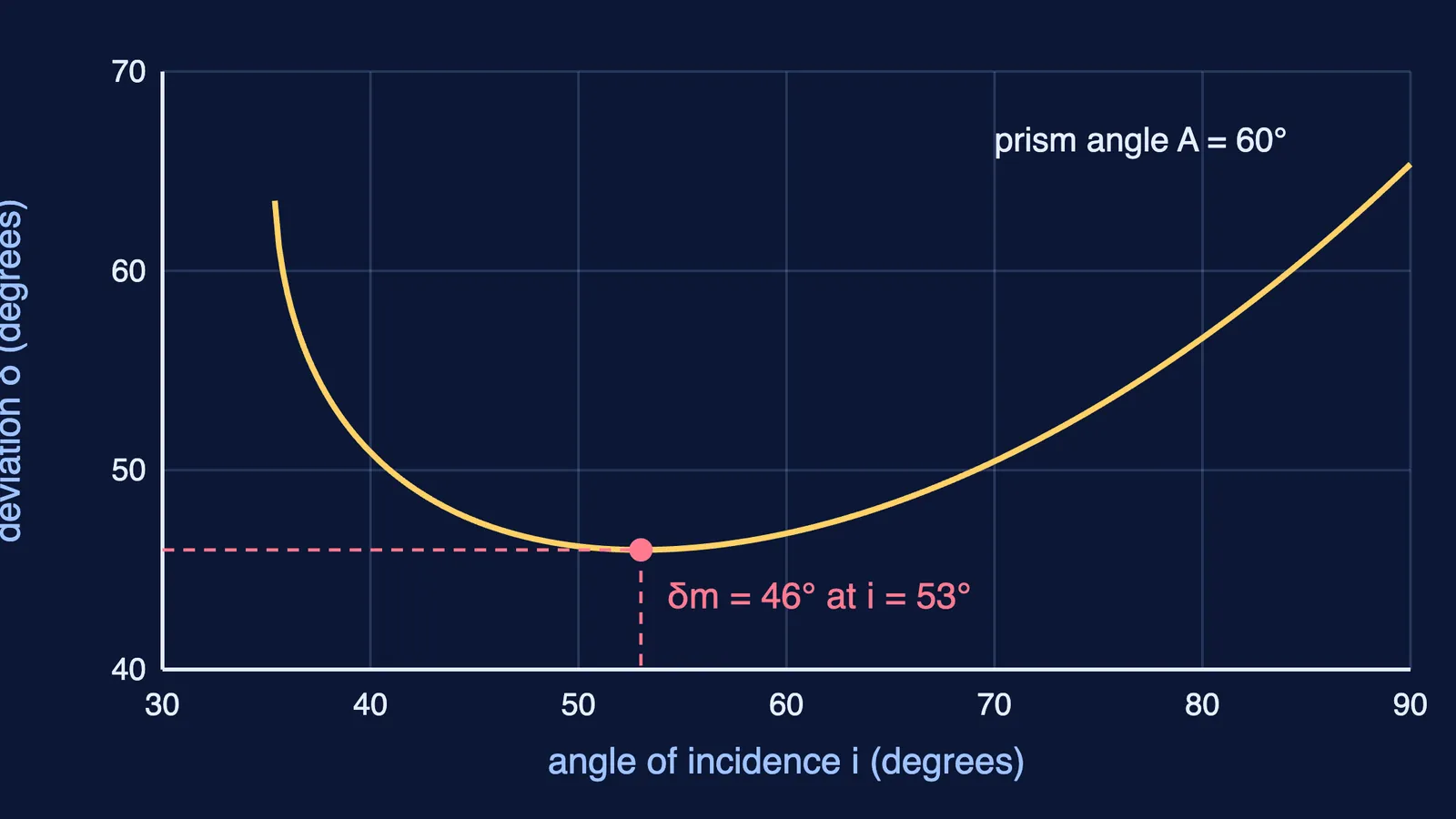
Q8 (hard). A student plots angle of deviation against angle of incidence for a prism of angle 60°. The minimum of the curve is at a deviation of 46.0°. What is the refractive index of the glass?
(A) 1.44 (B) 1.60 (C) 1.11 (D) 1.77
Answer: (B). n = sin((A + δm)/2)/sin(A/2) = sin 53°/sin 30° = 0.799/0.500 ≈ 1.60.
Trap: (A) puts sin δm on top instead of the sine of half of (A + δm).
What should you do after checking your answers?
Sort your misses into wrong setup, wrong formula and wrong arithmetic. For setup misses, write one line per experiment: what is varied, what is read, what is calculated. For the vernier and screw gauge, use our Physics and Measurement NEET practice questions, and if you also sit JEE Main, read experimental skills in the JEE Main physics syllabus.
For more practice, the Fermi Problem Library has worked problems with a step-by-step solver that explains the reasoning rather than printing an answer.
Try the set again in a week, without notes, in eight minutes.