On this page
Eight original JEE Advanced-style questions, easy to hard. Every answer names the trap.
Which part of the JEE Advanced syllabus does this set cover?
The official JEE (Advanced) 2026 syllabus lists, under Algebra, arithmetic and geometric progressions and means, sums of finite APs and GPs, infinite geometric series, sums of n, n² and n³, and the binomial theorem for a positive integral index with properties of binomial coefficients. The same PDF says the 2026 syllabus is unchanged from 2025.
How to use this set:
Allow 30 minutes, paper only.
In "one or more options correct" questions, test every option on its own before you mark.
Check any formula you use at n = 1 and n = 2.
New to the chapter? Start with our guide on how to prepare sequences, series and binomial theorem for JEE Advanced, and read how each format is set in JEE Advanced question types.
Easy: can you read a sequence from its sum?
Q1 (easy, single correct). The sum of the first n terms of an AP is Sₙ = 4n² − n. What is its 15th term?
(A) 115
(B) 119
(C) 59
(D) 885
Answer: (A). T₁₅ = S₁₅ − S₁₄ = 885 − 770 = 115. Trap: (B). Differentiating Sₙ gives 8n − 1, which is not the nth term.
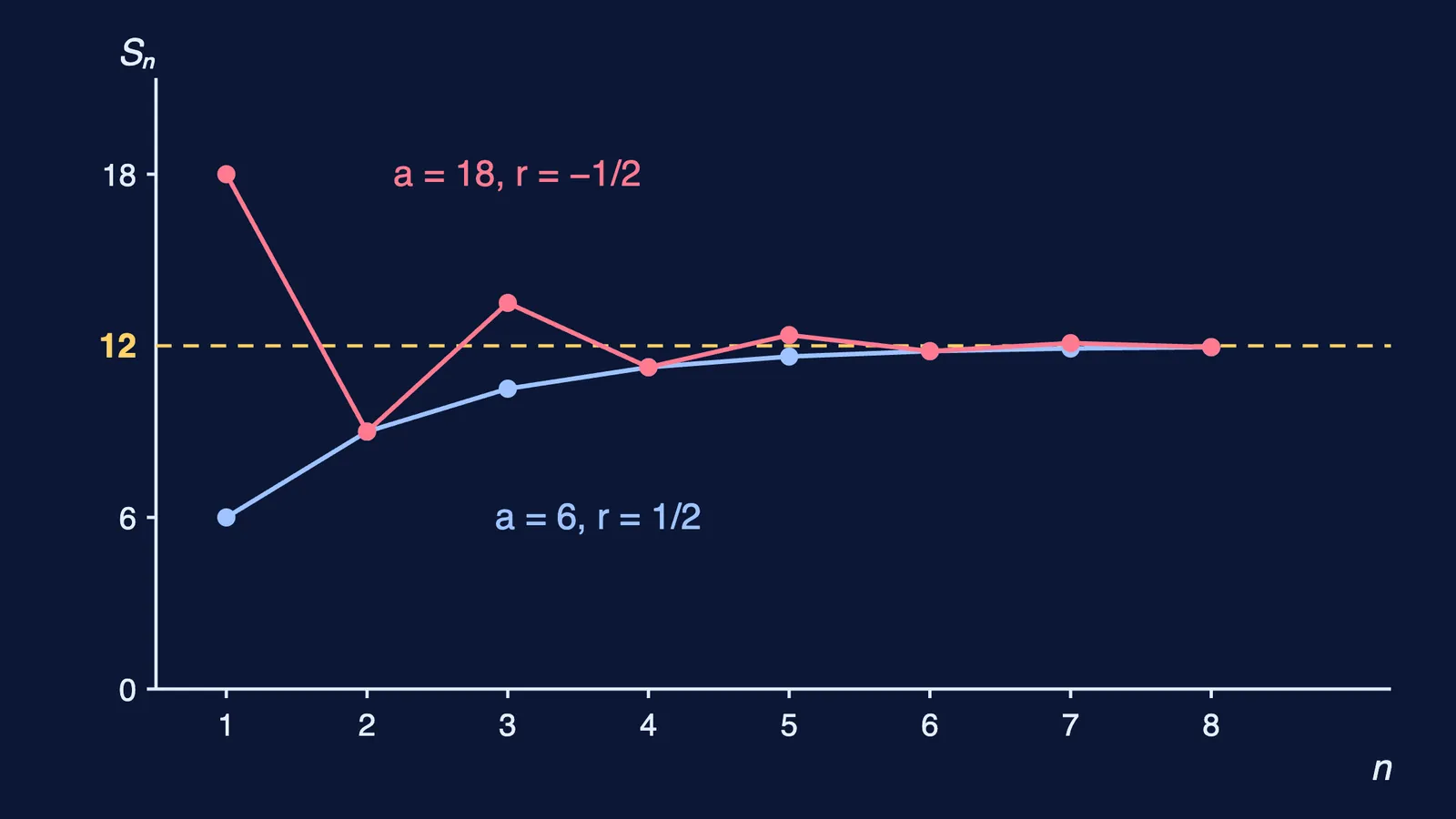
Q2 (easy, single correct). An infinite GP has sum 12, and the sum of its first two terms is 9. What can its first term be?
(A) 6 only
(B) 18 only
(C) 6 or 18
(D) 3 or 9
Answer: (C). a/(1 − r) = 12 and a(1 + r) = 9. Dividing, (1 − r)(1 + r) = 3/4, so r² = 1/4 and r = ±1/2. Both lie between −1 and 1, giving a = 6 (r = 1/2) or a = 18 (r = −1/2). Trap: (A). Taking only the positive root loses the alternating series.
Medium: can you combine two ideas?
Q3 (medium, numerical value). Find 11³ + 13³ + 15³ + ... + 29³.
Answer: 99800. The sum of the first m odd cubes is m²(2m² − 1). Take the first 15 odd cubes (up to 29) minus the first 5 (up to 9): 225·449 − 25·49 = 101025 − 1225 = 99800. Trap: 98469, which also subtracts 11³.
Q4 (medium, single correct). What is the remainder when 15⁴⁷ is divided by 49?
(A) 36
(B) 22
(C) 1
(D) 15
Answer: (B). 15⁴⁷ = (1 + 14)⁴⁷. Every term from 14² = 196 = 4·49 onward is a multiple of 49, so 15⁴⁷ ≡ 1 + 47·14 = 659 ≡ 22 (mod 49). Trap: (A). Writing the second term as 47·7 instead of 47·14 gives 330 ≡ 36.
Q5 (medium, one or more options correct). Three distinct non-zero numbers a, b, c form a GP with common ratio r, and 2a, 5b, 8c form an AP. Which statements are correct?
(A) r = 1/4
(B) r = 1 is also possible
(C) If a = 16, then a + b + c = 21
(D) The infinite GP a + b + c + ... has sum 4a/3
Answer: (A), (C), (D). 10b = 2a + 8c gives 10r = 2 + 8r², so 4r² − 5r + 1 = 0 and r = 1 or 1/4. Distinct terms rule out r = 1. With a = 16 the terms are 16, 4, 1, and a/(1 − 1/4) = 4a/3. Trap: (B). r = 1 solves the equation but makes the terms equal.
Hard: can you handle the multi-step ones?
Q6 (hard, one or more options correct). Which of these infinite sums, each over n = 1, 2, 3, ..., are correct?
(A) Σ n/3ⁿ = 3/4
(B) Σ n/2ⁿ = 4
(C) Σ (2n − 1)/3ⁿ = 1
(D) Σ n/4ⁿ = 4/9
Answer: (A), (C), (D). For |x| < 1, write S = x + 2x² + 3x³ + ... and subtract xS: (1 − x)S = x/(1 − x), so S = x/(1 − x)². This gives 3/4 at x = 1/3, 2 at x = 1/2 and 4/9 at x = 1/4. For (C), 2(3/4) − 1/2 = 1. Trap: (B). Dropping the factor x in the numerator gives 1/(1 − x)² = 4.
Q7 (hard, numerical value). Find the coefficient of x⁷ in (1 + x)¹² + x(1 + x)¹¹ + x²(1 + x)¹⁰ + ... + x⁷(1 + x)⁵.
Answer: 1716. The eight terms form a GP with first term (1 + x)¹² and ratio x/(1 + x). Since 1 − x/(1 + x) = 1/(1 + x), the sum is (1 + x)¹³ − x⁸(1 + x)⁵. The second part starts at x⁸, so the coefficient of x⁷ is C(13, 7) = 1716. Trap: 792, which is C(12, 7) from the first term alone.
Q8 (hard, one or more options correct). Let Cᵣ = C(10, r), with each Σ over r = 0 to 10. Which are correct?
(A) C₀² + C₁² + ... + C₁₀² = C(20, 10)
(B) Σ r·Cᵣ² = 10·C(19, 9)
(C) Σ r·Cᵣ² = 5·C(20, 10)
(D) C₀C₁ + C₁C₂ + ... + C₉C₁₀ = C(20, 10)
Answer: (A), (B), (C). Compare coefficients in (1 + x)¹⁰(x + 1)¹⁰ for (A). For (B), r·Cᵣ = 10·C(9, r − 1), so the sum is 10 times the coefficient of x⁹ in (1 + x)⁹(1 + x)¹⁰, which is 10·C(19, 9) = 923780. Pairing r with 10 − r gives half of 10·C(20, 10), also 923780, so (C) holds. In (D) the lower indices differ by one, so the sum is C(20, 9) = 167960. Trap: (D). An index shift moves you off the middle coefficient. Our sum of squares of binomial coefficients post proves (A).
What should you do after marking this set?
List each question you got wrong next to its trap.
Redo those questions after two days without the solution.
If the method was wrong, rework a similar problem.
If you get stuck partway through a problem, the Fermi Problem Library has worked problems with a step-by-step solver that explains the reasoning rather than printing an answer.