On this page
These eight original questions mix single-correct, one-or-more-correct and numerical types; each answer names the trap.
What does JEE Advanced test in fluids and elasticity?
The official JEE (Advanced) 2026 syllabus covers Hooke's law, Young's, bulk and rigidity moduli, Pascal's law, buoyancy, surface tension, capillary rise, viscosity, Stokes' law, continuity and Bernoulli's theorem, with Poiseuille's equation excluded. For theory and a study plan, read our guide on how to prepare fluids and elasticity for JEE Advanced.
How should you attempt this set?
Cover the answers; allow 30 minutes.
Note what is fixed: depth, volume or extension.
Retry misses two days later.
Take g = 10 m/s² and water's density as 1000 kg/m³.
Easy: pressure and shear
Q1 (easy, single correct). A U-tube with equal arms holds water. Oil (800 kg/m³) is poured into the left arm until the oil column is 12 cm long. How far does the right arm's water rise?
(A) 2.4 cm (B) 4.8 cm (C) 6.0 cm (D) 9.6 cm
Answer: (B). The right level rises x as the left interface falls x, so the water levels differ by 2x: 800 × 0.12 = 1000 × 2x gives x = 4.8 cm.
Trap: (D) is the level difference, 2x.
Q2 (easy, single correct). A rubber pad 2.0 cm thick, top face 10 cm × 10 cm, is glued to a table. A 500 N horizontal force on the top shifts it 0.50 mm. What is its modulus of rigidity?
(A) 1.25 × 10³ Pa (B) 5.0 × 10⁴ Pa (C) 2.0 × 10⁶ Pa (D) 1.0 × 10⁷ Pa
Answer: (C). Stress = 500/0.010 = 5.0 × 10⁴ Pa; strain = 0.50/20 = 0.025; G = 2.0 × 10⁶ Pa.
Trap: (D) uses a side face as the area. Revise the moduli with our Mechanical Properties of Solids Class 11 guide.
Medium: capillaries, Stokes' law and a draining tank
Q3 (medium, one or more correct). Water rises 6.0 cm in a capillary of radius r (contact angle zero) sticking 15 cm out of the water. Which are correct?
(A) In a tube of radius 2r, water rises 12 cm. (B) Tilted 60° from the vertical, the water column along the tube is 12 cm. (C) In a tube of radius r/2, the raised column weighs half as much. (D) In a freely falling lift, water still rises 6.0 cm.
Answer: (B), (C). Since h = 2T/(ρgr), the vertical height stays 6.0 cm, so the tilted length is 6.0/cos 60° = 12 cm. The column's weight balances 2πrT, so it scales with r. Doubling r halves h; in free fall water climbs to the top.
Trap: (A), treating h as proportional to r.
Q4 (medium, numerical). Equal-radius spheres A (density 1.8ρ) and B (0.6ρ) are in a liquid of density ρ. A alone has terminal speed 4.0 cm/s. A light thread joins them, A below B, far enough apart for Stokes' law to hold for each. Find the pair's terminal speed in cm/s.
Answer: 1.0. Alone, A's net weight 0.8ρVg balances drag kv₀; together the net weight is (1.8 + 0.6 − 2)ρVg = 0.4ρVg, against drag 2kv. So v = 4.0 × 0.4/(2 × 0.8) = 1.0 cm/s. The thread stays taut (tension 0.6ρVg).
Trap: 2.0, from counting drag on one sphere.
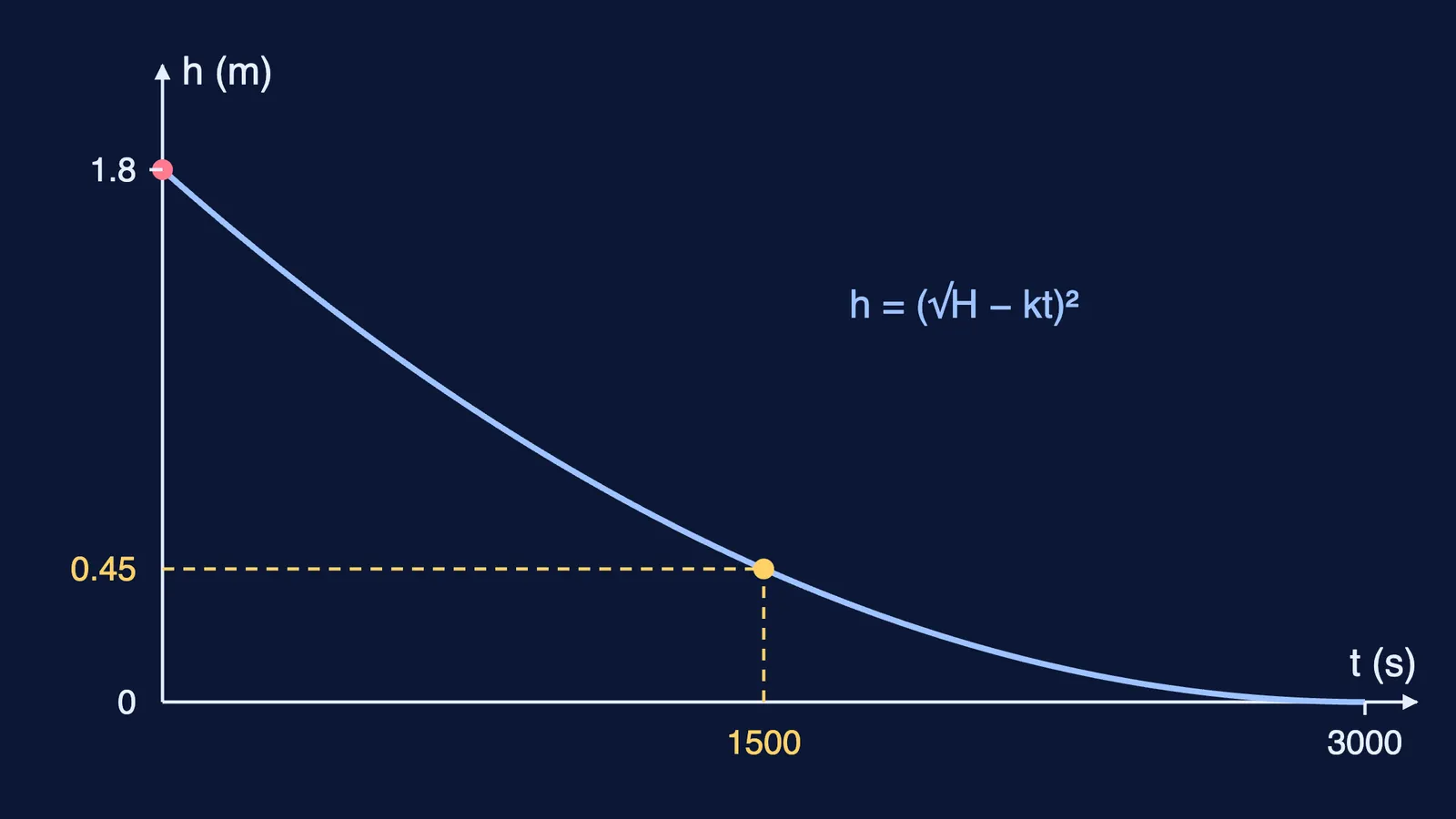
Q5 (medium, single correct). An open tank of cross-section 0.50 m² holds water 1.8 m deep. A 1.0 cm² hole opens in its base. How long until the level is 0.45 m?
(A) 18.75 min (B) 25.0 min (C) 35.4 min (D) 50.0 min
Answer: (B). A dh/dt = −a√(2gh) integrates to t = (A/a)√(2/g)(√1.8 − √0.45) = 5000 × 0.447 × 0.671 ≈ 1500 s.
Trap: (A) keeps the initial 6.0 m/s constant; (D) empties the tank.
Hard: can you combine elasticity, rotation and surface tension?
Q6 (hard, one or more correct). A light rod 1.0 m long hangs from two vertical wires at its ends, each 1.5 m long and 1.0 mm² in cross-section: steel (Y = 2.0 × 10¹¹ Pa) and brass (Y = 1.0 × 10¹¹ Pa). A 300 N load is placed so the rod stays level. Which are correct?
(A) The load is 1/3 m from the steel wire. (B) The steel wire's tension is 200 N. (C) The steel wire stores twice the brass wire's elastic energy. (D) The stress in the brass wire is 2.0 × 10⁸ Pa.
Answer: (A), (B), (C). Equal extensions need equal T/Y, so tensions are 200 N and 100 N; torques about the steel end give 100 × 1.0 = 300x, x = 1/3 m. Both extend 1.5 mm, storing ½TΔL = 0.15 J and 0.075 J. Brass stress is 1.0 × 10⁸ Pa.
Trap: (D) is the steel wire's stress.
Q7 (hard, numerical). A water-filled U-tube with a 20 cm horizontal base spins at 10 rad/s about one arm's axis. How many cm higher does water stand in the other arm?
Answer: 20. The base needs a pressure difference ∫ρω²x dx = ρω²L²/2 for the centripetal force, so Δh = ω²L²/(2g) = 0.20 m.
Trap: 40, from using ρω²L² without integrating.
Q8 (hard, one or more correct). Soap bubbles of radii 1.0 cm and 2.0 cm (surface tension 0.030 N/m) sit on the two ends (radius 0.50 cm) of a tube with a closed valve. Which are correct?
(A) The excess pressure in the 1.0 cm bubble is 12 Pa. (B) When the valve opens, air flows into the 1.0 cm bubble. (C) The 2.0 cm bubble's surface energy is about 3.0 × 10⁻⁴ J. (D) At equilibrium, the film on the smaller bubble's mouth has the larger bubble's radius of curvature.
Answer: (A), (C), (D). Two surfaces give excess pressure 4T/r = 12 Pa and surface energy 8πr²T ≈ 3.0 × 10⁻⁴ J. The smaller bubble has the higher pressure, so it empties into the larger until the radii of curvature match.
Trap: (B), assuming the bigger bubble pushes harder.
What should you do after this set?
7 or 8 right: try timed mixed papers.
4 to 6 right: redo the misses, then 10 problems on your weakest sub-topic.
Below 4: reread the guide, or warm up with our 8 JEE Main questions on properties of solids and liquids.
If one step keeps failing, the Fermi Problem Library has worked problems with a step-by-step solver that explains the reasoning rather than printing an answer.