On this page
These eight JEE Main-style questions are new, not taken from NCERT, exemplar or past papers. Each answer ends with the trap: the wrong option most students pick, and why.
What does JEE Main test in Properties of Solids and Liquids?
In the Syllabus for JEE (Main) - 2027 published by NTA (linked from jeemain.nta.nic.in), Properties of Solids and Liquids is Unit 7 of Physics. Every question stays inside that unit and the NCERT Class 11 chapters on solids, fluids and thermal properties. For theory and a study plan, see our guide on how to prepare Properties of Solids and Liquids for JEE Main.
How should you use this set?
Cover the answers and allow about 20 minutes for all eight.
Write the governing equation before any numbers.
Redo every miss two days later, without notes.
Easy: elasticity, pressure and radiation
Q1 (easy). Water has a bulk modulus of 2.2 × 10⁹ Pa. What pressure increase reduces the volume of a water sample by 0.10%?
(A) 2.2 × 10⁵ Pa (B) 2.2 × 10⁶ Pa (C) 2.2 × 10⁷ Pa (D) 2.2 × 10⁸ Pa
Answer: (B). B = Δp/(ΔV/V), so Δp = 2.2 × 10⁹ × 0.0010 = 2.2 × 10⁶ Pa.
Trap: (D) uses 0.10 instead of 0.0010 for the strain.
Q2 (easy). A closed tank holds water 3.0 m deep. The air above the water is at a gauge pressure of 0.50 × 10⁵ Pa. Take atmospheric pressure as 1.0 × 10⁵ Pa and g = 10 m/s². What is the absolute pressure at the bottom?
(A) 0.80 × 10⁵ Pa (B) 1.30 × 10⁵ Pa (C) 1.50 × 10⁵ Pa (D) 1.80 × 10⁵ Pa
Answer: (D). The air is at 1.50 × 10⁵ Pa absolute; the water adds ρgh = 1000 × 10 × 3.0 = 0.30 × 10⁵ Pa, giving 1.80 × 10⁵ Pa.
Trap: (B) treats the tank as open; (A) is the gauge pressure.
Q3 (easy). A blackened sphere at 27 °C emits 2.0 W of radiation. What does it emit at 327 °C?
(A) 4.0 W (B) 24 W (C) 32 W (D) 4.3 × 10⁴ W
Answer: (C). Power is proportional to T⁴ in kelvin. 300 K to 600 K multiplies it by 2⁴ = 16, giving 32 W.
Trap: (D) puts Celsius into the fourth power; (A) forgets the power of four.
Medium: viscosity, surface tension and Bernoulli
Q4 (medium). A steel ball of radius 1.0 mm (density 7800 kg/m³) falls through glycerine (density 1260 kg/m³, viscosity 1.5 Pa s). With g = 10 m/s², what is its terminal speed?
(A) 0.48 cm/s (B) 0.97 cm/s (C) 1.16 cm/s (D) 3.88 cm/s
Answer: (B). From Stokes' law, v_t = 2a²(ρ − σ)g/(9η) = 2 × (1.0 × 10⁻³)² × 6540 × 10/(9 × 1.5) ≈ 9.7 × 10⁻³ m/s.
Trap: (C) leaves out the buoyancy term σ; (D) uses the diameter as the radius.
Q5 (medium). A thin wire ring of radius 2.0 cm lies flat on water (S = 0.072 N/m). Beyond its weight, what force is needed to lift it off the surface?
(A) 9.0 × 10⁻⁵ N (B) 9.0 × 10⁻³ N (C) 1.8 × 10⁻² N (D) 3.6 × 10⁻² N
Answer: (C). The film clings to both the inner and outer edge, so F = S × 2 × 2πr = 0.072 × 4π × 0.020 ≈ 1.8 × 10⁻² N.
Trap: (B) counts one edge only; (D) uses the diameter as the radius.
Q6 (medium). Water flows through a horizontal pipe that narrows from 40 cm² to 10 cm² in cross-section. In the wide part the speed is 0.50 m/s. Open vertical tubes on each part show water columns. With g = 10 m/s², what is their height difference?
(A) 3.75 cm (B) 18.75 cm (C) 20.0 cm (D) 37.5 cm
Answer: (B). Continuity gives v₂ = 0.50 × 40/10 = 2.0 m/s. Bernoulli gives P₁ − P₂ = ½ρ(v₂² − v₁²) = 500 × (4.0 − 0.25) = 1875 Pa, and h = 1875/(1000 × 10) = 0.1875 m.
Trap: (C) ignores the speed in the wide part; (D) drops the ½ in ½ρv². Revise both in our Mechanical Properties of Fluids Class 11 guide.
Hard: can you handle a phase-change mix and a hanging wire?
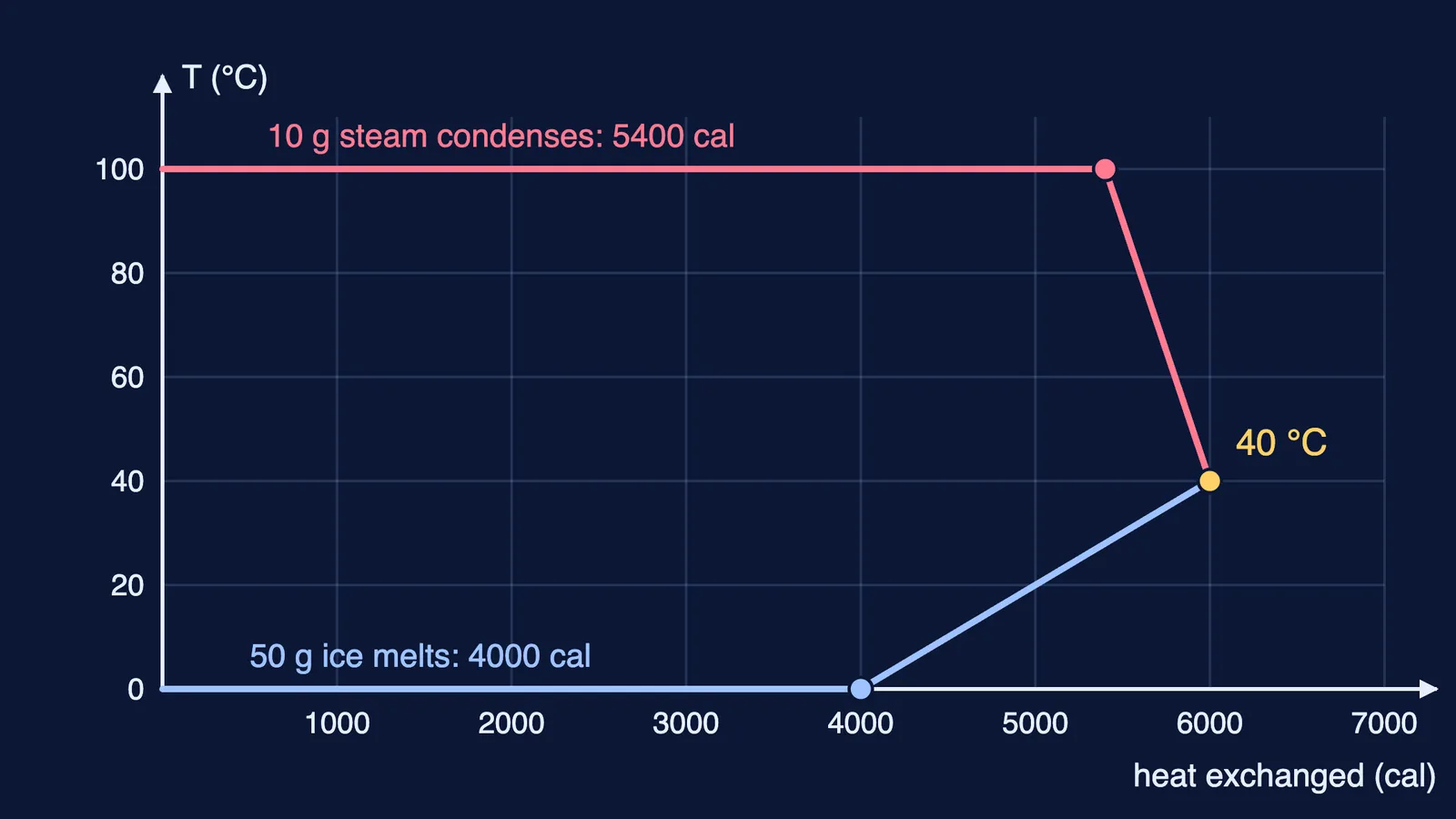
Q7 (hard, numerical value). 10 g of steam at 100 °C is passed into 50 g of ice at 0 °C in a container of negligible heat capacity. Latent heats: 540 cal/g (vaporisation), 80 cal/g (fusion); water's specific heat is 1 cal/(g °C). Find the final temperature in °C.
Answer: 40. All the ice melts, since the steam can give up to 6400 cal and melting needs 4000 cal. Then 10 × 540 + 10 × (100 − T) = 50 × 80 + 50 × T, so 2400 = 60T and T = 40 °C.
Trap: 28, from forgetting that the condensed water also cools from 100 °C.
Q8 (hard). A uniform steel wire 4.0 m long, of mass 2.0 kg and cross-section 1.0 mm², hangs from a ceiling with a 10 kg block at its lower end. Take Y = 2.0 × 10¹¹ N/m² and g = 10 m/s². What is the total extension of the wire?
(A) 2.0 mm (B) 2.2 mm (C) 2.4 mm (D) 4.4 mm
Answer: (B). Tension falls from (M + m)g at the top to Mg at the bottom, so the wire's weight acts as if half of it hung at the end. ΔL = (Mg + mg/2)L/(AY) = (100 + 10) × 4.0/(1.0 × 10⁻⁶ × 2.0 × 10¹¹) = 2.2 × 10⁻³ m.
Trap: (C) adds the whole 20 N of the wire's weight at the end; (A) ignores it.
What should you do after this set?
7 or 8 correct: try mixed problems, such as thermal stress in a clamped rod.
4 to 6 correct: redo the misses, then 15 fresh questions on those sub-topics.
Under 4: reread the NCERT sections first, with our Thermal Properties of Matter Class 11 guide if heat was the weak spot.
If one step keeps going wrong, the Fermi Problem Library has worked problems with a step-by-step solver that explains the reasoning rather than printing an answer.