On this page
Eight new NEET-style questions on electromagnetic waves, graded easy to hard. Each answer ends with the trap: the wrong option you are most likely to pick.
What does NEET cover in Electromagnetic Waves?
The NMC syllabus for NEET (UG)-2026 lists Electromagnetic Waves as Physics Unit 15: displacement current, the characteristics and transverse nature of electromagnetic waves, the spectrum from radio waves to gamma rays, and their applications. The textbook match is Chapter 8 of NCERT Class 12 Physics, marked Reprint 2026-27.
New to the chapter? Start with our guide on how to prepare Electromagnetic Waves for NEET.
How should you use this set?
In NEET-UG 2026, every question had four options and a single correct answer, marked +4 for a correct answer and −1 for a wrong one, according to the NTA information bulletin. So practise the way you will sit the paper:
Cover the answers and give yourself 10 minutes for all eight.
Skip any question you cannot start within 20 seconds.
Read every trap line, even for questions you got right.
Take c = 3 × 10⁸ m/s throughout (the exact value is 299 792 458 m/s).
Easy: spectrum, uses and field amplitudes
Q1 (easy). An electromagnetic wave has a frequency of 1.5 × 10¹³ Hz. It belongs to:
(A) microwaves (B) infrared (C) visible light (D) ultraviolet
Answer: (B). λ = c/ν = 3 × 10⁸/(1.5 × 10¹³) = 2.0 × 10⁻⁵ m = 20 μm. NCERT Table 8.1 puts infrared at 1 mm to 700 nm, so 20 μm is infrared. Trap: (A), because 20 μm sounds long. Microwaves start at 1 mm, 50 times longer.
Q2 (easy). Which pairing of radiation and use is incorrect?
(A) Microwaves: radar for aircraft navigation (B) Infrared: lamps for physical therapy (C) X-rays: killing germs in water purifiers (D) Gamma rays: destroying cancer cells
Answer: (C). Water purifiers use ultraviolet lamps to kill germs. X-rays are used for medical diagnosis and some cancer treatment. Trap: (D) looks wrong if you link cancer treatment only with X-rays, but NCERT lists gamma rays for destroying cancer cells too.
Q3 (easy). A plane electromagnetic wave in vacuum has an electric field amplitude of 66 V/m. The amplitude of its magnetic field is:
(A) 22 nT (B) 220 nT (C) 2.2 μT (D) 2.0 × 10¹⁰ T
Answer: (B). B₀ = E₀/c = 66/(3 × 10⁸) = 2.2 × 10⁻⁷ T = 220 nT. Trap: (D) multiplies by c instead of dividing.
Medium: direction, media and the wave equation
Q4 (medium). At a point in a plane electromagnetic wave, the electric field points along +x and the magnetic field along −z. The wave travels along:
(A) +y (B) −y (C) +z (D) −x
Answer: (A). The wave travels along E × B. Since x̂ × ẑ = −ŷ, x̂ × (−ẑ) = +ŷ. Trap: (B) drops the minus sign on B and gives x̂ × ẑ = −ŷ.
Q5 (medium). Green light of wavelength 520 nm in vacuum enters a non-magnetic transparent medium of relative permittivity 1.69. Its frequency and wavelength inside the medium are:
(A) 5.77 × 10¹⁴ Hz, 400 nm (B) 4.44 × 10¹⁴ Hz, 400 nm (C) 5.77 × 10¹⁴ Hz, 676 nm (D) 5.77 × 10¹⁴ Hz, 308 nm
Answer: (A). ν = c/λ = 5.77 × 10¹⁴ Hz, and the frequency does not change in the medium. With μr = 1, v = c/√εr = c/1.3, so λ = 520/1.3 = 400 nm. Trap: (D) divides by εr instead of √εr.
Q6 (medium). The electric field of a wave in vacuum is E_y = (36 V/m) sin(40πx − ωt), with x in metres. The magnetic field amplitude and the frequency of the wave are:
(A) 1.2 × 10⁻⁷ T, 6.0 GHz (B) 1.2 × 10⁻⁷ T, 37.7 GHz (C) 1.08 × 10¹⁰ T, 6.0 GHz (D) 1.2 × 10⁻⁷ T, 20 Hz
Answer: (A). k = 40π rad/m, so λ = 2π/k = 0.05 m and ν = c/λ = 6.0 GHz, a microwave. B₀ = 36/(3 × 10⁸) = 1.2 × 10⁻⁷ T. Trap: (B) reads λ as 1/k and forgets the 2π.
Hard: displacement current and statements
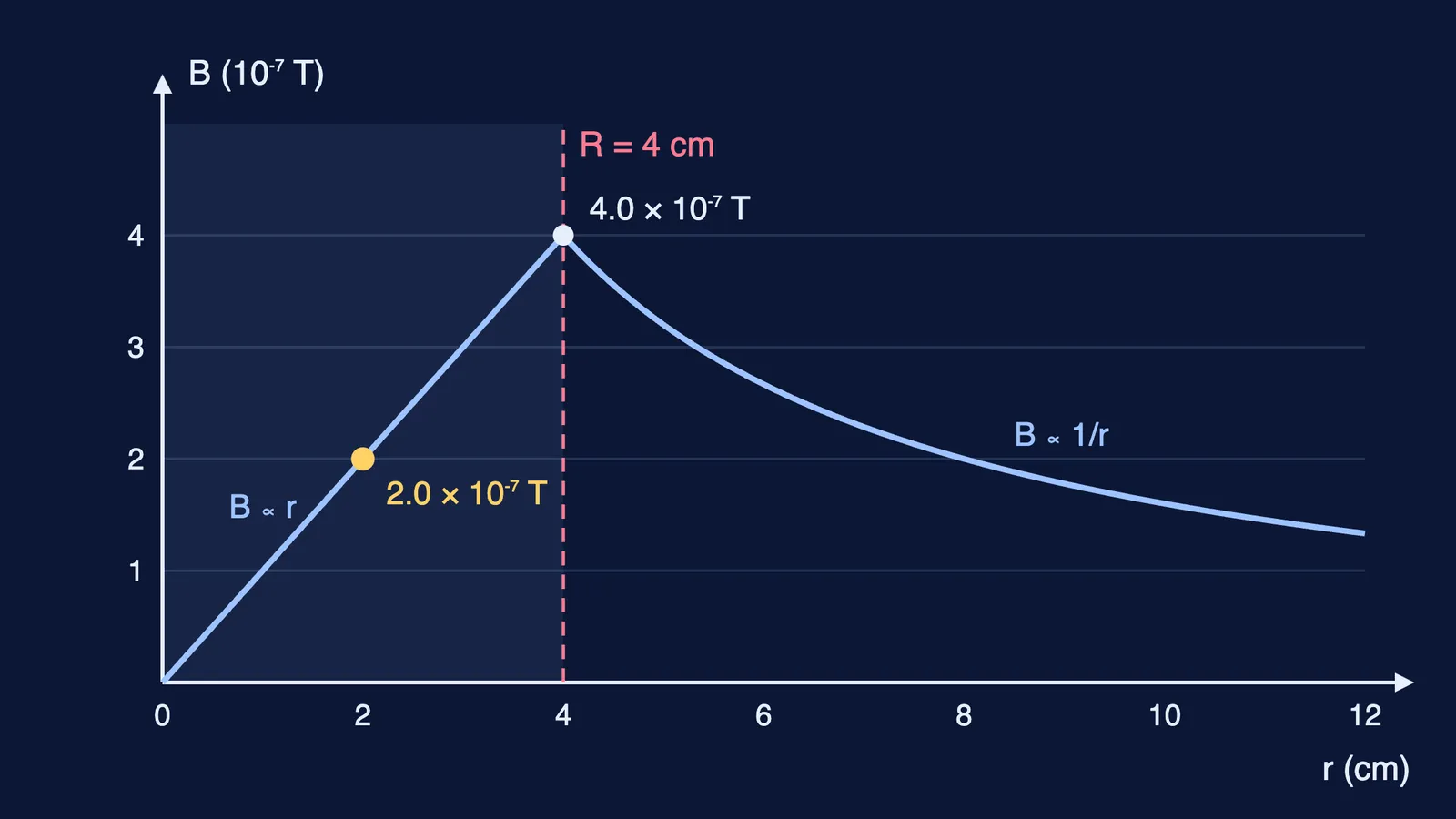
Q7 (hard). A parallel-plate capacitor has circular plates of radius 4.0 cm. While it charges, the electric field between the plates rises at 1.8 × 10¹² V m⁻¹ s⁻¹. Ignoring edge effects, the magnetic field between the plates at 2.0 cm from the axis is:
(A) zero (B) 2.0 × 10⁻⁷ T (C) 4.0 × 10⁻⁷ T (D) 8.0 × 10⁻⁷ T
Answer: (B). The total displacement current is i_d = ε₀πR² dE/dt ≈ 0.080 A. A loop of radius 2.0 cm encloses a quarter of the plate area, so a quarter of i_d. Ampere-Maxwell gives B = μ₀(i_d/4)/(2π × 0.020) = 2.0 × 10⁻⁷ T. Trap: (D) puts the whole i_d inside the smaller loop.
Q8 (hard). Consider these statements about electromagnetic waves:
(a) A displacement current exists only where the electric field changes with time.
(b) In vacuum, X-rays travel faster than radio waves.
(c) In a plane wave in vacuum, the electric and magnetic fields reach their maxima at the same place and time.
(d) Ordinary glass absorbs ultraviolet, so you cannot get sunburnt through a glass window.
The correct statements are:
(A) (a) and (c) only (B) (a), (c) and (d) only (C) (b) and (d) only (D) all four
Answer: (B). i_d = ε₀ dΦE/dt is zero for a steady field, so (a) holds. E and B oscillate in phase, so (c) holds, and NCERT states (d) directly. All electromagnetic waves travel at c in vacuum, so (b) is false. Trap: (D) assumes higher frequency means higher speed.
What should you do after checking your answers?
Sort each miss into one of three groups: spectrum facts (Q1, Q2, Q8), relations and units (Q3, Q5, Q6) or direction and displacement current (Q4, Q7). For fact errors, rewrite NCERT Table 8.1 from memory.
Redo every miss two days later without notes. If a method keeps breaking at the same step, the Fermi Problem Library has worked problems with a step-by-step solver that explains the reasoning rather than printing an answer.
Next, carry v = c/n into our Optics for NEET guide and the ray optics NEET practice questions.