On this page
Most ray optics marks are lost on signs, units and using the right formula in the wrong medium. These 8 questions are built to catch those slips.
The NEET (UG)-2026 syllabus from the National Medical Commission lists mirrors, refraction, the thin lens and lens maker formulas, total internal reflection, lens power and the prism under Unit 16 Optics. Every question stays inside it.
How should you use these ray optics questions?
Cover the solutions; allow about 90 seconds each.
Write u, v, f and R with signs before you put in any numbers.
Read each solution and trap, and note which trap caught you.
If a step does not make sense, the Fermi Problem Library has worked problems with a step-by-step solver that explains the reasoning rather than printing an answer. For the chapter plan, read how to prepare optics for NEET.
Easy: can you get mirror and lens signs right?
Q1 (easy). An object is placed 18 cm in front of a concave mirror of focal length 12 cm. Where is the image, and what is it like?
(A) 7.2 cm behind the mirror, virtual (B) 36 cm in front of the mirror, real, inverted, twice the size (C) 36 cm behind the mirror, virtual, upright (D) 6 cm in front of the mirror, real, diminished
Answer: (B). With u = −18 cm and f = −12 cm, 1/v = 1/f − 1/u = −1/12 + 1/18 = −1/36, so v = −36 cm: the image is real and in front of the mirror. Magnification m = −v/u = −2, so it is inverted and twice the size. Trap: (A) drops the signs.
Q2 (easy). A coin lies at the bottom of a tank filled with water (n = 4/3) to a depth of 48 cm. Seen from directly above, by how much does the coin appear to be raised?
(A) 36 cm (B) 64 cm (C) 12 cm (D) 16 cm
Answer: (C). Apparent depth = real depth/n = 48 ÷ (4/3) = 36 cm, so the coin appears raised by 48 − 36 = 12 cm. Trap: (A) is the apparent depth itself; the question asks for the shift.
Q3 (easy). A thin convex lens of focal length 25 cm is placed in contact with a thin concave lens of focal length 40 cm. What is the power of the combination?
(A) +6.5 D (B) −1.5 D (C) +0.015 D (D) +1.5 D
Answer: (D). Convert to metres first: P = 1/0.25 − 1/0.40 = 4 − 2.5 = +1.5 D. Trap: (C) uses focal lengths in centimetres, and (A) adds the powers without the concave lens's minus sign.
Medium: what changes when the medium changes?
Q4 (medium). A glass block (n = 1.5) is fully immersed in water (n = 4/3). A ray inside the glass meets the glass–water surface at an angle of incidence of 60°. What happens?
(A) Total internal reflection, because 60° is more than 41.8° (B) Total internal reflection, because 60° is more than 48.6° (C) It refracts into the water, because 60° is less than the critical angle of about 63° (D) It grazes along the surface at 90°
Answer: (C). For glass to water, sin C = n(water)/n(glass) = (4/3)/1.5 = 8/9, so C ≈ 62.7°. Since 60° is smaller, the ray refracts into the water. Trap: (A) uses the glass–air critical angle, but the surrounding water raises it.
Q5 (medium). An equiconvex glass lens (n = 1.5) has a focal length of 24 cm in air. What is its focal length when it is immersed in a liquid of refractive index 1.25?
(A) 30 cm (B) 48 cm (C) 9.6 cm (D) 60 cm
Answer: (D). From the lens maker formula, 1/f is proportional to (n(lens)/n(medium) − 1). In air this factor is 0.5; in the liquid it is 1.5/1.25 − 1 = 0.2. So f(liquid) = 24 × 0.5/0.2 = 60 cm. Trap: (B) uses n(lens) − n(medium) = 0.25 instead of the ratio, and (C) flips the ratio. See also why a convex lens's focal length grows in water.
Hard: can you handle prisms and curved surfaces?
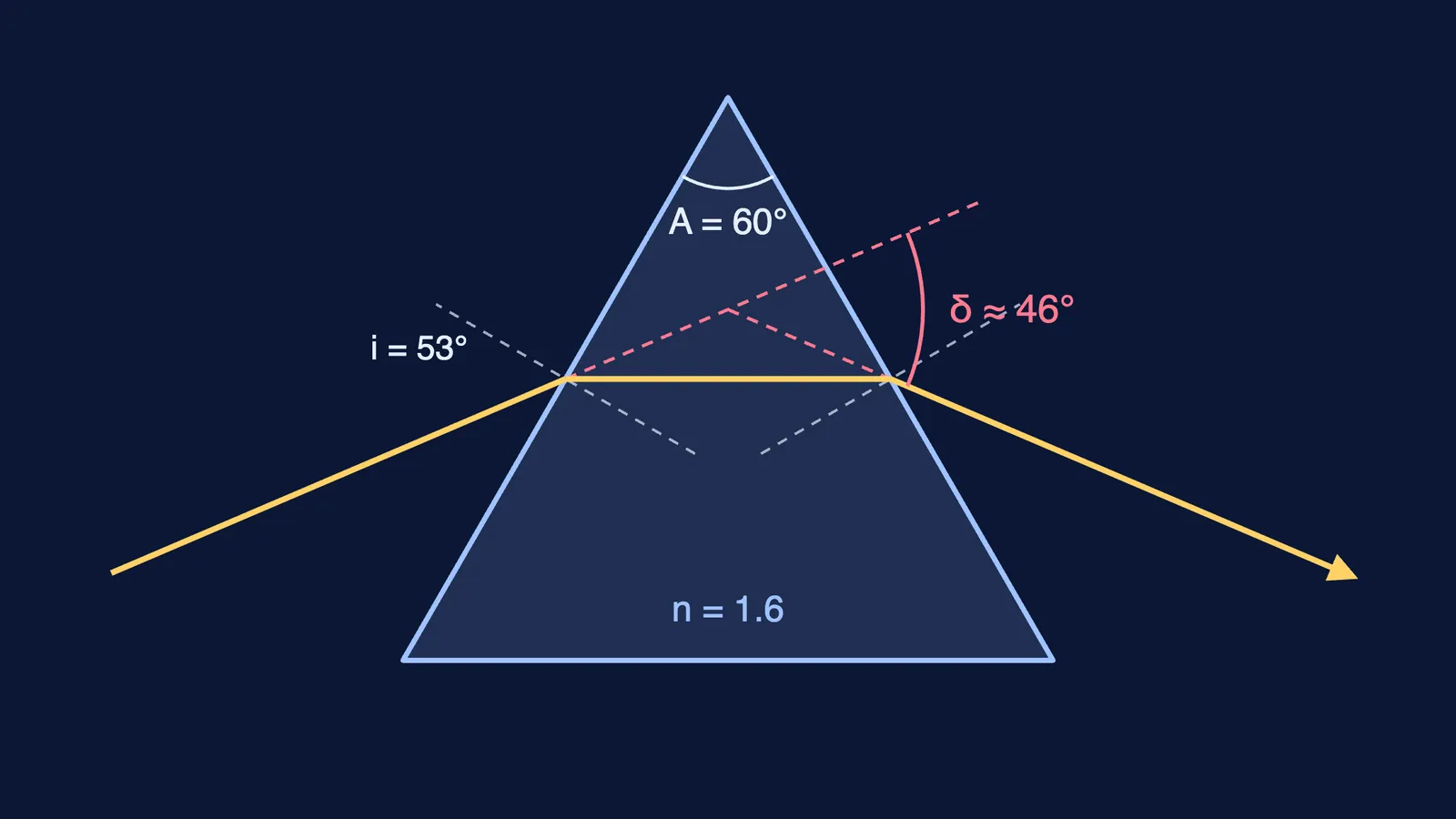
Q6 (hard). A prism with refracting angle 60° is made of glass of refractive index 1.6. What is its angle of minimum deviation?
(A) 36° (B) 46° (C) 53° (D) 106°
Answer: (B). At minimum deviation r = A/2 = 30°, so sin i = 1.6 × sin 30° = 0.8 and i ≈ 53.1°. Then δm = 2i − A ≈ 106.3° − 60° ≈ 46°. Trap: (A) uses δ = (n − 1)A, which only works for thin prisms with small angles.
Q7 (hard). An object and a screen are fixed 80 cm apart. A convex lens placed between them forms a sharp image on the screen at two positions that are 40 cm apart. What is the focal length of the lens?
(A) 20 cm (B) 25 cm (C) 15 cm (D) 30 cm
Answer: (C). The two positions swap u and v, so u + v = 80 and v − u = 40, giving u = 20 cm and v = 60 cm. Then 1/f = 1/20 + 1/60 = 1/15, so f = 15 cm. Trap: (A) is D/4, which holds only when the two positions merge into one; (B) adds d² instead of subtracting it in (D² − d²)/4D.
Q8 (hard). A glass sphere (n = 1.5) of radius 12 cm has a small air bubble 4 cm inside it, on a diameter. Viewed from the nearer side along that diameter, how far below the surface does the bubble appear?
(A) 2.7 cm (B) 3.0 cm (C) 2.4 cm (D) 6.0 cm
Answer: (B). Light goes from glass to air, so n1 = 1.5, n2 = 1, u = −4 cm, and R = −12 cm because the centre is on the glass side. Using n2/v − n1/u = (n2 − n1)/R: 1/v + 0.375 = 1/24, so 1/v = −1/3 and v = −3 cm. Trap: (A) treats the surface as flat (4 ÷ 1.5); (C) takes R as +12 cm; (D) multiplies by n instead of dividing.
Redo the ones you missed after two days.