On this page
NEET kinetics questions are short, but each hides a slip: a unit read wrongly, a stoichiometric factor dropped, or a 2.303 put in the wrong place. These 8 original questions target those slips, easy to hard.
The NEET (UG)-2026 syllabus notified by the National Medical Commission lists Chemical Kinetics as Unit 8 of Physical Chemistry. It covers rate laws, order and molecularity, units of k, zero and first-order half-lives and the Arrhenius equation. Every question below stays inside that list and inside NCERT Class 12 Chemistry, Unit 3 Chemical Kinetics (Reprint 2026-27).
How should you use this chemical kinetics practice set?
Cover the answers and give yourself about a minute per question.
Write the order and the formula you will use before you touch a number.
Read the solution and the trap even when you got it right.
Note each trap that caught you; redo those in three days.
For the full chapter plan, read how to prepare Chemical Kinetics for NEET.
Easy: can you read rates, units and orders?
Q1 (easy). A reaction with a single reactant A has k = 3.2 × 10⁻³ L mol⁻¹ min⁻¹. If [A] is doubled, by what factor does the rate change?
(A) 1 (B) 2 (C) 4 (D) 8
Answer: (C). The units of k are (mol L⁻¹)¹⁻ⁿ time⁻¹. Here the concentration part is (mol L⁻¹)⁻¹, so n = 2 and rate = k[A]²; doubling [A] gives 2² = 4. Trap: (B) comes from seeing min⁻¹ and reading first order.
Q2 (easy). For the reaction 2X + Y → 3Z, the concentration of Z rises at 0.012 mol L⁻¹ s⁻¹. At what rate does X disappear?
(A) 0.018 mol L⁻¹ s⁻¹ (B) 0.008 mol L⁻¹ s⁻¹ (C) 0.004 mol L⁻¹ s⁻¹ (D) 0.012 mol L⁻¹ s⁻¹
Answer: (B). Rate of reaction = ⅓ d[Z]/dt = 0.004 mol L⁻¹ s⁻¹, and −d[X]/dt = 2 × 0.004 = 0.008 mol L⁻¹ s⁻¹. Trap: (A) multiplies by 3/2 instead of 2/3, and (C) is the rate of reaction, not the rate for X.
Q3 (easy). Which statement about order and molecularity is correct?
(A) Molecularity can be zero for a surface reaction. (B) Order is found by experiment and can be a fraction. (C) The order of any reaction equals the sum of the coefficients in its balanced equation. (D) Molecularity is defined for complex reactions.
Answer: (B). NCERT states that order is an experimental quantity that can be zero or a fraction, while molecularity applies only to elementary reactions and cannot be zero or a non-integer. Trap: (C) is the most common one; the balanced equation does not give the rate law.
Medium: which integrated law fits the question?
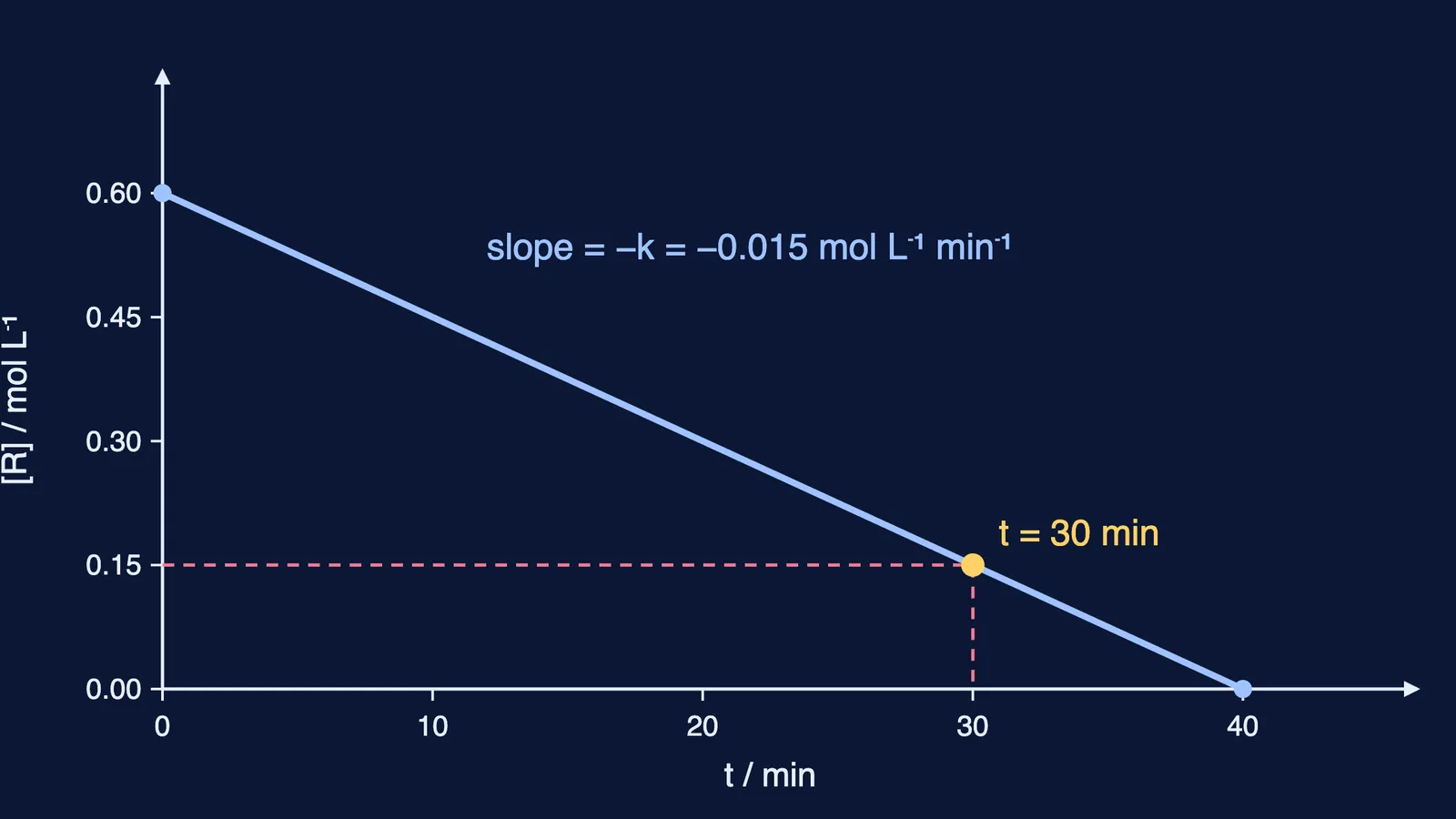
Q4 (medium). A gas decomposes on a hot metal surface by zero-order kinetics with k = 0.015 mol L⁻¹ min⁻¹. Its starting concentration is 0.60 mol L⁻¹. How long until it falls to 0.15 mol L⁻¹?
(A) 40 min (B) 92 min (C) 30 min (D) 10 min
Answer: (C). For zero order, kt = [R]₀ − [R], so t = (0.60 − 0.15)/0.015 = 30 min. Trap: (A) is the time for the gas to run out completely, and (B) uses the first-order formula.
Q5 (medium). A first-order reaction has a half-life of 12 min. About how long does it take to reach 90% completion?
(A) 21.6 min (B) 17.3 min (C) 40 min (D) 1.8 min
Answer: (C). k = 0.693/12 = 0.0578 min⁻¹. For 90% completion, [R]₀/[R] = 10, so t = (2.303/k) log 10 = 2.303/0.0578 ≈ 40 min. Check: three half-lives (36 min) leave 12.5%, so 10% needs a little longer. Trap: (A) assumes the concentration falls in a straight line, and (B) drops the 2.303 while using log.
Q6 (medium). A gas-phase reaction follows rate = k[X]²[Y]. At constant temperature the gas mixture is compressed to one third of its volume. How does the rate change?
(A) It rises 9 times (B) It falls to 1/27 (C) It rises 3 times (D) It rises 27 times
Answer: (D). One third of the volume triples every concentration, so the rate changes by 3² × 3 = 27. Trap: (A) triples only X and forgets Y; (B) assumes a smaller volume slows the reaction.
Hard: can you handle temperature and catalysts?
Q7 (hard). For a reaction, a plot of log k against 1/T is a straight line with slope −4.0 × 10³ K. What is the activation energy? (R = 8.314 J K⁻¹ mol⁻¹)
(A) 33.3 kJ mol⁻¹ (B) 76.6 kJ mol⁻¹ (C) 18.3 kJ mol⁻¹ (D) 1.1 kJ mol⁻¹
Answer: (B). From the Arrhenius equation, log k = log A − Eₐ/(2.303RT), so the slope is −Eₐ/2.303R. Eₐ = 2.303 × 8.314 × 4000 ≈ 76.6 kJ mol⁻¹. Trap: (A) uses the ln k slope (−Eₐ/R) for a log k plot; (C) uses R in calories but reports kilojoules.
Q8 (hard). At 300 K, a catalyst lowers the activation energy of a reversible reaction by 10 kJ mol⁻¹. Assume the pre-exponential factor A is unchanged. Which statement is correct?
(A) The forward rate rises about 55 times and the equilibrium constant rises 55 times. (B) The forward and backward rates both rise about 55 times; the equilibrium constant is unchanged. (C) Only the forward rate rises about 55 times. (D) The forward rate rises about 4 times; the equilibrium constant is unchanged.
Answer: (B). The rate ratio is e^(ΔEₐ/RT) = e^(10000/(8.314 × 300)) = e^4.01 ≈ 55. The catalyst lowers the barrier by the same amount in both directions, so both rates rise equally. NCERT notes that a catalyst does not change the equilibrium constant; equilibrium is only reached sooner. Trap: (D) stops at the exponent 4.01 and forgets to take e to that power.
What should you do after this set?
Sort every miss into one bin: units, choosing the law, or log and 2.303.
If most misses are in choosing the law, rewrite the zero and first-order rows of NCERT Table 3.4 from memory.
For more practice on a weak step, the Fermi Problem Library has worked problems with a step-by-step solver that explains the reasoning rather than printing an answer.
For the board exam, see Chemical Kinetics Class 12: board answers, traps and a plan. Our Chemical Kinetics guide for JEE Main covers the longer problems.