On this page
These eight NEET-UG Biology questions were written for this post rather than taken from NCERT, exemplar or past papers. They move from naming a phase to tracking chromosomes, chromatids and DNA across a whole cell lineage, and each answer names the trap behind the most tempting wrong option.
What does NEET ask from cell cycle and cell division?
The NEET (UG)-2026 syllabus from the National Medical Commission lists "Cell cycle, mitosis, meiosis and their significance" under Biology Unit 3. Every fact in this set comes from Chapter 10 of the NCERT Class 11 Biology book, Reprint 2026-27. New to the chapter? Start with our guide on how to prepare cell cycle and cell division for NEET, or the Class 11 chapter walkthrough if you want the theory first.
How should you use this practice set?
Cover the answer and give yourself about a minute per question.
For any counting question, write chromosome number (n) and DNA content (C) side by side before you choose.
Read the trap even when you were right.
Keep a list of the traps that caught you; that list is your revision sheet.
If n and 2n still blur, our explainer on haploid vs diploid cells sorts them out. If a whole idea feels shaky rather than one step, the Fermi Concept Library covers every concept in biology, each with its own lesson.
Easy: can you place each event in the right phase?
All three answers are statements in NCERT Chapter 10.
Q1 (easy). An animal cell has just begun replicating its DNA in the nucleus. Which event does NCERT place in its cytoplasm in the same phase?
(A) Asters form around each centrosome (B) The centriole duplicates (C) Sister chromatids separate (D) A cleavage furrow appears
Answer: (B). NCERT says that in animal cells, during S phase, DNA replication begins in the nucleus and the centriole duplicates in the cytoplasm. Trap: (A) happens in prophase, around centrosomes that were already duplicated in S phase, so it is easy to mistake for duplication.
Q2 (easy). Which of these cells divides by mitosis even though it is haploid?
(A) A diploid onion root-tip cell (B) An adult human heart cell (C) A human zygote (D) A body cell of a male honey bee
Answer: (D). NCERT gives male honey bees as an exception where haploid animal cells divide by mitosis. Heart cells sit in G0 and do not divide. Trap: (A) does divide by mitosis, but it is diploid; read both conditions in the stem.
Q3 (easy). In an onion root-tip squash (16 chromosomes per cell, per NCERT), you want to count chromosomes, each seen as two sister chromatids joined at a centromere. Which cells should you pick?
(A) Metaphase (B) Early prophase (C) Anaphase (D) Telophase
Answer: (A). Condensation is complete and the chromosomes sit on the metaphase plate, the stage at which NCERT says chromosome morphology is most easily studied. Trap: (C) shows 32 separated daughter chromosomes moving apart, not 16 paired chromatids.
Medium: how do chromosome number and DNA change?
Use the NCERT rule from section 10.1: S phase doubles DNA from 2C to 4C while the chromosome number stays 2n (NCERT Chapter 10).
Q4 (medium). A plant has 2n = 18, and each daughter cell after mitosis has 2C of DNA. What does one cell have in G2?
(A) 18 chromosomes, 2C (B) 18 chromosomes, 4C (C) 36 chromosomes, 4C (D) 36 chromosomes, 2C
Answer: (B). S phase doubles DNA to 4C but adds no centromeres, so the count stays 18. Trap: (C) counts sister chromatids as separate chromosomes; they share one centromere until anaphase.
Q5 (medium). An animal has 2n = 14 and 2C of DNA in G1. A cell completes meiosis I, including cytokinesis. What does each daughter cell have?
(A) 7 chromosomes, C (B) 14 chromosomes, 2C (C) 7 chromosomes, 2C (D) 14 chromosomes, 4C
Answer: (C). In anaphase I homologues separate with both chromatids, so each cell gets 7 chromosomes and half of 4C, which is 2C. There is no DNA replication in interkinesis. Trap: (A) is the state after meiosis II, not meiosis I.
Q6 (medium). Arrange these prophase I events in order: (i) chiasmata terminalise (ii) recombination nodules appear (iii) the synaptonemal complex dissolves (iv) homologous chromosomes begin synapsis.
(A) iv, iii, ii, i (B) ii, iv, iii, i (C) iv, ii, i, iii (D) iv, ii, iii, i
Answer: (D). Synapsis is zygotene, nodules are pachytene, dissolution of the complex marks the start of diplotene, and terminalisation is diakinesis. Trap: (A) assumes the complex must go before crossing over, but nodules appear while homologues are still synapsed.
Hard: can you track chromatids across a whole lineage?
Both questions combine NCERT's rules on anaphase I, anaphase II and the single round of DNA replication before meiosis (NCERT Chapter 10).
Q7 (hard). In an organism with 2n = 8, how many chromatids move towards each pole in anaphase I, and in anaphase II of one dividing cell?
(A) 4 and 4 (B) 8 and 4 (C) 8 and 8 (D) 16 and 8
Answer: (B). In anaphase I, 4 chromosomes go to each pole, each still with 2 chromatids: 8 chromatids. Each new cell holds 8 chromatids; in anaphase II the centromeres split and 4 go to each pole. Trap: (A) counts chromosomes in anaphase I instead of chromatids.
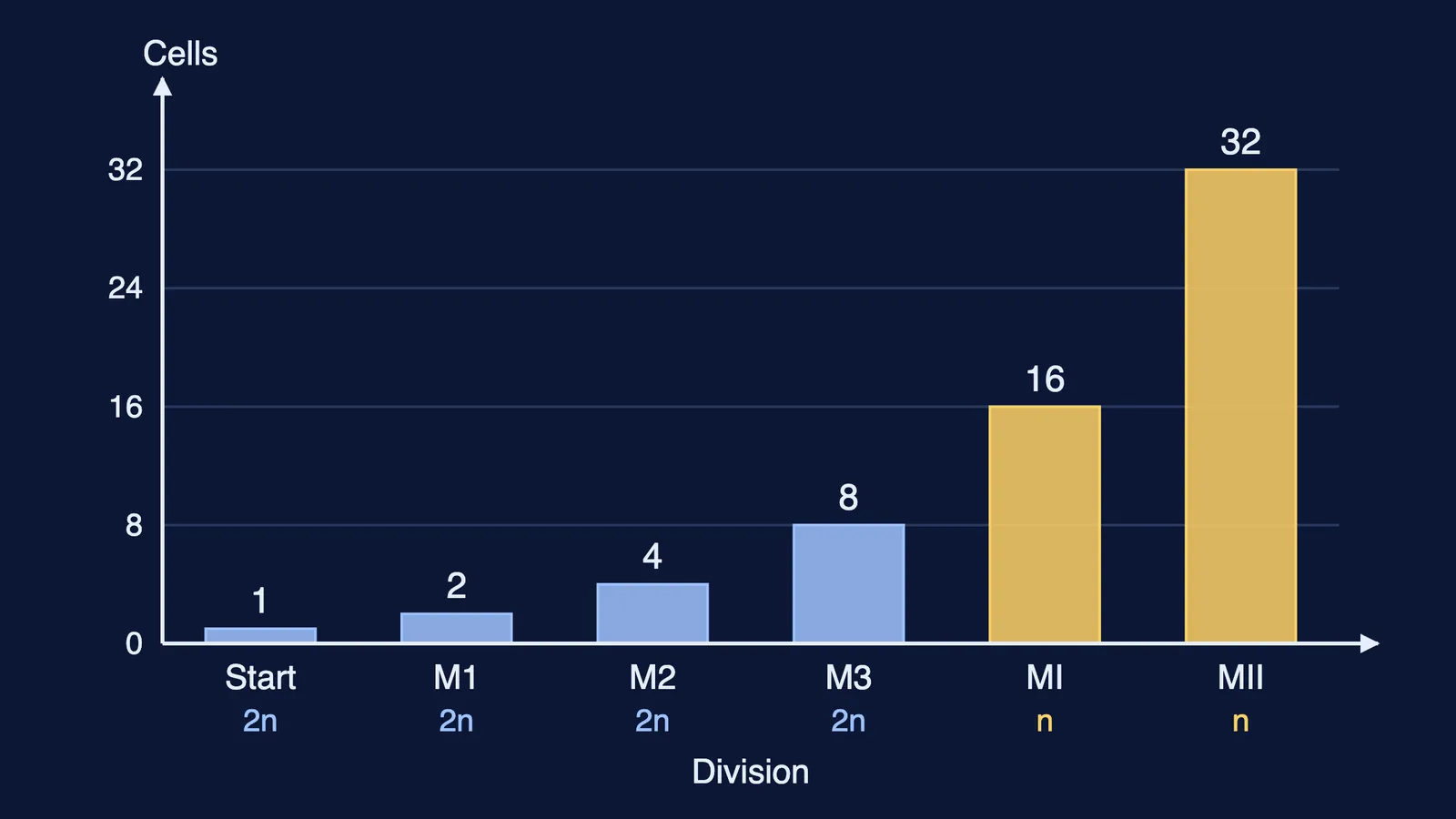
Q8 (hard). One diploid cell goes through three successive mitotic divisions, and every resulting cell then completes meiosis. How many haploid cells result, and how many S phases took place in the whole lineage?
(A) 32 cells, 15 S phases (B) 32 cells, 23 S phases (C) 64 cells, 15 S phases (D) 16 cells, 15 S phases
Answer: (A). The mitoses need 1 + 2 + 4 = 7 S phases and give 8 cells. Each of the 8 then replicates once and gives 4 haploid cells: 8 more S phases and 32 cells. Trap: (B) gives each meiosis two replications because it has two divisions; NCERT says meiosis has only a single cycle of DNA replication.
Got all eight? Rework Q7 and Q8 with 2n = 12 and four mitotic rounds before you move on.