On this page
These eight questions are written from scratch for this set. They climb from a one-step impulse question to friction on a banked road, and each answer names the trap behind the most tempting wrong option.
What does NEET cover in laws of motion?
Laws of Motion is Unit 3 of the physics syllabus in the NMC syllabus for NEET (UG)-2026, published by NTA. It covers Newton's laws, impulse, momentum conservation, friction, and circular motion on level and banked roads; every question stays inside it.
New to the chapter? Read our guide on how to prepare laws of motion for NEET first.
How should you use this practice set?
Cover the answers; allow one minute per easy question, two per hard one.
Draw a free-body diagram every time. Most traps are a missing or extra force.
Count a guess as wrong.
Use g = 10 m/s², sin 37° = 0.6, cos 37° = 0.8.
Easy: can you apply F = ma and impulse cleanly?
Q1 (easy). A 400 g ball moving at 15 m/s is hit straight back along the same line at 20 m/s. Contact lasts 0.02 s. What is the average force on the ball?
(A) 100 N (B) 700 N (C) 14 N (D) 350 N
Answer: (B). Take the return direction as positive; change in momentum = 0.4 × (20 − (−15)) = 14 N s. Average force = 14 / 0.02 = 700 N. Trap: (A) subtracts the speeds (20 − 15 = 5 m/s) and ignores the reversal of direction.
Q2 (easy). A 5 kg carton rests on a floor with μs = 0.4 and μk = 0.3. You push it sideways with 12 N. What is the friction force on the carton?
(A) 20 N (B) 15 N (C) 12 N (D) 0 N
Answer: (C). Limiting friction = μs mg = 0.4 × 50 = 20 N. The 12 N push is less, so the carton stays at rest and friction equals the push. Trap: (A) treats μs mg, the maximum, as the actual friction.
Q3 (easy). Touching blocks of 2 kg and 3 kg sit on a frictionless floor. A 20 N horizontal force pushes the 2 kg block into the 3 kg block. What force acts between them?
(A) 8 N (B) 20 N (C) 10 N (D) 12 N
Answer: (D). Common acceleration = 20 / 5 = 4 m/s². The contact force alone accelerates the 3 kg block: 3 × 4 = 12 N. Trap: (A) multiplies the acceleration by the wrong block's mass.
Medium: can you handle strings, curves and inclines?
Q4 (medium). Masses of 3 kg and 5 kg hang from a light string over an ideal pulley. What is the tension in the string?
(A) 30 N (B) 37.5 N (C) 40 N (D) 50 N
Answer: (B). Acceleration = (5 − 3) × 10 / 8 = 2.5 m/s². For the 3 kg mass moving up, T − 30 = 3 × 2.5, so T = 37.5 N. Trap: (C) averages the two weights.
Q5 (medium). A car takes a flat curve of radius 45 m with μs = 0.5 between tyres and road. What is the maximum speed without skidding?
(A) 54 km/h (B) 15 km/h (C) 76 km/h (D) 38 km/h
Answer: (A). Friction supplies the centripetal force: μmg = mv²/r, so v = √(μrg) = √(0.5 × 45 × 10) = 15 m/s = 54 km/h. Trap: (B) is the m/s value read as km/h.
Q6 (medium). A 2 kg block slides down a 37° incline with μk = 0.25. What is its acceleration?
(A) 6 m/s² (B) 4 m/s² (C) 3.5 m/s² (D) 8 m/s²
Answer: (B). Normal force = mg cos 37°, so friction = 0.25 × 2 × 10 × 0.8 = 4 N up the slope. Net force down the slope = 12 − 4 = 8 N, and a = 8 / 2 = 4 m/s². Trap: (C) uses friction = μmg, forgetting that the normal force on a slope is mg cos θ.
Hard: can you find limits where friction runs out?
Q7 (hard). Block A (2 kg) rests on block B (4 kg), which lies on a frictionless floor. μs between A and B is 0.3. A horizontal force F pulls the top block A. What is the largest F for which the two blocks move together?
(A) 6 N (B) 9 N (C) 12 N (D) 18 N
Answer: (B). Together, a = F / 6. Only friction drives B, so it must be 4F / 6. Maximum friction is 0.3 × 2 × 10 = 6 N, so 4F / 6 ≤ 6, giving F ≤ 9 N. Trap: (D) is the answer if F pulls the lower block (a = μg, F = 6 × 3).
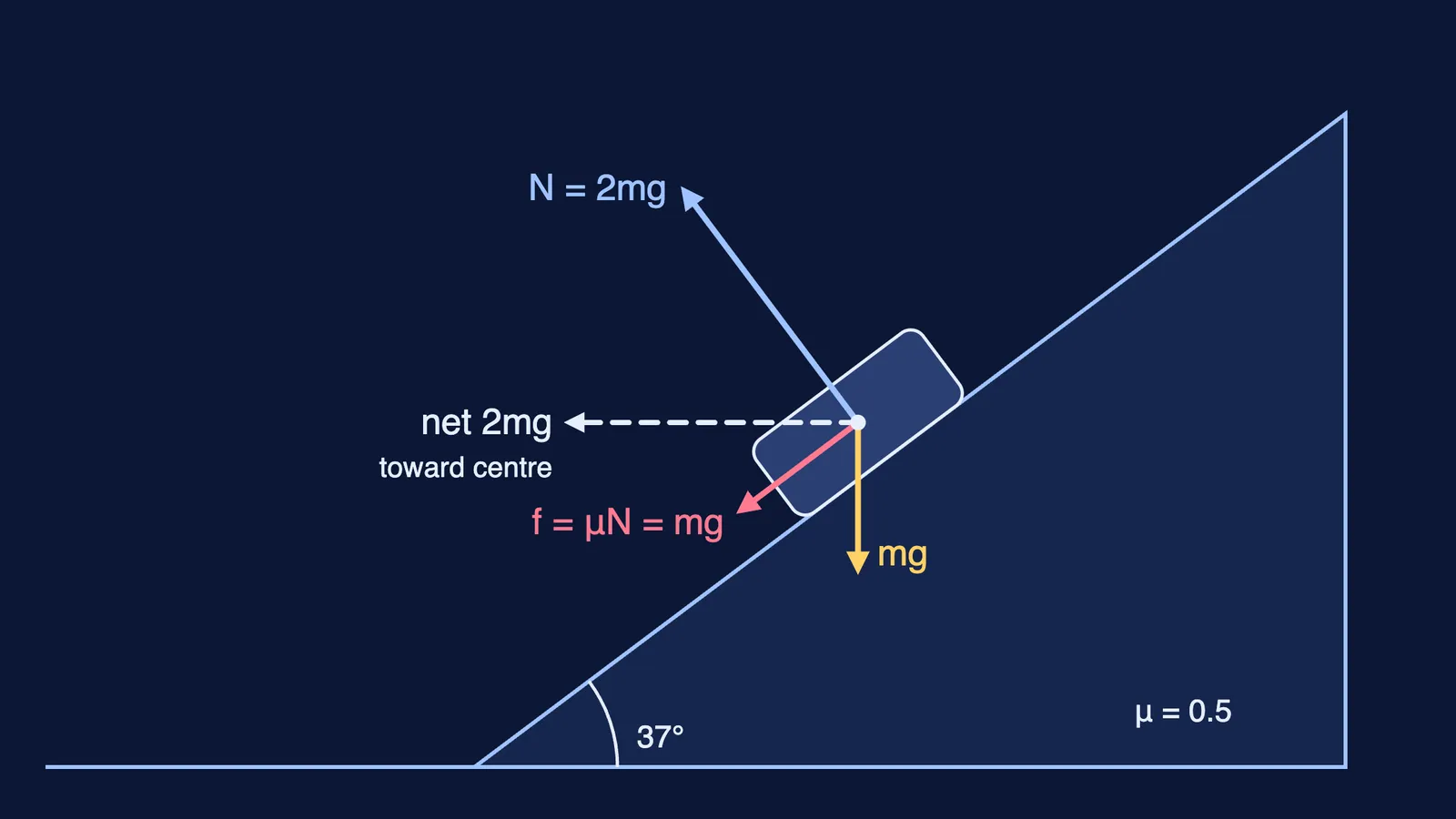
Q8 (hard). A curve of radius 20 m is banked at 37°, with μs = 0.5. What is the maximum speed a car can take without slipping outward?
(A) 6.0 m/s (B) 12.2 m/s (C) 15.8 m/s (D) 20 m/s
Answer: (D). At maximum speed, friction acts down the slope. Vertically: N cos θ − f sin θ = mg. Horizontally: N sin θ + f cos θ = mv²/r, with f = μN. Dividing gives v² = rg (tan θ + μ) / (1 − μ tan θ) = 200 × 1.25 / 0.625 = 400, so v = 20 m/s. Trap: (B) is √(rg tan θ), the no-friction speed, and (A) is the minimum speed, with friction acting up the slope.
The diagram at the top shows Q8's forces to scale; our post on the maximum safe speed on a banked road with friction derives the formula.
What should you do after this set?
Write each miss as one line: question, trap, correct step. Missed Q3 or Q7? Redo them with one diagram per block. Missed Q5 or Q8? Mark the direction of friction before any equation.
When a wrong method keeps coming back, the Fermi Problem Library has worked problems with a step-by-step solver that explains the reasoning rather than printing an answer. For the previous chapter, try our kinematics NEET practice questions with full solutions.