On this page
These eight questions cover chemical and ionic equilibrium for JEE Main, graded easy to hard. Each has a worked solution and a trap: the wrong option a hurried student is most likely to pick. All eight were written for this post.
The official JEE (Main) 2027 syllabus from NTA puts this chapter in Unit 6, Equilibrium: Kp and Kc, Le Chatelier's principle, ionization of water, the pH scale, common ion effect, hydrolysis of salts, solubility products and buffer solutions. All eight sit inside that list. If you are starting the chapter, read our guide on how to prepare equilibrium for JEE Main first.
How should you use this practice set?
According to the JEE (Main) 2027 information bulletin, Chemistry has 20 multiple-choice questions in Section A and 5 numerical-value questions in Section B, with +4 for a correct answer and −1 for a wrong one in both.
Set a timer for 16 minutes, about two minutes a question.
Write your option and one line of reasoning before reading the solution.
For each miss, write the trap in your own words. That line is your revision note.
Q5 is numerical: enter the nearest integer.
Easy: can you read K and pH straight off the data?
Q1 (easy). For PCl₅(g) ⇌ PCl₃(g) + Cl₂(g), Kc = 0.040 mol L⁻¹ at 500 K. Taking R = 0.0831 bar L mol⁻¹ K⁻¹, Kp at 500 K is about
(A) 9.6 × 10⁻⁴ bar (B) 0.040 bar (C) 1.66 bar (D) 3.32 bar
Answer: (C). Δn = 2 − 1 = +1, so Kp = Kc(RT) = 0.040 × 0.0831 × 500 = 1.66 bar. Trap: (A) divides by RT, the result of taking Δn as reactants minus products.
Q2 (easy). For the reaction X₂(g) + 3Y₂(g) ⇌ 2XY₃(g), ΔH is negative. Which change increases the value of the equilibrium constant?
(A) Adding a catalyst (B) Doubling the total pressure (C) Lowering the temperature (D) Adding argon at constant volume
Answer: (C). K changes only with temperature. For an exothermic reaction, cooling favours products, so K rises. Trap: (B) does make more XY₃, since the right side has fewer gas moles, but the concentration ratio settles back to the same K. A shift in position is not a change in K.
Q3 (easy). The pH of 0.0040 M Ba(OH)₂ at 298 K (Kw = 1.0 × 10⁻¹⁴) is
(A) 2.10 (B) 11.60 (C) 11.90 (D) 12.20
Answer: (C). Each Ba(OH)₂ gives two OH⁻, so [OH⁻] = 0.0080 M, pOH = 2.10 and pH = 14 − 2.10 = 11.90. Trap: (B) uses [OH⁻] = 0.0040 M and forgets the 2. (A) is the pOH, not the pH.
Medium: can you handle the algebra of K?
Q4 (medium). For 2X(g) + Y(g) ⇌ 2Z(g), Kc = 400 at a fixed temperature. At the same temperature, Kc for Z(g) ⇌ X(g) + ½Y(g) is
(A) 0.0025 (B) 0.05 (C) 20 (D) 200
Answer: (B). Reversing inverts K; halving the coefficients takes the square root: Kc = (1/400)^½ = 1/20 = 0.05. Trap: (A) inverts but forgets the square root. Our explainer on how K changes when a reaction is reversed or multiplied walks through both rules.
Q5 (medium, numerical). 0.50 mol of gas A is placed in an empty 2.0 L flask and heated. It sets up A(g) ⇌ B(g) + C(g) with Kc = 0.15 mol L⁻¹. Find the percentage of A that dissociates, to the nearest integer.
Answer: 53. Use concentration, not moles: [A]₀ = 0.25 M, so x²/(0.25 − x) = 0.15, so x² + 0.15x − 0.0375 = 0 and x = 0.133 M. Fraction dissociated = 0.133/0.25 = 0.53, so the answer is 53. Trap: putting 0.50 (moles) into Kc gives 42. Volume matters whenever Δn is not zero.
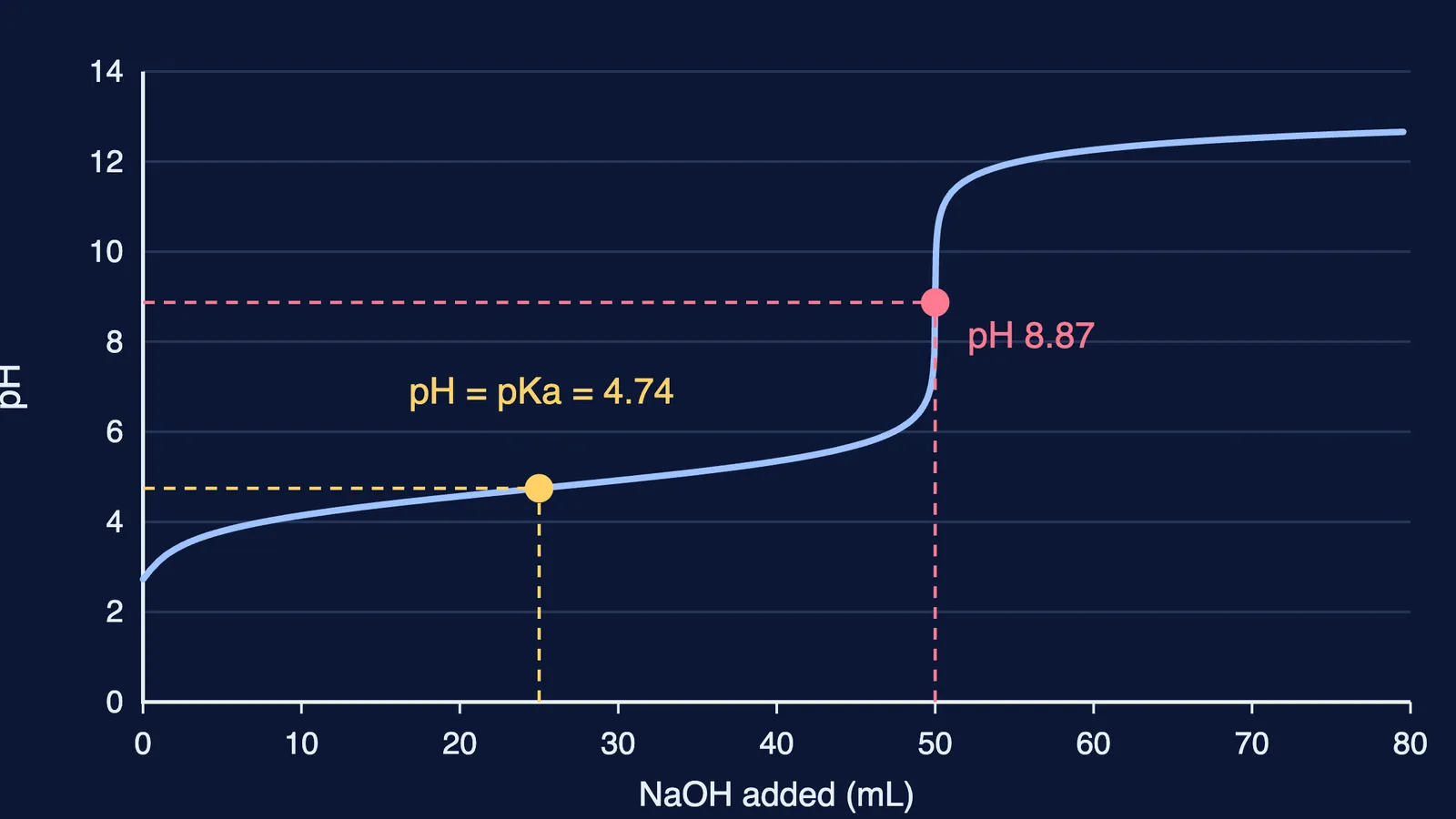
Q6 (medium). 25 mL of 0.20 M NaOH is added to 50 mL of 0.20 M acetic acid (Ka = 1.8 × 10⁻⁵) at 298 K. The pH of the mixture is
(A) 4.74 (B) 7.00 (C) 9.26 (D) 2.72
Answer: (A). NaOH neutralises half the acid, leaving equal moles of CH₃COOH and CH₃COO⁻, a buffer. pH = pKa + log([salt]/[acid]) = pKa + 0 = 4.74. Trap: (B) assumes acid plus base means neutral. (C) is pKb of acetate, a sign that pKa and pKb got swapped.
Hard: can you combine two ideas in one question?
Q7 (hard). A sparingly soluble salt MX₂ has Ksp = 4.0 × 10⁻¹² at 298 K. Its molar solubility in 0.10 M NaX solution is
(A) 1.0 × 10⁻⁴ M (B) 4.0 × 10⁻¹⁰ M (C) 1.0 × 10⁻¹⁰ M (D) 4.0 × 10⁻¹¹ M
Answer: (B). In pure water s would be (Ksp/4)^⅓ = 1.0 × 10⁻⁴ M. With 0.10 M X⁻ already present, Ksp = s(0.10 + 2s)² ≈ s(0.10)², so s = 4.0 × 10⁻¹² / 0.010 = 4.0 × 10⁻¹⁰ M. Trap: (C) doubles the 0.10 M as well. The factor 2 belongs to the X⁻ coming from the salt, not to the X⁻ you added.
Q8 (hard). 50 mL of 0.20 M acetic acid (Ka = 1.8 × 10⁻⁵) is titrated with 50 mL of 0.20 M NaOH at 298 K (Kw = 1.0 × 10⁻¹⁴). The pH at this point is
(A) 4.74 (B) 7.00 (C) 8.87 (D) 9.02
Answer: (C). This is the equivalence point: all the acid is now sodium acetate, and the volume has doubled, so c = 0.10 M. Acetate hydrolyses: Kb = Kw/Ka = 5.6 × 10⁻¹⁰, so [OH⁻] = √(Kb × c) = 7.5 × 10⁻⁶ M, pOH = 5.13 and pH = 8.87. Trap: (D) uses 0.20 M and forgets the dilution. (B) is the Q6 mistake again: a salt of a weak acid is basic, not neutral.
What should you do after this set?
Count traps, not marks. If you lost Q4 or Q5, practise writing K expressions before touching numbers; our piece on why equilibrium does not mean equal amounts helps with the intuition. If Q6 to Q8 tripped you up, redo them as one story: acid alone, half neutralised, fully neutralised.
When a method, not a fact, is the problem, the Fermi Problem Library has worked problems with a step-by-step solver that explains the reasoning rather than printing an answer.