On this page
Most JEE and NEET preparation is not exciting. Wanting a rank or a seat gets you started, but on a slow evening it often runs out.
A 2014 study tested a different kind of reason, one that reaches beyond you. Here is what it found, an exercise built from it, and its limits.
What is a self-transcendent purpose for learning?
In Yeager and colleagues' 2014 paper in the Journal of Personality and Social Psychology, a self-transcendent purpose for learning means studying partly so you can make a positive difference to other people or the world, not only for your own career or interest. The team, led by David Yeager with Angela Duckworth among the co-authors, titled the paper "Boring but important": their target was tedious work.
The exercise did not ask students to drop personal goals; it asked them to connect the two.
What did the "boring but important" study find?
The paper reports four studies with over 2,000 adolescents and young adults in the United States.
Grades. 338 Class 9 students at a California school did a 20-30 minute online session. In the next grading period their maths and science GPA, adjusted for earlier grades, was 3.04 out of 4, against 2.93 for a control group, a small effect; students who started below a 3.0 GPA gained about 0.2 grade points.
Boring revision. Before an exam, 71 college students spent about 49 seconds per review question after the purpose exercise, against 25 seconds for controls.
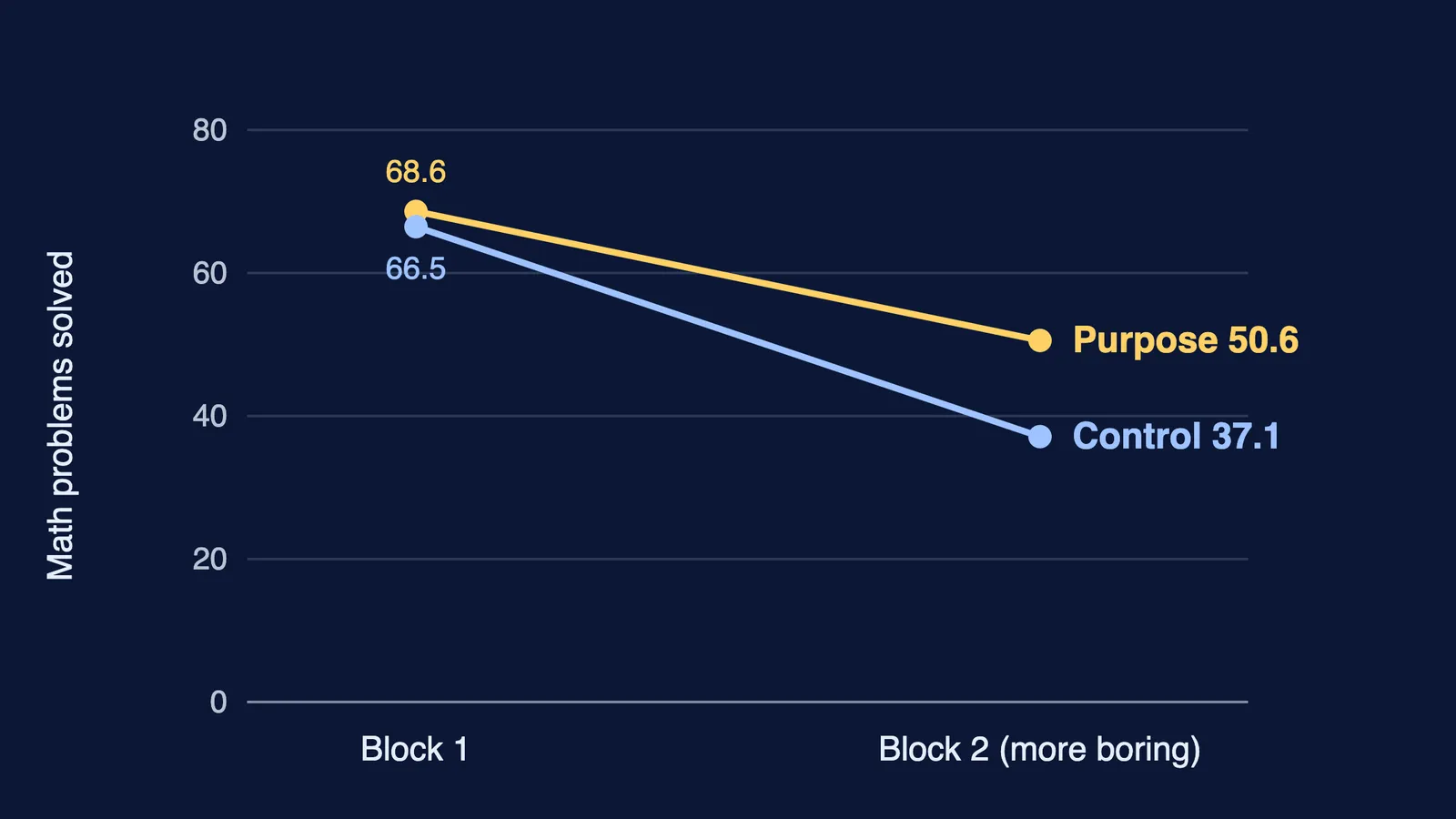
Boring maths with temptation. 429 university students solved easy maths problems with games and videos one click away. In the second, more boring block, the control group solved 44% fewer problems while the purpose group solved 26% fewer.
A closely matched version that stressed only personal benefits, such as an interesting career, did not reliably produce these gains in the same paper.
Where is the evidence weaker?
The effects were small, and the authors themselves wrote that the exercise is not a "magic bullet" for underachievement. It targets schoolwork feeling pointless, not a missing concept or lack of sleep.
Later work is mixed. A 2020 study by Jill Gandhi, Tyler Watts, Michael Masucci and C. Cybele Raver gave a purpose-for-learning writing exercise to low-income, ethnic minority adolescents and found a small negative effect on self-reported grades the following year and no effect on other outcomes. A 2021 field experiment led by Stephanie Reeves, with Yeager as a co-author, found, at one US middle school, that the exercise improved an English writing assignment only when a teacher's handwritten note made that purpose feel believable in class.
None of this was tested on Indian entrance-exam students. The original authors also flagged that feeling others are counting on you might hurt high-stakes performance, an open question. So point your purpose at learning, not at "I cannot let everyone down."
How do you write your purpose in 15 minutes?
This is our adaptation of the study's steps, not the researchers' exact material.
Minutes 0-5: What could be better? The original first prompt asked students how the world could be a better place. Pick something you have actually seen, like a long queue at a district hospital or a road that floods every monsoon.
Minutes 5-10: Connect it to your syllabus. In three sentences, link one chapter you are studying now to that problem.
Minutes 10-15: Write to a junior. The study ended with students writing a short note, usually 2-4 sentences, to future students about why learning mattered to them. Write yours to a Class 9 student. Keep both reasons, personal and bigger.
A NEET example: "My nani waited a whole day for a diagnosis. I want to be a doctor who reads a case quickly and explains it kindly. Today that means genetics PYQs. I also want a stable life, and that is fine too."
A JEE example: "Our street floods every July. I want to understand how water and structures behave. Fluid mechanics is the first step, so tonight I do twenty pressure problems."
How do you use it on a low day?
Keep it where the boring work happens, inside your formula notebook or PYQ register.
Reread it before the dull task, not after. In the study, the difference showed up in the most boring stretch.
Then start one small task. Pair it with a daily done-list of small wins, and if you still cannot begin, read why we procrastinate and how to take the first step.
Rewrite it monthly. If it reads like pressure, soften it, or connect it to the kind of person you want to be.
If the low day is about one problem you cannot crack, the Fermi Problem Library has worked problems with a step-by-step solver that explains the reasoning rather than printing an answer.
A purpose note helps with boredom, not lasting sadness, panic or hopelessness. If those go on for weeks, talk to a parent, teacher or school counsellor, or call Tele MANAS, the government's mental health helpline.
Write your note tonight; reread it before tomorrow's dullest task.