On this page
These eight NEET-UG Physics questions were written for this set. They run from one-line Ohm's law to a two-battery Kirchhoff circuit, and each answer names the trap behind the tempting wrong option.
What does NEET expect from Current Electricity?
The NEET (UG)-2026 syllabus from the National Medical Commission lists Current Electricity as Unit 12: drift velocity and mobility, Ohm's law, resistivity, resistor combinations, temperature dependence of resistance, internal resistance and emf, cell combinations, Kirchhoff's laws, the Wheatstone bridge and the metre bridge. Every question stays inside that list. New to the chapter? Start with our guide on how to prepare Current Electricity for NEET.
How should you use this practice set?
Cover the solution. Allow about a minute for easy questions and two for hard ones.
Write the equation you are using before putting in numbers.
Read the trap even when you were right.
Note every trap that caught you; that list is your revision sheet.
If one wrong method keeps catching you, the Fermi Problem Library has worked problems with a step-by-step solver that explains the reasoning rather than printing an answer.
Easy: Ohm's law, combinations and temperature
Q1 (easy). An electric kettle is rated 1.2 kW at 240 V. What is the resistance of its heating element at its rating?
(A) 0.2 Ω (B) 5 Ω (C) 48 Ω (D) 96 Ω
Answer: (C). R = V²/P = 240²/1200 = 48 Ω.
Trap: (B) is the current, P/V = 5 A, not the resistance.
Q2 (easy). A 6 Ω and a 3 Ω resistor in parallel are connected in series with a 4 Ω resistor across an ideal 12 V battery. What is the current through the 3 Ω resistor?
(A) 2/3 A (B) 4/3 A (C) 2 A (D) 4 A
Answer: (B). The pair is 2 Ω, the total 6 Ω, so the battery gives 2 A. The pair has 2 × 2 = 4 V across it, so the 3 Ω carries 4/3 A.
Trap: (A) is the current in the 6 Ω. In parallel, the smaller resistor takes the larger share.
Q3 (easy). A heater coil measures 40 Ω at 20 °C, with temperature coefficient 4.0 × 10⁻³ per °C. Using R = R₀(1 + αΔT), what is its resistance at 120 °C?
(A) 16 Ω (B) 28.6 Ω (C) 56 Ω (D) 59.2 Ω
Answer: (C). ΔT = 100 °C, so R = 40 × (1 + 0.4) = 56 Ω.
Trap: (D) uses 120 °C as ΔT. The formula needs the change, not the final temperature.
Medium: drift velocity and real cells
Q4 (medium). A copper wire carries a steady current. Over one short section its diameter is half that of the rest. What is the ratio of drift speed in the thin section to that in the thick section?
(A) 1/4 (B) 1/2 (C) 2 (D) 4
Answer: (D). The same current flows in both parts and I = neAv_d, so v_d is proportional to 1/A, that is, to 1/d². Halving d multiplies v_d by 4.
Trap: (C) uses diameter instead of area.
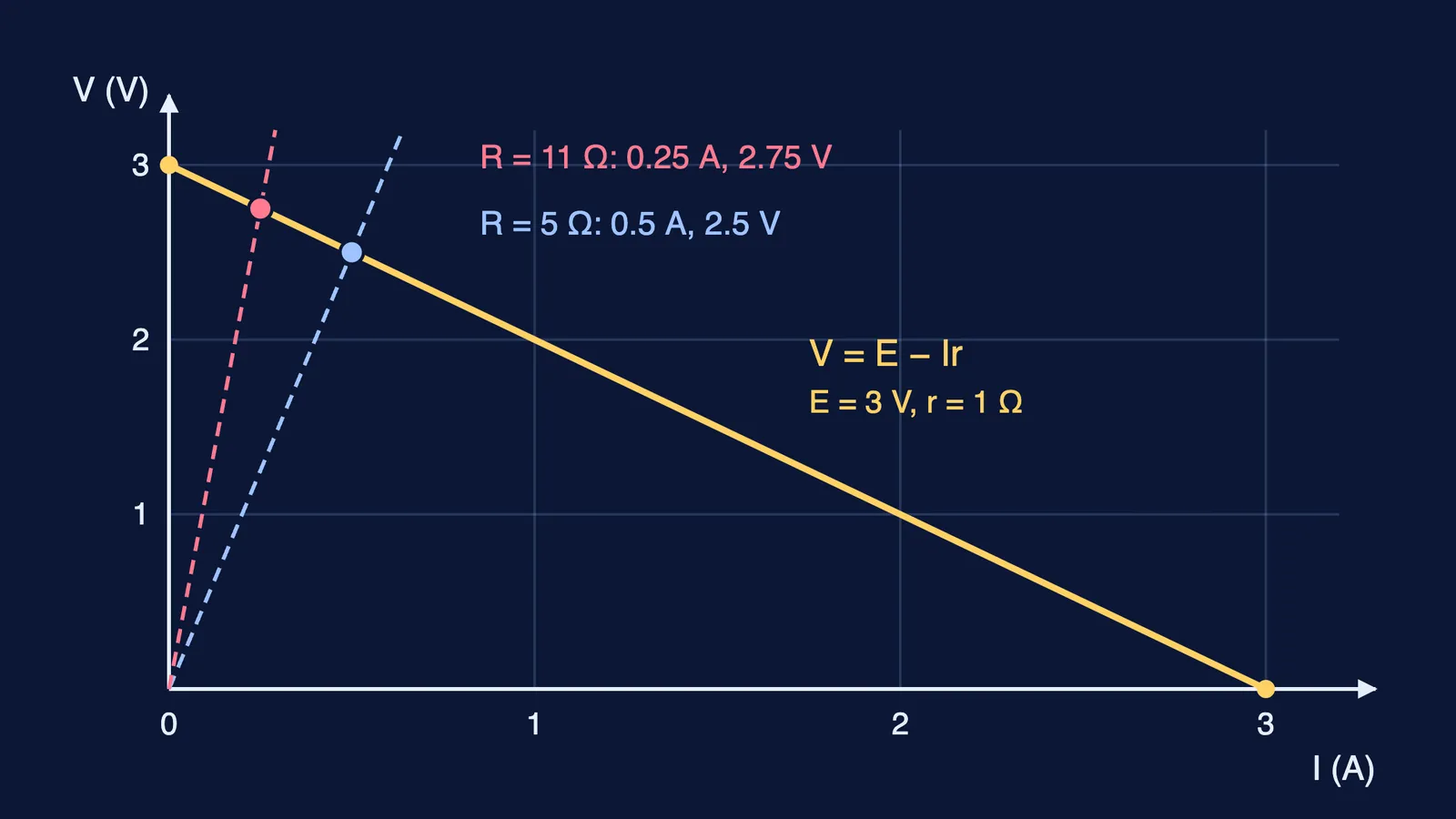
Q5 (medium). A cell gives a terminal voltage of 2.5 V across a 5 Ω resistor and 2.75 V across an 11 Ω resistor. What are its emf E and internal resistance r?
(A) 3.0 V, 1 Ω (B) 2.75 V, 0.5 Ω (C) 3.0 V, 0.5 Ω (D) 3.5 V, 2 Ω
Answer: (A). The currents are 0.5 A and 0.25 A. From V = E − Ir: E = 2.5 + 0.5r = 2.75 + 0.25r, so r = 1 Ω and E = 3.0 V.
Trap: (B) treats the larger terminal voltage as the emf; that is only true when no current flows. Our note on finding internal resistance from voltmeter readings works the same idea.
Q6 (medium). A 2 V cell (internal resistance 1 Ω) and a 4 V cell (internal resistance 2 Ω) are connected in parallel, positive to positive, across a 2 Ω resistor. What is the current in the 2 Ω resistor?
(A) 1.0 A (B) 1.125 A (C) 1.2 A (D) 1.33 A
Answer: (A). E_eq = (2/1 + 4/2)/(1/1 + 1/2) = 8/3 V and r_eq = 2/3 Ω, so I = (8/3)/(8/3) = 1.0 A. The terminal voltage is 2 V, so the 2 V cell carries no current.
Trap: (B) averages the emfs to 3 V, which works only when the internal resistances are equal.
Hard: can you handle the metre bridge and Kirchhoff's laws?
Q7 (hard). In a metre bridge, an unknown X is in the left gap and 12 Ω in the right gap; balance is at 40.0 cm from the left end. A resistor Y is then joined in parallel with the 12 Ω and balance moves to 50.0 cm. What is Y?
(A) 4 Ω (B) 8 Ω (C) 16 Ω (D) 24 Ω
Answer: (D). X/12 = 40/60 gives X = 8 Ω. At 50 cm the right gap must also be 8 Ω, so 1/Y = 1/8 − 1/12 = 1/24 and Y = 24 Ω.
Trap: (A) subtracts 12 − 8 as if in series. For more on the bridge, see why resistances are swapped in a metre bridge.
Q8 (hard). Three branches join points A and B: a 12 V cell in series with 2 Ω, a 4 Ω resistor alone, and a 6 V cell in series with 2 Ω. Both cells are ideal, positive terminals towards A. What is the current through the 6 V cell?
(A) 1.0 A, leaving its positive terminal (B) 0.6 A, leaving its positive terminal (C) 0.6 A, entering its positive terminal (D) 1.8 A, entering its positive terminal
Answer: (C). With B at 0 V, the junction rule at A gives (12 − V)/2 + (6 − V)/2 = V/4, so V = 7.2 V. The current out of the 6 V cell is (6 − 7.2)/2 = −0.6 A: 0.6 A enters its positive terminal, so it is being charged.
Trap: (B) has the right size but ignores the minus sign, which tells you the direction.
Scored under 6? Redo your trap list tomorrow without looking.