On this page
In the Class 12 meter bridge practical, you take a set of readings, swap the wire and the resistance box between the two gaps, and take them all again. It can feel like busywork, but the swap removes an error you cannot see on the scale.
What is end error in a meter bridge?
The bridge formula assumes the wire's resistance runs exactly from the 0 cm mark to the 100 cm mark, and that the thick copper strips have no resistance. Neither is quite true. The NCERT Class 12 physics lab manual, Experiment 2 (it spells it “metre bridge”) lists among its sources of error: “Effect of end resistances due to copper strips, connecting screws, may affect the measurement.”
In that experiment, the unknown resistance is found from S = R × l / (100 − l), where l is the balancing length AD in centimetres and R is the value taken from the resistance box.
End error is the extra resistance at the ends of the bridge wire, in strips, screws and joints, that this formula leaves out. Picture it as a little hidden wire at each end, with lengths α (left) and β (right).
Because end error pushes every reading the same way, it is a systematic error. The NCERT manual's introduction says systematic errors “are those errors for which corrections can be applied and in principle they can be removed.” More readings in one position repeat the same bias.
Why are resistances interchanged in a meter bridge experiment?
With the wire S in the left gap, the stretch of bridge wire on its side really behaves like l + α of wire, and the box's side like (100 − l) + β. The formula drops α and β, so your answer is off in one direction.
Swap them and the wire sits next to the right end, so the same hidden lengths bias the formula the opposite way. When the null point is near the middle, one set of readings comes out high and the other low by roughly the same amount, so their average lands close to the true value. As the NCERT procedure puts it: “The interchange takes care of unaccounted resistance offered by terminals.”
What do the readings look like before and after the swap?
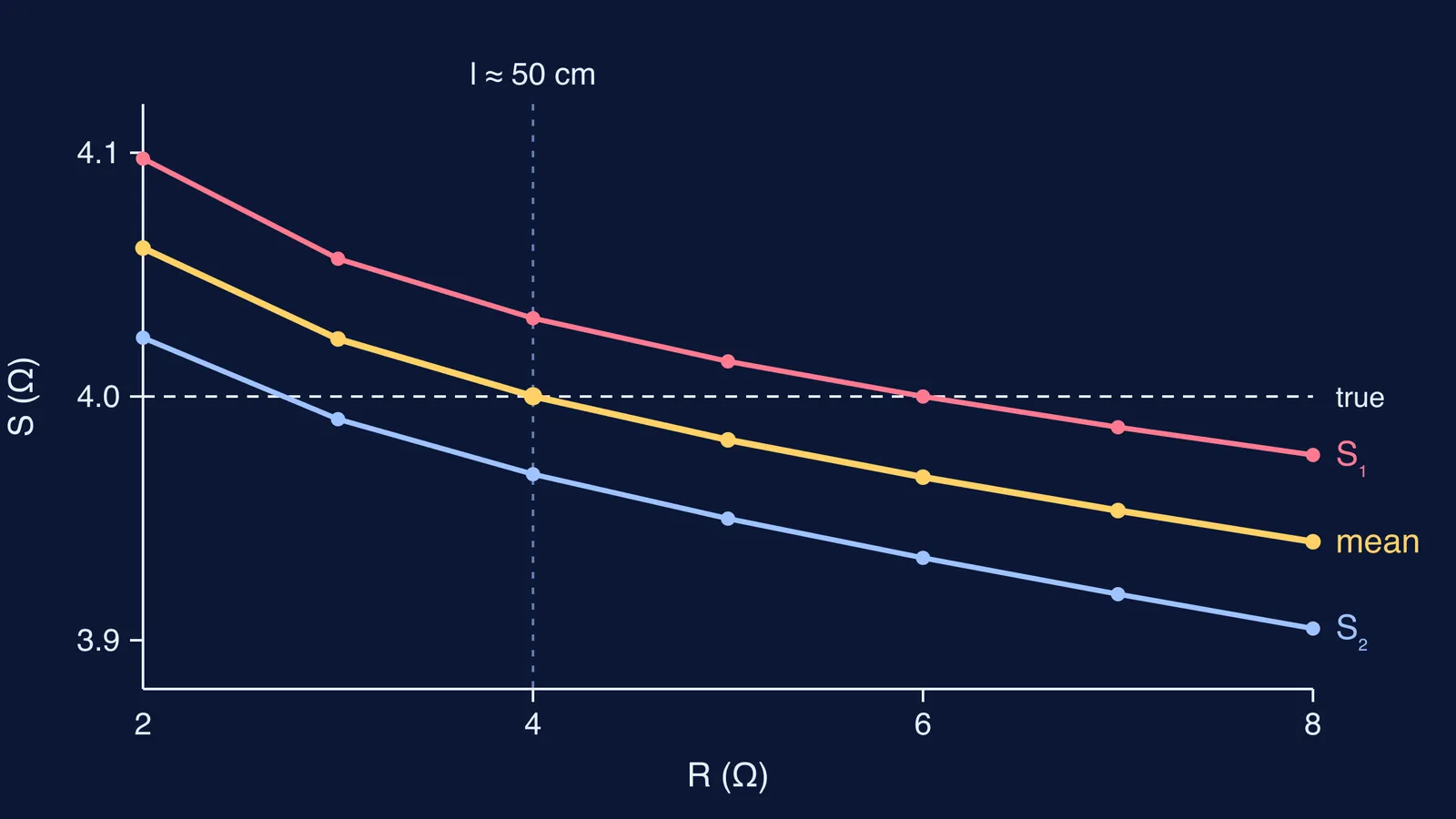
Here is an illustration with numbers we chose, using the two formulas from the NCERT observation table. Take a wire of true resistance 4.000 Ω, with α = 0.8 cm and β = 1.2 cm. Null points are rounded to 0.1 cm.
Wire in the left gap, S₁ = R × l / (100 − l):
R = 3 Ω, l = 57.5 cm, S₁ = 4.059 Ω
R = 4 Ω, l = 50.2 cm, S₁ = 4.032 Ω
R = 5 Ω, l = 44.5 cm, S₁ = 4.009 Ω
Mean before the swap: 4.033 Ω, about 0.8% too high.
Wire in the right gap, S₂ = R × (100 − l′) / l′:
R = 3 Ω, l′ = 42.9 cm, S₂ = 3.993 Ω
R = 4 Ω, l′ = 50.2 cm, S₂ = 3.968 Ω
R = 5 Ω, l′ = 55.9 cm, S₂ = 3.945 Ω
Mean after the swap: 3.969 Ω, about 0.8% too low.
Average of the two: (4.033 + 3.969) / 2 = 4.001 Ω. An error of about 0.03 Ω in each position shrinks to 0.001 Ω.
Does swapping always cancel the end error completely?
Not completely. Our own algebra shows the fractional error left after averaging is roughly (α + β)/2 × [1/(100 − l) − 1/l]. That bracket is zero at l = 50 cm, so the nearer the null point is to the middle, the better the swap works. Above, R = 4 Ω balanced at 50.2 cm and that pair averaged 4.000 Ω; at R = 5 Ω the pair averaged 3.977 Ω.
That is one more reason to follow the NCERT precaution that “null points should be in the middle of the wire (30 cm to 70 cm)”: choose R close to your expected S. The swap is not meant to fix errors not tied to the ends, such as uneven wire thickness.
A checklist for your practical and viva
Estimate S first, and pick R values that put the null point between 30 and 70 cm, as the NCERT manual advises.
Take readings for each R with the wire in the left gap.
Interchange wire and box, keeping the same length of wire in the new gap.
Repeat for the same R values with the right-gap formula.
Average S₁ and S₂ for each R, then across all rows.
In the viva: end resistances bias the result one way, swapping reverses the bias, the mean cancels it.
If the Wheatstone bridge balance itself feels shaky, the Fermi Concept Library gives each physics concept its own lesson. For practice, the Fermi Problem Library has worked problems with a step-by-step solver that explains the reasoning rather than printing an answer.