On this page
Current Electricity is a few relations used again and again. Here are the syllabus, three solved problems, the traps and a plan.
What does the NEET syllabus include in Current Electricity?
The NMC's updated syllabus for NEET (UG)-2026 lists Unit 12, Current Electricity, as: electric current; drift velocity, mobility and their relation with electric current; Ohm's law; electrical resistance; V-I characteristics of ohmic and non-ohmic conductors; electrical energy and power; electrical resistivity and conductivity; series and parallel combinations of resistors; temperature dependence of resistance; internal resistance, potential difference and emf of a cell; combination of cells in series and parallel; Kirchhoff's laws and their applications; Wheatstone bridge; metre bridge.
In the 2026-27 reprint, this sits in Chapter 3, Current Electricity, of NCERT Class 12 Physics Part I, sections 3.2 to 3.13. One gap: the chapter ends with the Wheatstone bridge and names the metre bridge in one sentence. NMC still lists it, so learn it as a Wheatstone bridge whose ratio arms are lengths of one uniform wire. The potentiometer appears in neither document.
How is Current Electricity asked in NEET?
In NEET-UG 2026, physics had 45 questions in a 180-question paper answered in 180 minutes, with +4 for a correct answer and −1 for a wrong one, according to the NTA information bulletin. That is about a minute per question, each with four options and one correct answer. More in the NEET-UG paper pattern.
Three habits matter, all built from the NCERT chapter:
Formula recall in seconds: R = ρl/A, I = neAv_d, V = ε − Ir, R_T = R_0[1 + α(T − T_0)].
Unit checks to strike out options: mobility is in m²/(V s), resistivity in Ω m.
Close reading of NCERT lines: statement and assertion-reason items test points such as "mobility is positive".
Worked examples: three NEET-style problems
1. Stretching a wire. A 5 Ω wire is stretched to three times its length. Find the new resistance and drift speed at the same current.
Volume is fixed, so area falls to a third and R = ρl/A becomes 9R = 45 Ω. At the same current, v_d = I/(neA) triples. Shortcut: stretching by a factor k multiplies R by k².
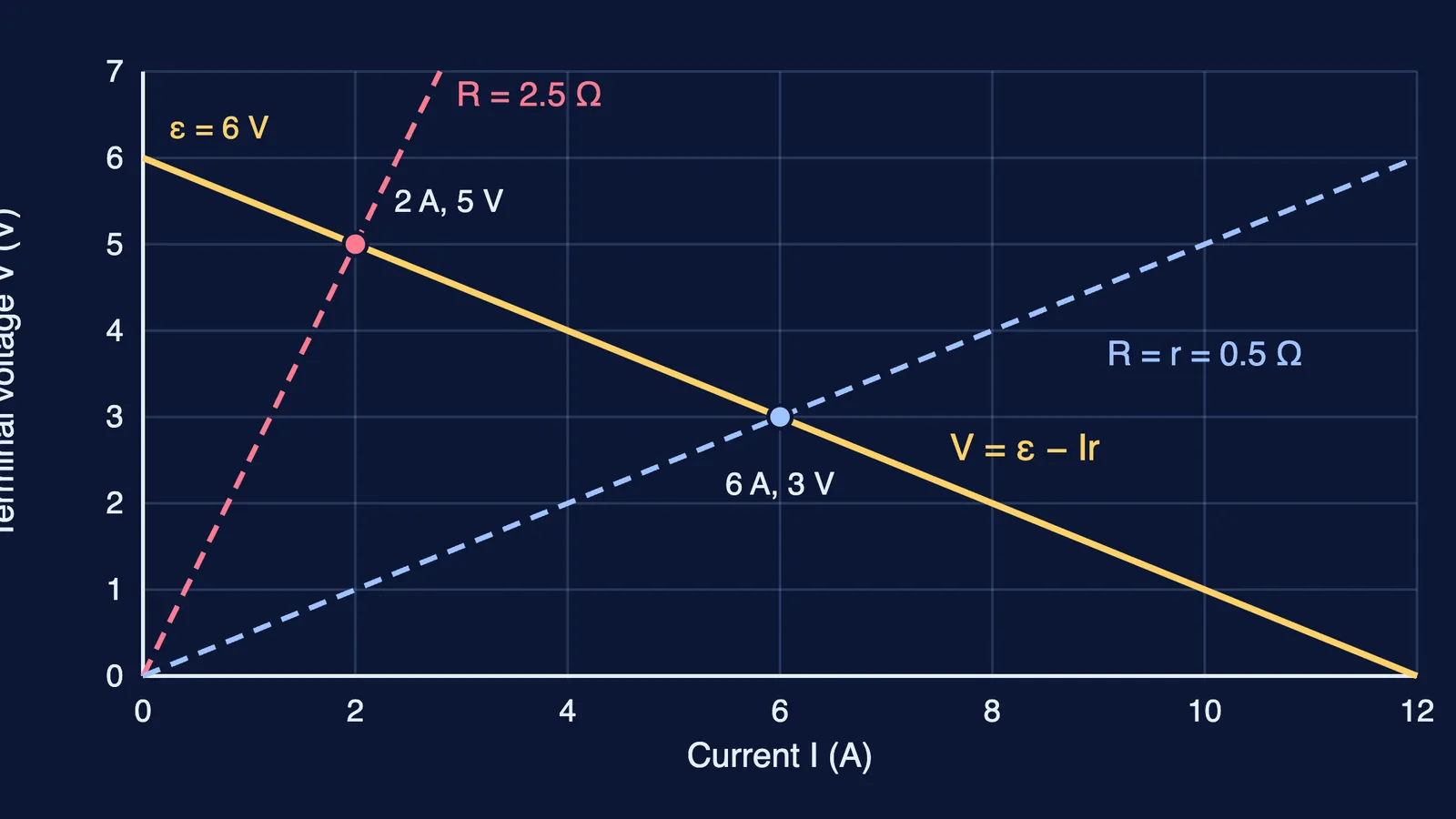
2. A cell with internal resistance. A cell of emf 6 V and internal resistance 0.5 Ω drives a 2.5 Ω resistor. I = ε/(R + r) = 6/3 = 2 A, and the terminal voltage V = ε − Ir = 5 V. The resistor takes I²R = 10 W; 2 W is lost inside the cell.
With a 0.5 Ω resistor (equal to r), I = 6 A, V = 3 V and the resistor takes 18 W, the most this cell can give any external resistor.
3. Wheatstone and metre bridge. A bridge has 2 Ω and 4 Ω on top, 3 Ω and 6 Ω below, and 5 Ω across the middle. Since 2/4 = 3/6, it is balanced and the 5 Ω carries no current. Remove it: R_eq = (6 × 9)/(6 + 9) = 3.6 Ω.
On a metre bridge, unknown X (left gap) and 9 Ω (right gap) balance at 25 cm. X/9 = 25/75, so X = 3 Ω. Swap them and balance moves to 75 cm, a favourite wrong option.
Stuck on a step? The Fermi Problem Library has worked problems with a step-by-step solver that explains the reasoning rather than printing an answer.
Which mistakes cost marks in Current Electricity?
Kirchhoff sign errors: fix each loop's direction and write −IR when you cross a resistor along the current.
Using emf where terminal voltage is asked, or forgetting V = ε + Ir while a cell is charging.
Mixing up combinations: in series, emfs and internal resistances add; n identical cells in parallel keep one cell's emf, with internal resistance r/n.
Treating resistivity as a property of shape: ρ depends on material and temperature; R also depends on length and area.
Can't picture it? The Fermi Simulation Lab has interactive simulations for the ideas that are easier to see than to read.
How should you practise Current Electricity for NEET?
A two-week plan, about an hour a day, on the NCERT chapter:
Days 1-3: sections 3.2 to 3.9; put every formula and unit on one card.
Days 4-6: sections 3.10 to 3.13 plus the metre bridge; solve the NCERT examples without looking.
Days 7-9: do 20 mixed single-correct questions a day, a minute each, with a timer.
Days 10-12: label every wrong answer as recall, sign, unit or reading.
Days 13-14: a timed 15-question set; redo the misses a day later.
Try these:
Two identical cells (1.5 V, 0.5 Ω each) in series across 2 Ω. Find the current.
The same cells in parallel across 2 Ω. Find the current.
A wire is 10 Ω at 20 °C, with α = 4.0 × 10⁻³ per °C. Find its resistance at 70 °C.
Answers: 1.0 A; 2/3 A (about 0.67 A); 12 Ω.
Next, see how to write Current Electricity answers in the Class 12 board exam or, for longer multi-loop circuits, Current Electricity for JEE Main, with solved circuits.