On this page
JEE (Advanced) 2027 will be held on 23 May 2027 (Sunday), organised by IIT Delhi, says the official JEE (Advanced) website. To sit it, you need to be among the top 2,50,000 candidates in the B.E./B.Tech paper of JEE (Main) 2027, as the eligibility page states. In 2026 the exam had two papers of three hours each, and appearing in both was compulsory, according to the 2026 Information Brochure. Question types and marking have changed from year to year; our note on JEE Advanced question types explains why.
What does the JEE Advanced syllabus say about oscillations and waves?
The official JEE (Advanced) 2026 syllabus lists, under mechanics: "Forced and damped oscillation (in one dimension), resonance. Linear and angular simple harmonic motions." Later it adds: "Wave motion (plane waves only), longitudinal and transverse waves, superposition of waves; Progressive and stationary waves; Vibration of strings and air columns; Resonance; Beats; Speed of sound in gases; Doppler effect (in sound)." The same document says the 2026 syllabus is unchanged from 2025. As of 19 November 2026, the 2027 syllabus has not been published.
Unit 10 of NTA's JEE (Main) 2027 syllabus covers SHM, springs, the simple pendulum, progressive and standing waves and beats, but does not name angular SHM, damped and forced oscillation, or the Doppler effect. If the basics feel shaky, start with our guides to oscillations for JEE Main and waves and sound for JEE Main.
How do you find the period of an angular SHM?
A uniform rod (mass 1.2 kg, length 0.9 m) hangs from a frictionless pivot at its top. A light horizontal spring (k = 40 N/m) is fixed to the rod 0.6 m below the pivot and is unstretched when the rod is vertical. Find the period of small oscillations. Take g = 9.8 m/s².
Turn the rod through a small angle θ. Gravity gives a restoring torque mg(L/2)θ; the spring stretches by dθ (d = 0.6 m) and gives kd²θ.
Total torque: (5.292 + 14.4)θ = 19.692θ N m, against I = mL²/3 = 0.324 kg m².
ω² = 19.692/0.324 ≈ 60.8 s⁻², so ω ≈ 7.80 rad/s and T ≈ 0.806 s.
Checks: with k = 0 you get the physical pendulum, T = 2π√(2L/3g) ≈ 1.55 s. With g = 0, T = 2π√(mL²/3kd²) ≈ 0.942 s. The answer sits below both, as two restoring torques adding should give.
Why does a closed pipe have only odd harmonics?
A pipe closed at one end has effective length 0.50 m (end correction included). The air is at 300 K; take γ = 1.4 and M = 0.029 kg/mol. Two such pipes sound their first overtone while a cyclist rides from one towards the other at 4 m/s.
Speed of sound: v = √(γRT/M) = √(1.4 × 8.314 × 300/0.029) ≈ 347 m/s.
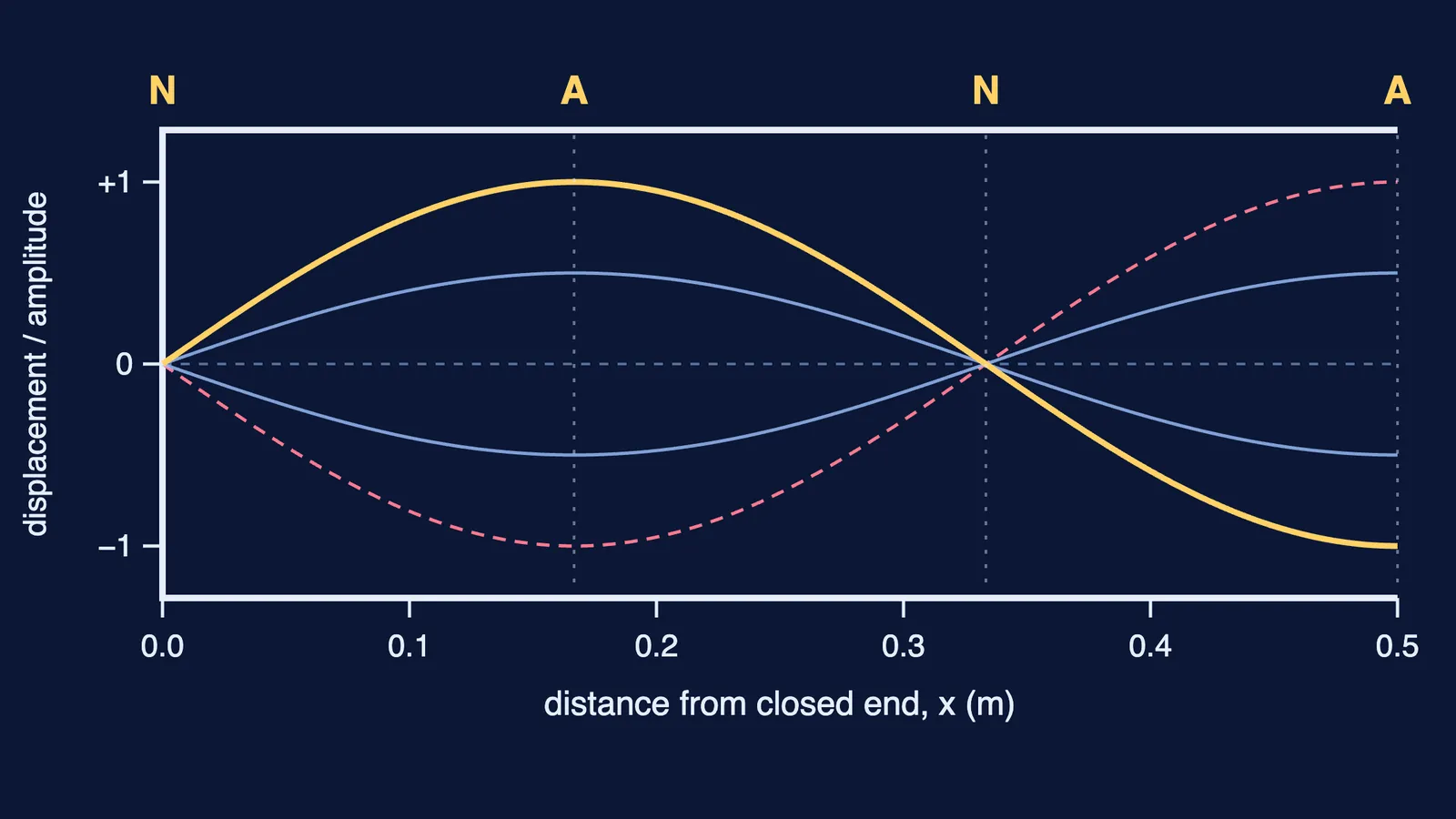
Fundamental: f₁ = v/4L ≈ 173.5 Hz. A closed pipe has only odd harmonics, so the first overtone is 3f₁ ≈ 520.5 Hz, not 347 Hz.
The cyclist moves towards one pipe and away from the other, hearing 3f₁(1 + u/v) ≈ 526.5 Hz and 3f₁(1 − u/v) ≈ 514.5 Hz.
Beat frequency: 2 × 3f₁ × u/v = 3u/2L = 12 Hz.
Stuck on why the closed end must be a node? The Fermi Simulation Lab has interactive simulations for the ideas that are easier to see than to read.
Now judge these multiple-correct statements:
The first overtone is 347 Hz: false, that is the missing second harmonic.
The cyclist hears 12 beats per second: true.
Warming the air to 330 K changes the beat frequency: false, v cancels, so beats stay 12 Hz while both pitches rise.
Each pipe has a displacement node 1/3 m from its closed end: true, as the diagram at the top shows.
How should you practise oscillations and waves for JEE Advanced?
Week 1: linear and angular SHM; write the restoring force or torque before any formula.
Week 2: damped and forced oscillation and resonance; sketch amplitude against driving frequency.
Week 3: strings, air columns and speed of sound in gases; list allowed harmonics first.
Week 4: superposition, beats and Doppler effect, mixed with one SHM problem a day.
Log each error and the check that would have caught it. Lost on a step? The Fermi Problem Library has worked problems with a step-by-step solver that explains the reasoning rather than printing an answer.
Try these, then check:
A damped oscillator's amplitude falls from 10 cm to 5 cm in 4 s. Assuming exponential decay, find the amplitude at 10 s.
A 0.6 m string has tension 90 N and mass 0.01 kg/m. Which of its harmonics lie between 200 Hz and 400 Hz?
A car moving at 12 m/s towards a wall sounds a 480 Hz horn. What frequency does the driver hear in the echo (v = 343 m/s)?
Answers: about 1.77 cm; about 237 Hz, 316 Hz and 395 Hz; about 515 Hz.