On this page
At JEE Advanced level, current electricity is less about new formulas than about combining them. Here is the official scope, two worked problems and a plan.
What does the JEE Advanced syllabus include for current electricity?
The JEE (Advanced) 2026 syllabus is the latest official list; it says it is the same as 2025, and the 2027 syllabus has not been published yet. It lists:
Electric current; Ohm's law; series and parallel arrangements of resistances and cells; Kirchhoff's laws and simple applications; heating effect of current
Moving coil galvanometer, voltmeter, ammeter and their conversions
RC, LR, LC and LCR (in series) circuits with d.c. and a.c. sources
Experiments: verifying Ohm's law with a voltmeter and ammeter, and a wire's specific resistance using a meter bridge and post office box
Compared with NTA's JEE (Main) 2027 syllabus, two items here appear only in the Advanced list: RC and LR circuits on d.c. sources, and the post office box. The potentiometer is in neither list. For the basics, see our Current Electricity guide for JEE Main.
JEE (Advanced) 2027 will be held on 23 May 2027 (Sunday), organised by IIT Delhi (official website). One eligibility criterion is being in the top 2,50,000 of the B.E./B.Tech. paper of JEE (Main) 2027 (eligibility page). According to its Information Brochure, JEE (Advanced) 2026 had two compulsory three-hour papers, with question types and marking given in the on-screen instructions; these can change yearly. See our explainer on JEE Advanced question types and partial marking.
How hard are JEE Advanced current electricity problems?
The difficulty is layering: one question may need Kirchhoff's laws, a time constant and an energy argument, then ask for every correct option or a typed number. Three habits help:
Solve the two easy instants first. At t = 0 an uncharged capacitor acts like a wire; in steady state it carries no current.
Replace the rest of the circuit. Seen from a capacitor or meter, any network of cells and resistors acts like one emf behind one resistance.
Check limits and units. Send a resistance to zero or infinity; RC must come out in seconds.
Worked example 1: a capacitor charging through a real cell
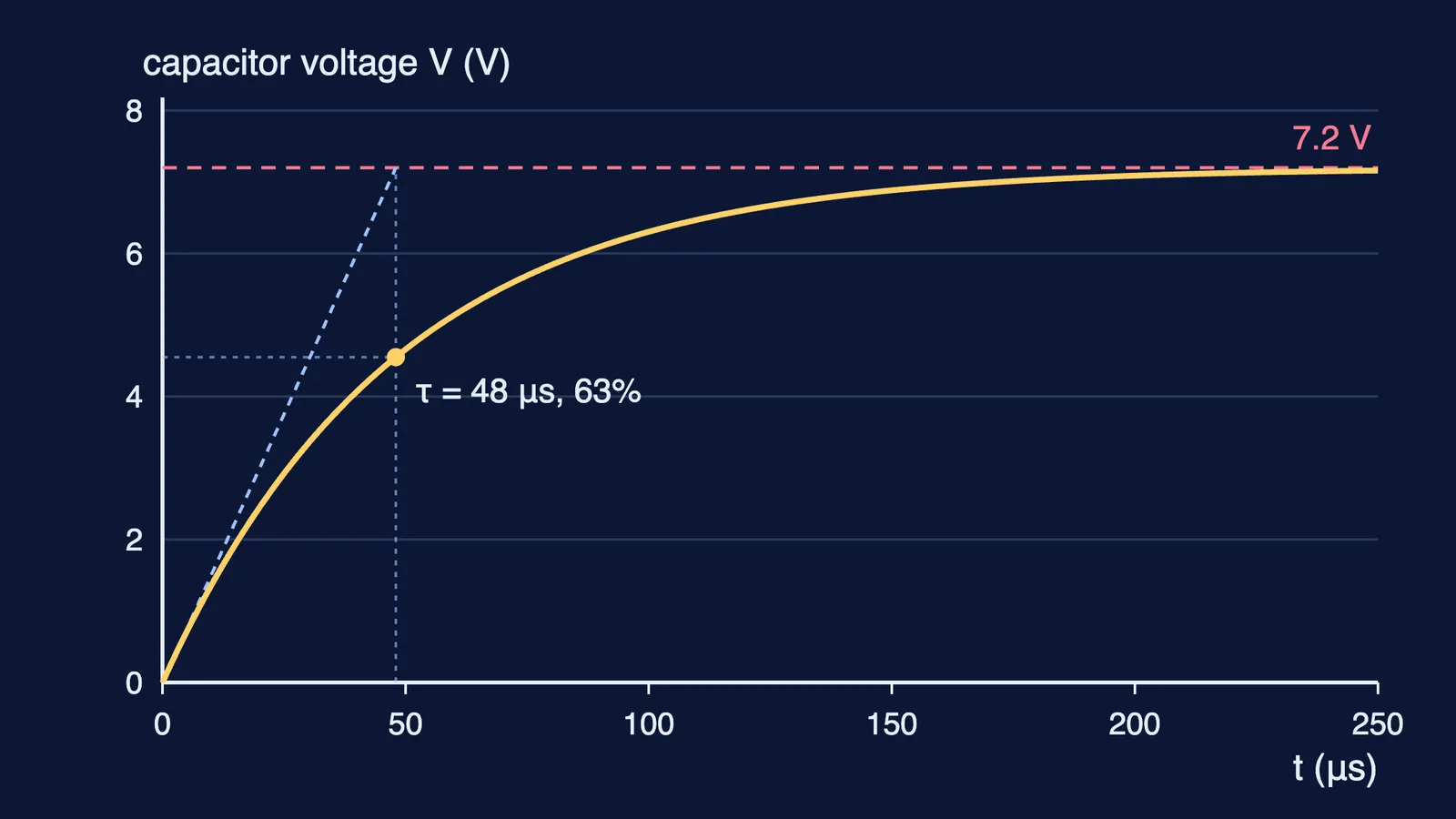
A 12 V cell with internal resistance 1 Ω is in series with 3 Ω, then a 6 Ω resistor with an uncharged 20 μF capacitor across it. The switch closes at t = 0.
At t = 0 the capacitor shorts the 6 Ω: cell current 12/(1 + 3) = 3 A, terminal voltage 12 − 3 × 1 = 9 V.
In steady state: cell current 12/(1 + 3 + 6) = 1.2 A, capacitor voltage 1.2 × 6 = 7.2 V, charge 20 μF × 7.2 V = 144 μC.
Seen from the capacitor, the circuit is 7.2 V behind (4 × 6)/(4 + 6) = 2.4 Ω. So τ = 2.4 Ω × 20 μF = 48 μs, and V(t) = 7.2(1 − e^(−t/48 μs)) volts.
The trap: using 10 Ω or 4 Ω for τ. Limit check: as the 6 Ω goes to infinity, the formulas give 12 V through 4 Ω.
Worked example 2: a voltmeter that changes the answer
A 50 Ω galvanometer reads full scale at 2 mA. For a 10 V voltmeter, add 10/0.002 − 50 = 4950 Ω in series, so the meter's resistance is 5000 Ω.
Place it across one of two 5 kΩ resistors in series with an ideal 20 V supply. You expect 10 V, but meter and resistor in parallel make 2.5 kΩ: it reads 20 × 2.5/7.5 ≈ 6.67 V. To read within 1% of 10 V, the meter needs at least about 247.5 kΩ. As its resistance goes to infinity, the reading returns to 10 V.
Not sure which loop or instant to start from? The Fermi Problem Library has worked problems with a step-by-step solver that explains the reasoning rather than printing an answer.
How should you practise current electricity for JEE Advanced?
In a meter bridge, unknown X in the left gap and 45 Ω in the right balance at 37.5 cm from the left end. Find X.
Cells of 6 V and 4 V, each with 1 Ω internal resistance, are joined in parallel (positive to positive) across 2 Ω. Find each cell's current.
A 10 μF capacitor at 50 V discharges through 2 kΩ. When has it lost half its stored energy?
Answers: 1. 27 Ω. 2. The 6 V cell gives 2 A; the 4 V cell carries none. 3. τ ln 2 / 2 with τ = 20 ms, about 6.93 ms.
Then a two-week plan:
Days 1-3: Kirchhoff and node voltages; symmetric networks; check by power balance.
Days 4-5: galvanometer conversions, meter bridge and post office box.
Days 6-9: RC on d.c.: charging, discharging, energy, switching.
Days 10-12: mixed problems, marking every option true or false with a reason.
Days 13-14: timed sets; log each mistake as concept, setup or arithmetic.