On this page
JEE (Advanced) 2027 will be held on 23 May 2027 (Sunday), organised by IIT Delhi, says the official JEE (Advanced) website. One eligibility condition is a place among the top 2,50,000 candidates in the B.E./B.Tech paper of JEE (Main) 2027 (eligibility page). JEE (Advanced) 2026 had two papers of three hours each, and appearing in both was compulsory, according to the 2026 Information Brochure. Question types and marking are not fixed from year to year.
What does the JEE Advanced syllabus say about work, energy and collisions?
The official JEE (Advanced) 2026 syllabus lists, under Mechanics: "Kinetic and potential energy; Work and power; Conservation of linear momentum and mechanical energy." The next line adds: "Systems of particles; Centre of mass and its motion; Impulse; Elastic and inelastic collisions." The document says it is unchanged from 2025. As of 19 November 2026, the 2027 syllabus has not been published.
NTA's JEE (Main) 2027 syllabus covers the same energy and collision ideas in Units 3 and 4; for centre of mass, its Unit 5 names only a two-particle system and a rigid body. The Advanced list adds systems of particles with the motion of their centre of mass and, in its rigid-body section, "Collision of point masses with rigid bodies." Shaky on basics? Start with our Work, Energy and Power guide for JEE Main.
The bigger difference is depth: Advanced problems chain energy, momentum and energy again, and can have several correct options.
How do you solve a collision problem with a spring?
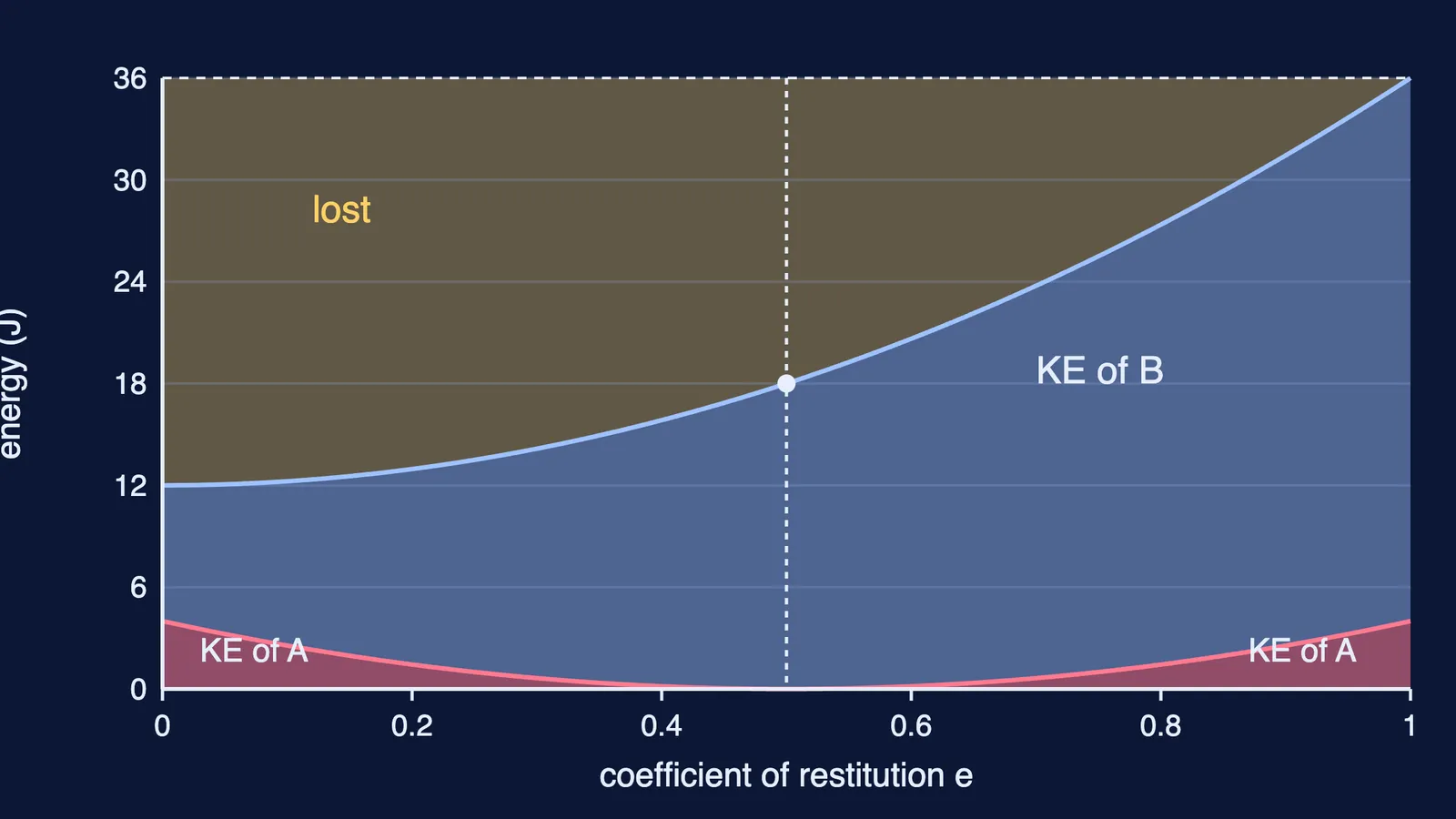
Block A (2 kg) slides from rest down a smooth track of height 1.8 m and, on the smooth floor, hits block B (4 kg) at rest, with coefficient of restitution 0.5. B then compresses a light spring (900 N/m) fixed to a wall. Take g = 10 m/s². Which statements are true?
Energy on the track: A reaches the floor at √(2 × 10 × 1.8) = 6 m/s.
Momentum and restitution: 12 = 2vA + 4vB and vB − vA = 3, so vA = 0 and vB = 3 m/s.
Kinetic energy falls from 36 J to ½ × 4 × 3² = 18 J. The impulse on B is 4 × 3 = 12 N s.
Energy in the spring: 18 = ½ × 900 × x², so the maximum compression is 0.2 m.
A stops dead: true.
Half the kinetic energy is lost in the collision: true.
The maximum compression is 0.2 m: true.
B never meets A again: false. B returns at 3 m/s and hits A, sending A back at 3 m/s (B keeps 1.5 m/s). A climbs 3²/20 = 0.45 m.
Checks: e = 1 gives vA = −2 m/s, vB = 4 m/s and no loss; e = 0 gives a common 2 m/s. The loss formula ½ × (mAmB/(mA + mB)) × u² × (1 − e²) also gives 18 J.
Want to watch e decide who stops? Fermi Simulation Lab has interactive simulations for the ideas that are easier to see than to read.
How do you handle constant power?
An 800 kg car's engine delivers a constant 24 kW; ignore friction. How long does it take to go from 10 m/s to 20 m/s, and how far does it travel?
Work-energy: P × t = ½m(v² − u²), so 24000 t = 400 × 300 and t = 5 s.
Force = P/v and a = v dv/dx give m v² dv = P dx, so x = m(v³ − u³)/(3P) = 800 × 7000/72000 ≈ 77.8 m.
Checks: the distance must lie between 50 m and 100 m, and beat the 75 m of steady acceleration, since the car accelerates hardest at low speed (3 m/s² at 10 m/s, 1.5 m/s² at 20 m/s). Dimensions: kg × (m/s)³ / W gives metres.
How should you practise work, energy and collisions for JEE Advanced?
Week 1: variable forces, potential-energy curves and equilibrium from U(x).
Week 2: power, vertical circles and springs; write the energy equation first.
Week 3: impulse, string jerks and collisions in two dimensions; check in the centre-of-mass frame.
Week 4: mixed problems; judge every multiple-correct option on its own, as our guide to partial marking in multiple-correct questions explains.
Unsure where your method broke? The Fermi Problem Library has worked problems with a step-by-step solver that explains the reasoning rather than printing an answer.
Try these:
A 0.5 kg ball is dropped from 5 m onto a floor with e = 0.6, and contact lasts 0.02 s (g = 10 m/s²). Find the ball's change in momentum and the average force from the floor.
A 1 kg particle moves along x with U(x) = 2x³ − 6x joules (x in metres). Find the stable equilibrium, and the speed there after starting from rest at x = 0.
Answers: change in momentum 8 N s upwards; average floor force 405 N, not 400 N, since the floor also supports the weight. Stable equilibrium at x = 1 m; speed √8 ≈ 2.83 m/s.