On this page
This guide covers induction and AC for JEE (Advanced): the official list, what it adds beyond JEE Main, three original worked examples and a plan.
What is in the JEE Advanced electromagnetic induction syllabus?
The official JEE (Advanced) 2026 syllabus lists: "Electromagnetic induction: Faraday's law, Lenz's law; Self and mutual inductance; RC, LR, LC and LCR (in series) circuits with d.c. and a.c. sources." It also lists electromagnetic waves, their characteristics and the spectrum, with elementary facts about their uses.
That syllabus is unchanged from 2025. The 2027 syllabus is not published yet (as of 19 November 2026), so plan with the 2026 list. The JEE (Advanced) website says the 2027 exam is on 23 May 2027 (Sunday), organised by IIT Delhi; the eligibility page requires, among other criteria, a place in the top 2,50,000 of the JEE (Main) 2027 B.E./B.Tech. paper.
What does JEE Advanced add beyond JEE Main?
The JEE (Main) 2027 syllabus covers Faraday's and Lenz's laws, inductance, the LCR series circuit, resonance and AC power, but does not name RC, LR or LC circuits. So transients and LC oscillations need extra work. Build on our Electromagnetic Induction and AC for JEE Main guide.
The 2026 Information Brochure said JEE (Advanced) 2026 had two compulsory three-hour papers, with the marking scheme given in the instructions at exam time, so do not plan around a fixed pattern. See our guide to JEE Advanced question types.
How do you solve multi-concept induction and AC problems?
Example 1: LR circuit, switched on and off. A 12 V battery and a switch feed a 6 Ω resistor, followed by a 0.30 H ideal inductor in parallel with a 12 Ω resistor. Find the current at switch-on, the steady inductor current, the time constant, and the 12 Ω resistor's voltage just after the switch opens.
At t = 0 the inductor carries no current, so the battery current is 12/18 = 0.67 A.
Steady state: the inductor shorts the 12 Ω, so it carries 12/6 = 2.0 A.
The inductor sees 6 Ω parallel to 12 Ω, 4 Ω, so τ = 0.30/4 = 0.075 s.
On opening, 2.0 A flows through 12 Ω: 24 V, twice the battery emf, decaying with τ = 0.025 s and releasing ½LI² = 0.60 J.
Trap: using 18 Ω for τ; short the battery and find what the inductor sees.
Example 2: LC oscillation between two capacitors. A 4.0 μF capacitor at 50 V is connected through an ideal 10 mH inductor to an uncharged 1.0 μF capacitor. Find the maximum current and the largest voltage on the 1.0 μF capacitor.
200 μC is conserved; the capacitors act in series, C = 0.80 μF, ω = 1.12 × 10⁴ rad/s.
Current peaks when the voltages are equal: q/1.0 = (200 − q)/4.0 gives q = 40 μC at 40 V. Stored energy falls from 5.0 to 4.0 mJ, so ½LI² = 1.0 mJ and I = 0.447 A.
Charge swings symmetrically about 40 μC, up to 80 μC: 80 V, above the starting 50 V. Energy check: 1.8 + 3.2 = 5.0 mJ.
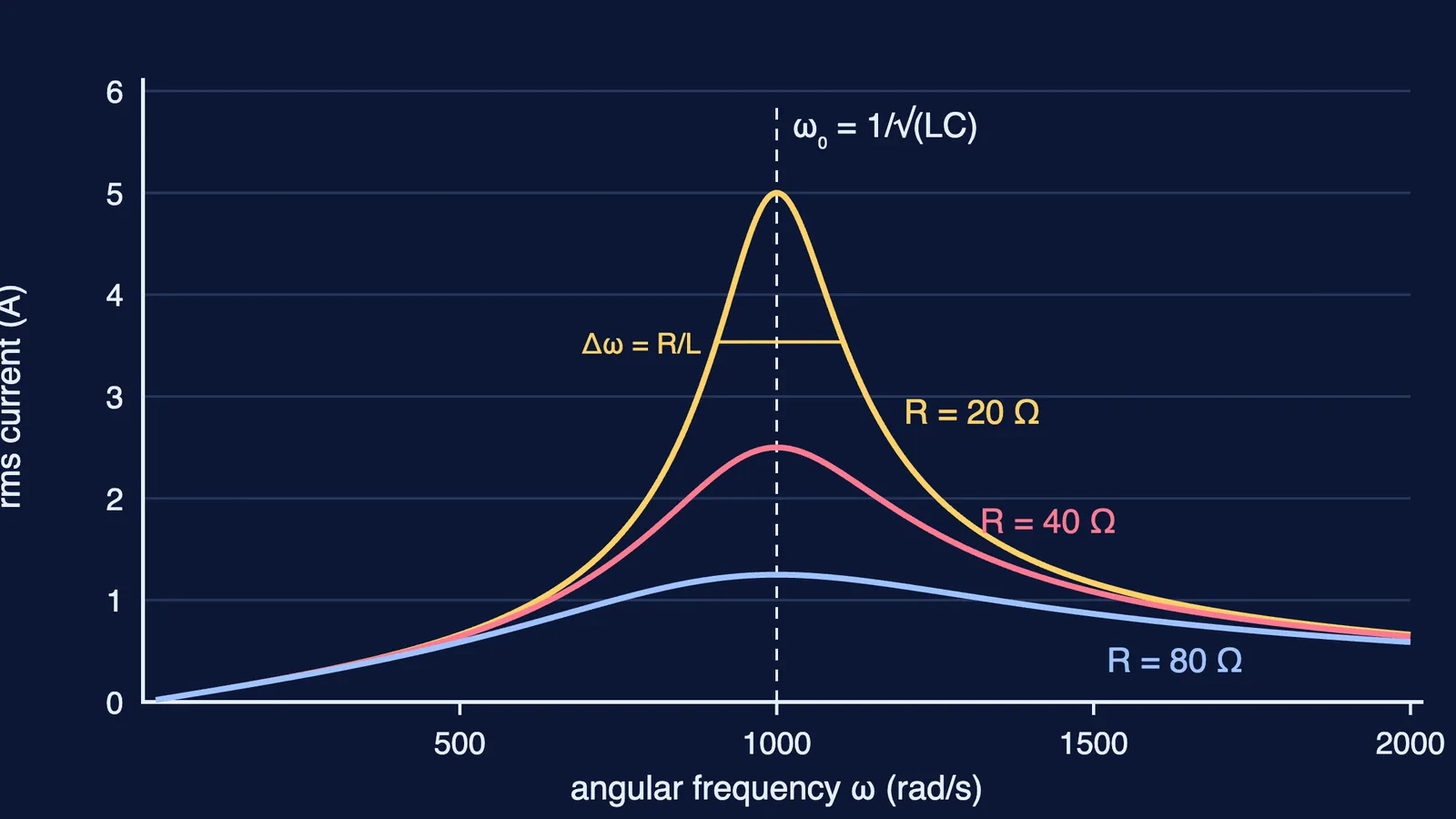
Example 3: series LCR, multiple-correct. A 100 V rms variable-frequency source drives R = 20 Ω, L = 0.10 H and C = 10 μF in series. Which are true? (A) Resonance is at 1000 rad/s. (B) At resonance the inductor voltage is 500 V rms. (C) At 500 rad/s the current leads the voltage. (D) At 500 rad/s the power exceeds 10 W.
ω₀ = 1/√(LC) = 1000 rad/s: (A) true.
At resonance I = 100/20 = 5.0 A, V_L = 5.0 × 100 = 500 V rms: (B) true.
At 500 rad/s, X_L = 50 Ω, X_C = 200 Ω: capacitive, current leads by 82.4°: (C) true.
Z = 151 Ω, I = 0.661 A, P = I²R = 8.7 W: (D) false.
Which traps cost marks in EMI and AC?
At every switch, inductor current and capacitor voltage stay continuous.
In series LCR, rms voltages across R, L and C add as phasors.
State Lenz's law in words before writing a sign.
How should you plan EMI and AC practice?
Week 1: Faraday and Lenz; write flux as a function of time first.
Week 2: RC and LR circuits; derive each exponential and sketch it.
Week 3: LC oscillations, series LCR with phasors, and the EM spectrum.
Week 4: timed mixed sets; name the failed step in each wrong answer.
Stuck on which step broke? The Fermi Problem Library has worked problems with a step-by-step solver that explains the reasoning rather than printing an answer.
Practise with this original:
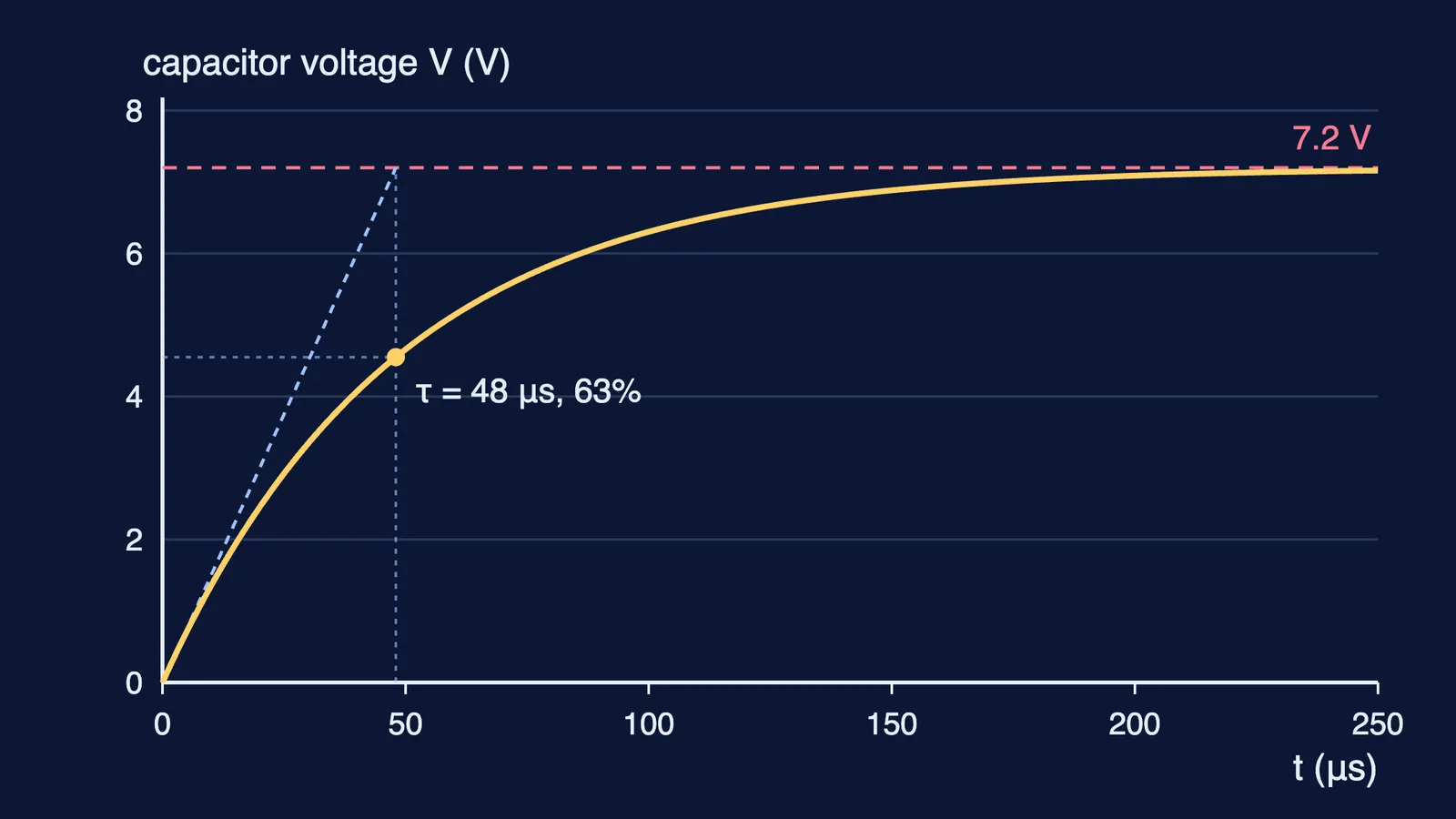
A 50 μF capacitor charges from 9.0 V through 30 kΩ. When does its charge reach three-quarters of the final value, and how much heat does the resistor give off in all? Answer: t = RC ln 4 = 2.08 s; 2.0 mJ, equal to the energy stored.