On this page
JEE (Advanced) 2027 will be held on 23 May 2027 (Sunday), organised by IIT Delhi, says the official JEE (Advanced) website. One eligibility criterion, on the eligibility page, is being among the top 2,50,000 candidates in the B.E./B.Tech paper of JEE (Main) 2027. The 2026 Information Brochure describes two papers of three hours each, and appearing in both is compulsory. Question types change from year to year; see our note on JEE Advanced question types.
What does the JEE Advanced syllabus say about kinematics?
The official JEE (Advanced) 2026 syllabus lists, under Mechanics: "Kinematics in one and two dimensions (Cartesian coordinates only), projectiles; Uniform circular motion; Relative velocity." The same document notes that the 2026 syllabus is unchanged from 2025. The 2027 syllabus is not yet published (as of 19 November 2026); recheck it next year.
Unit 2 of NTA's JEE (Main) 2027 syllabus names the same ideas: motion in a straight line, relative velocity, motion in a plane, projectile motion and uniform circular motion. So the Advanced list adds no new topic here; it adds the limit "Cartesian coordinates only". Under Newton's laws, Advanced also lists "uniformly accelerated frames of reference"; JEE Main does not. The difference is depth: Advanced questions mix frames, hide a second idea inside the first, and can have several correct options. If the basics feel shaky, start with our kinematics guide for JEE Main.
How do you solve a projectile seen from a moving frame?
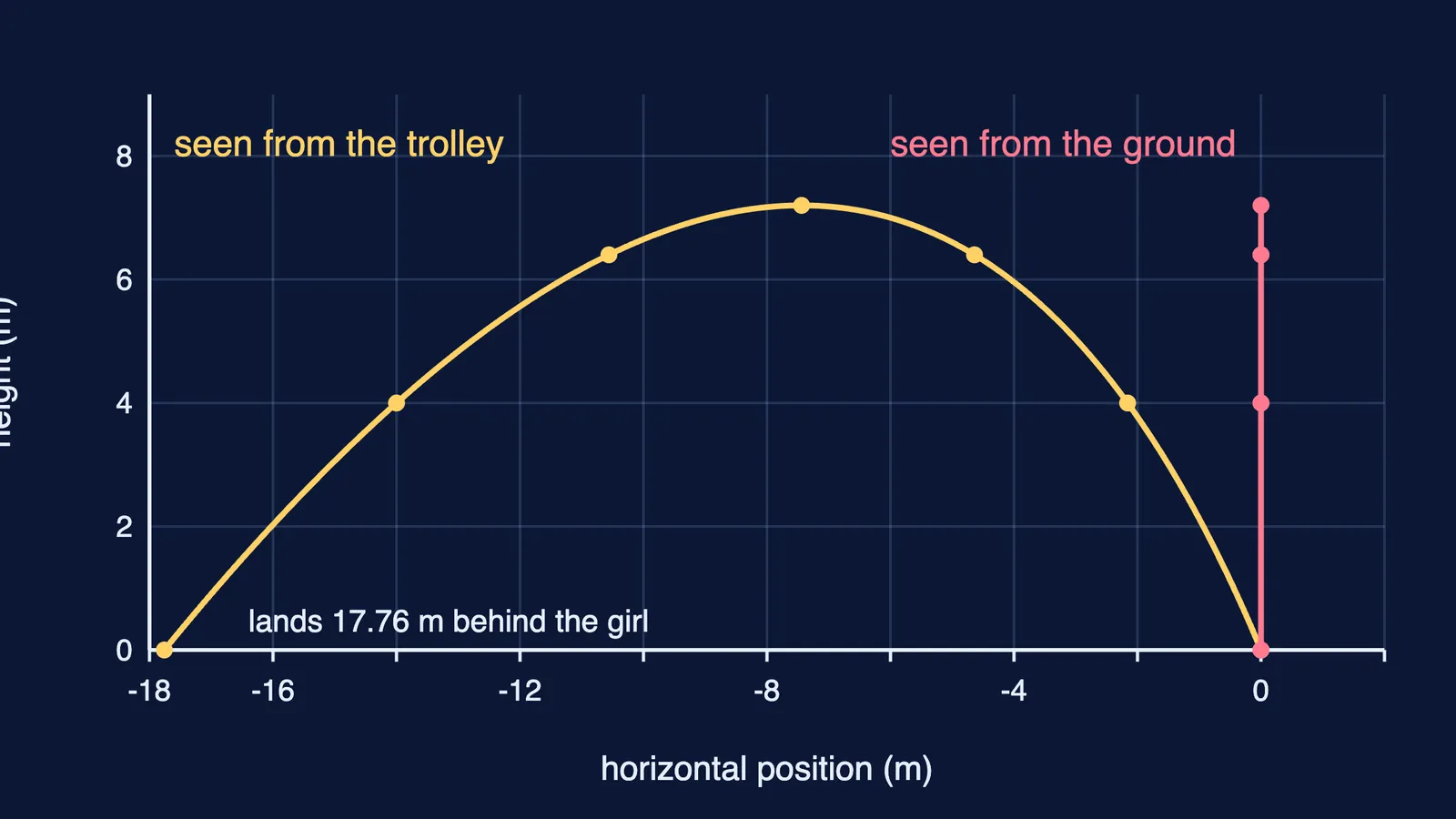
A trolley moves along level ground. At the instant its speed is 5 m/s, and while it speeds up at a steady 2 m/s², a girl on it throws a ball. Relative to the trolley, the ball leaves with 5 m/s backwards and 12 m/s upwards. Take g = 10 m/s², ignore air; the throw starts at ground level. Which statements are true?
Ground frame: horizontal velocity is 5 − 5 = 0, so the ball goes straight up and down.
Vertical motion is the same in both frames: time of flight = 2 × 12/10 = 2.4 s, and maximum height = 12²/(2 × 10) = 7.2 m.
The trolley keeps accelerating. In 2.4 s it moves 5 × 2.4 + ½ × 2 × 2.4² = 12 + 5.76 = 17.76 m.
So the ball lands 17.76 m behind the girl.
A ground observer sees a vertical path: true.
The maximum height is 7.2 m: true.
The ball lands 12 m behind her: false, 12 m assumes the trolley stops accelerating.
At the top, the ball's speed relative to the trolley is 7.4 m/s: true, since 5 + 2 × 1.2 = 7.4 m/s.
Checks: set the acceleration to zero and the gap becomes 12 m, as it should. The trolley-frame method, with a backward pseudo-acceleration of 2 m/s², gives the same 17.76 m.
Hard to picture two frames at once? Fermi Simulation Lab has interactive simulations for the ideas that are easier to see than to read.
What is the relative velocity of two bodies on a circle?
Two cars start together on a circular track of radius 50 m, moving the same way at steady speeds of 10 m/s and 15 m/s. When are they first diametrically opposite, and what are their relative speed and relative acceleration then?
The faster car gains angle at (15 − 10)/50 = 0.1 rad/s. Opposite means a gap of π, so t = π/0.1 ≈ 31.4 s.
When opposite, their velocities point in opposite directions, so the relative speed is 10 + 15 = 25 m/s, not 5 m/s.
Centripetal accelerations are 10²/50 = 2 m/s² and 15²/50 = 4.5 m/s², both towards the centre, so they also point opposite ways. Relative acceleration = 6.5 m/s².
Checks: at t = 0 the relative speed is 5 m/s, and halfway round it is 25 m/s; a quarter-circle gap gives √(10² + 15²) ≈ 18.0 m/s, in between.
How should you practise kinematics for JEE Advanced?
Week 1: one-dimensional motion with variable acceleration; read area and slope from v–t graphs.
Week 2: projectiles from a height and onto slopes; split every motion into x and y.
Week 3: relative velocity: rain, river and closest-approach problems; write each velocity as a vector first.
Week 4: circular motion and mixed problems; in multiple-correct questions, judge each option on its own.
Stuck on where a method went wrong? The Fermi Problem Library has worked problems with a step-by-step solver that explains the reasoning rather than printing an answer.
Try these, then check:
Ship A sails east at 5 m/s. Ship B, 338 m due north of A, sails south at 12 m/s. Find their closest distance and when it occurs.
A stone is thrown at 20 m/s, 30° above the horizontal (g = 10 m/s²). Find the radius of curvature of its path at launch and at the highest point.
Answers: closest distance 130 m, after 24 s. Radius of curvature ≈ 46.2 m at launch and 30 m at the top.
For Class 11 foundations, see our Motion in a Plane guide.