On this page
Motion in a Plane is where Class 11 physics swaps + and − signs for vectors. Forces, work and rotation all reuse its component method.
How many marks is Motion in a Plane in CBSE Class 11?
In the CBSE Physics curriculum for 2026-27, Motion in a Plane is Chapter 3 in Unit II, Kinematics. Of the 70 theory marks, Units I to III (Chapters 1 to 4) share one block of 23 marks; there is no separate figure for this chapter.
It lists vectors (including scalar and vector products), projectile motion and uniform circular motion, and notes that content NCERT marks as excluded for 2026-27 is not to be tested by schools. The practical list includes finding a weight with the parallelogram law of vectors and an activity on how a projectile's range varies with angle.
What does the current NCERT chapter cover?
The NCERT Class 11 Physics Part I chapter, Reprint 2026-27, runs from section 3.1 to 3.10: scalars and vectors, graphical addition (head-to-tail and parallelogram), resolution with unit vectors î and ĵ, analytical addition, motion with constant acceleration, projectiles and uniform circular motion. The scalar product is taught in Chapter 5 and the vector product in section 6.5 of the same book.
How do you add vectors by components?
Use Ax = A cos θ and Ay = A sin θ, add x parts and y parts separately, then rebuild the resultant.
Example 1. Vector A is 10 m at 30° to the x-axis; vector B is 6 m at 120°.
Ax = 10 cos 30° = 8.66 m, Ay = 10 sin 30° = 5.00 m
Bx = 6 cos 120° = −3.00 m, By = 6 sin 120° = 5.20 m
Rx = 5.66 m, Ry = 10.20 m
R = √(5.66² + 10.20²) = 11.7 m, at tan⁻¹(10.20/5.66) ≈ 61.0° to the x-axis
Check: A and B are 90° apart, so R = √(10² + 6²) = 11.7 m, at 30° + tan⁻¹(6/10) = 61.0°.
How do you solve a projectile question step by step?
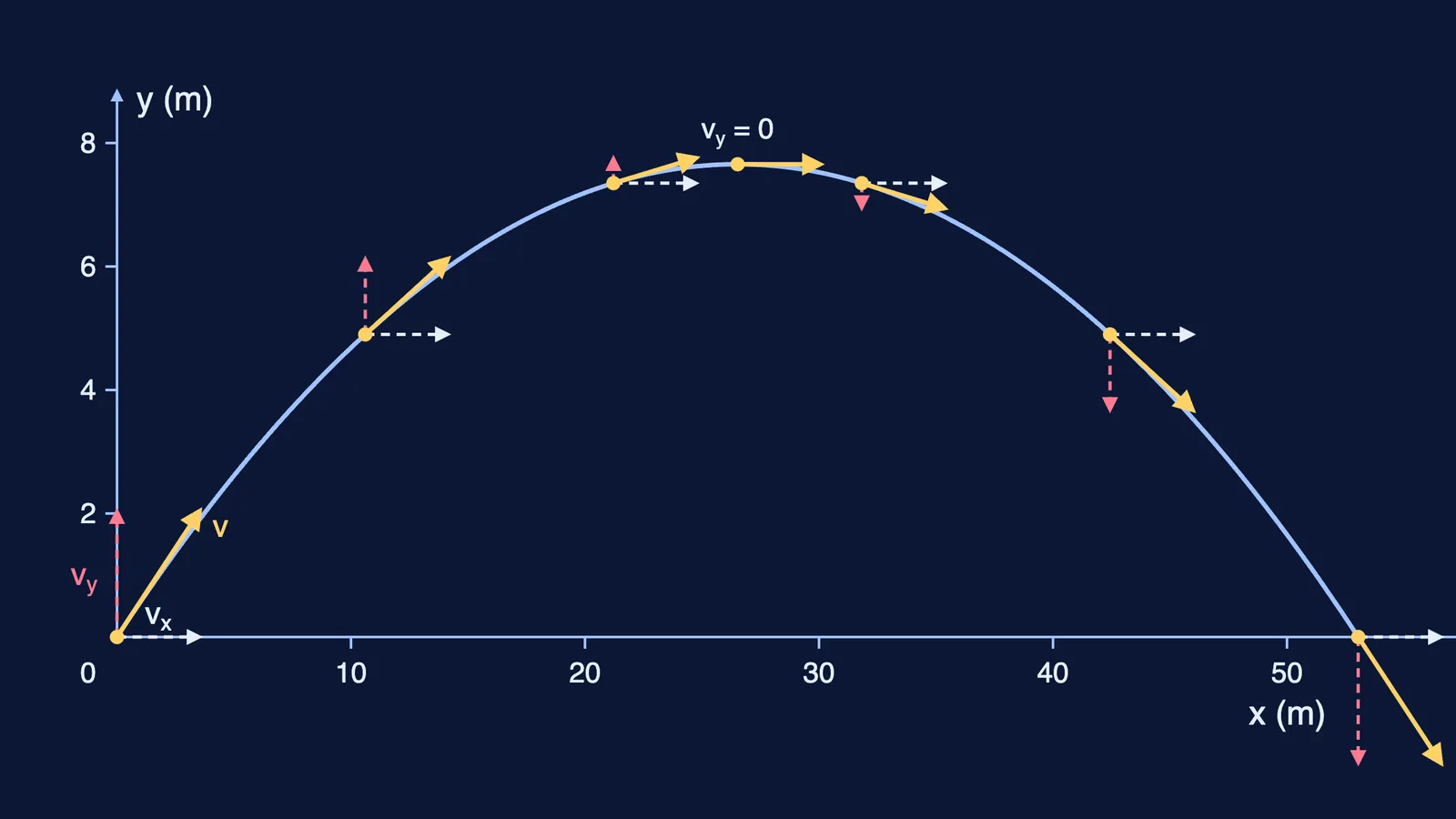
Horizontal and vertical motion share only the time t. NCERT's results are tm = vo sin θo / g, Tf = 2 vo sin θo / g, hm = (vo sin θo)² / 2g and R = vo² sin 2θo / g.
Example 2. A ball is kicked from level ground at vo = 24.5 m/s, θo = 30°, g = 9.8 m/s².
Components: vox = 24.5 cos 30° = 21.2 m/s; voy = 24.5 sin 30° = 12.25 m/s
Time to the top: tm = 12.25/9.8 = 1.25 s
Time of flight: Tf = 2 × 1.25 = 2.50 s
Maximum height: hm = 12.25² / (2 × 9.8) = 150.06/19.6 = 7.66 m
Range: R = vox × Tf = 21.2 × 2.50 = 53.0 m. Check: 24.5² × sin 60° / 9.8 = 53.0 m
At t = 2.0 s: vx = 21.2 m/s; vy = 12.25 − 19.6 = −7.35 m/s; speed = √(21.2² + 7.35²) = 22.5 m/s, 19.1° below the horizontal
The curriculum points to CBSE's Class 12 paper for question design. Its 2026-27 Physics sample paper bans calculators, and the marking scheme marks numericals in half-mark steps.
What should you know about uniform circular motion?
Speed is constant but direction changes, so there is an acceleration towards the centre, of magnitude ac = v²/R = ω²R, with v = Rω and ω = 2πν.
Example 3. The tip of a fan blade, 0.50 m from the axis, makes 2 revolutions per second. ω = 2π × 2 = 12.6 rad/s; v = 12.6 × 0.50 = 6.28 m/s; ac = 6.28²/0.50 = 79 m/s², towards the centre. Its direction keeps changing, so it is not a constant vector.
Which board-style questions should you practise?
Written for this guide:
(1 mark) A projectile's horizontal velocity component during flight is (a) increasing (b) decreasing (c) constant (d) zero. Answer: (c).
(1 mark, assertion-reason) A: in uniform circular motion speed is constant. R: the acceleration is zero. Answer: A true, R false.
(2 marks) Find the magnitude and direction of A = 8î − 15ĵ m. Answer: 17 m, 61.9° below the x-axis.
(3 marks) A ball is thrown horizontally at 12 m/s from 19.6 m. Find time to land, horizontal distance and landing speed. Answer: 2.0 s, 24 m, 23.0 m/s.
(5 marks) Show a projectile's path is a parabola, then find the speed giving a maximum range of 40 m. Answer: 19.8 m/s.
Also preparing for JEE Main? Our kinematics guide for JEE Main adds relative velocity; the Class 12 vector algebra board guide takes vectors further. If you get stuck partway through a derivation, Fermi's AI tutor works out what you already know and builds a plan for the session, so you restart from the step that tripped you.