On this page
Preparing thermal physics for JEE Advanced means learning to pick the right law, combine two ideas and check each answer against a limiting case. Below: the official list, what goes beyond Main, examples and a plan.
What does the JEE Advanced 2026 syllabus include in thermal physics?
The official JEE (Advanced) 2026 syllabus states that it is the same as the 2025 syllabus. Its Thermal Physics list reads: thermal expansion of solids, liquids and gases; calorimetry, latent heat; heat conduction in one dimension; elementary concepts of convection and radiation; Newton's law of cooling; ideal gas laws; specific heats (Cv and Cp for monoatomic and diatomic gases); isothermal and adiabatic processes, bulk modulus of gases; equivalence of heat and work; first law of thermodynamics and its applications (only for ideal gases); second law of thermodynamics, reversible and irreversible processes, Carnot engine and its efficiency; blackbody radiation: absorptive and emissive powers; Kirchhoff's law; Wien's displacement law, Stefan's law.
The 2027 syllabus is not yet published (as of 19 November 2026), so use this list. The JEE (Advanced) home page says the 2027 exam is on 23 May 2027 (Sunday), organised by IIT Delhi. One eligibility criterion is a place in the top 2,50,000 of the JEE (Main) 2027 B.E./B.Tech paper.
How is JEE Advanced thermal physics different from JEE Main?
The JEE (Main) 2027 syllabus covers expansion, calorimetry, heat transfer and the first and second laws. The Advanced list also names items the Main list does not: Newton's law of cooling, the Carnot engine and its efficiency, absorptive and emissive powers, Kirchhoff's law of radiation, Wien's displacement law and Stefan's law.
The 2026 Information Brochure describes two compulsory papers of three hours each; question types and marking are announced in the paper, so see our JEE Advanced question types. If basics are shaky, start with the Thermodynamics for JEE Main guide and the Class 11 thermal properties notes.
Worked example 1: what does a gas mixture's γ change?
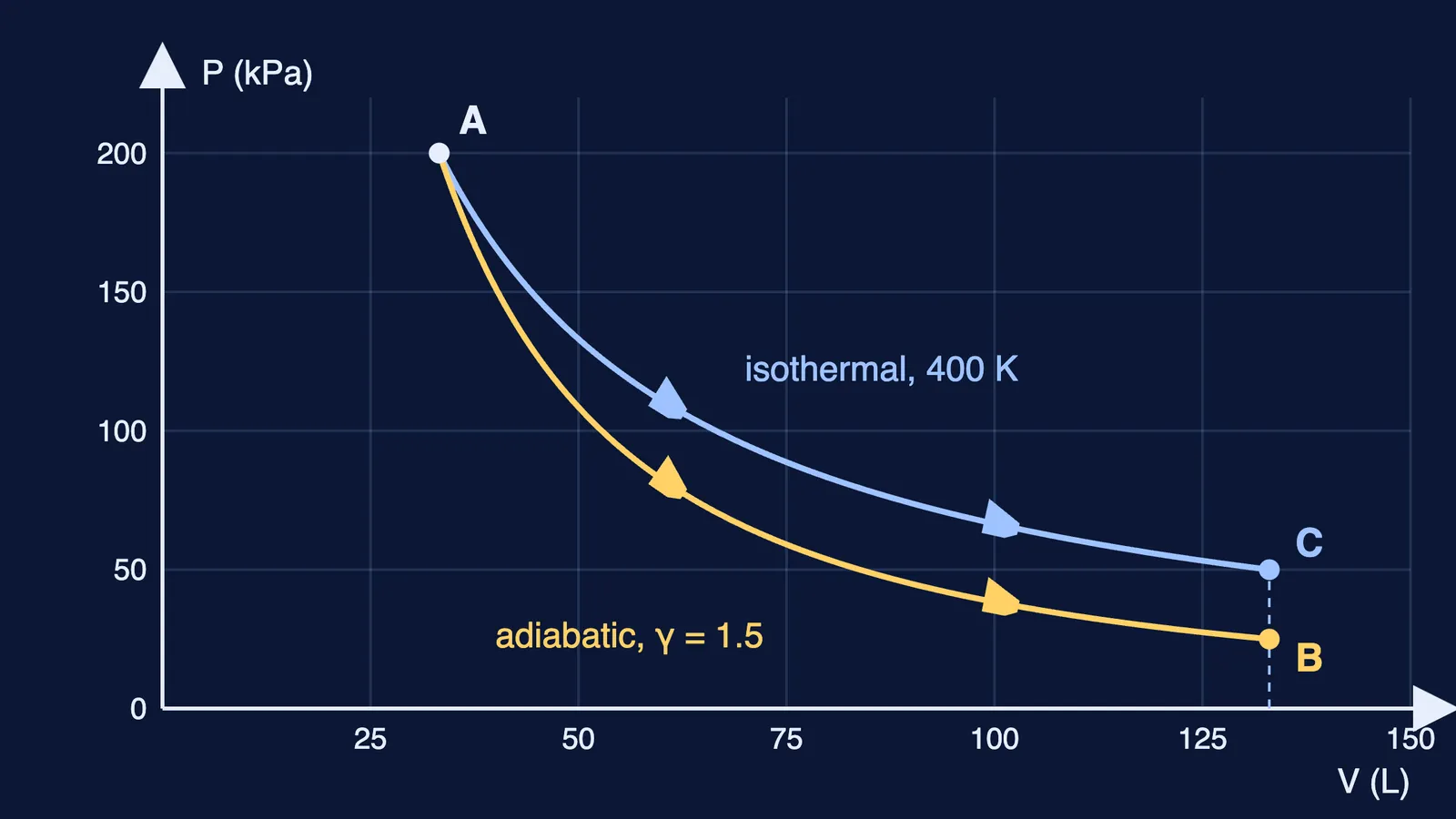
Problem. 1 mol of helium and 1 mol of nitrogen at 400 K and 200 kPa expand reversibly and adiabatically to four times their volume. Find the final temperature, pressure and work done by the gas.
Average heat capacities, not γ: Cv = (3R/2 + 5R/2)/2 = 2R, Cp = 3R, γ = 1.5.
TV^(γ−1) is constant: T = 400 / 4^0.5 = 200 K.
PV^γ is constant: P = 200 / 4^1.5 = 25 kPa.
Work by the gas = nCv(T₁ − T₂) = 2 × 2R × 200 ≈ 6.65 kJ, with R = 8.314 J/(mol K) from NIST.
Checks. γ = 1.5 lies between 7/5 and 5/3, as it must. Averaging γ values gives 1.533 and about 191 K, a likely trap. Isothermal expansion ends at 50 kPa: the adiabat is steeper.
Hard to picture adiabats? Fermi Simulation Lab has interactive simulations for the ideas that are easier to see than to read.
Worked example 2: when does Newton's law of cooling break down?
Problem. A small blackbody of area 0.02 m² sits in surroundings at 300 K. Find its net radiated power at 310 K and 400 K, exactly and by Newton's law of cooling.
Stefan's law: net power = σA(T⁴ − T₀⁴), with σ = 5.670 × 10⁻⁸ W m⁻² K⁻⁴ from NIST.
At 310 K: σ × 0.02 × (310⁴ − 300⁴) ≈ 1.29 W.
For small ΔT, T⁴ − T₀⁴ ≈ 4T₀³ΔT, which is Newton's law of cooling: 4σA(300)³ × 10 ≈ 1.22 W, about 5% low.
At 400 K: exact ≈ 19.8 W, linear ≈ 12.2 W, about 38% low.
Lesson. Newton's law is the small-gap limit of Stefan's law; for large gaps, use T⁴.
How should you practise thermal physics for JEE Advanced?
A four-week plan:
Week 1: expansion, calorimetry, latent heat. Check whether all the ice melts.
Week 2: conduction in series and parallel, radiation, cooling.
Week 3: first law, PV graphs, mixtures, bulk modulus, Carnot cycles.
Week 4: timed mixed problems; redo every miss.
Unsure where a method went wrong? The Fermi Problem Library has worked problems with a step-by-step solver that explains the reasoning rather than printing an answer.
Practice:
A glass flask is filled with 500 cm³ of liquid. The liquid's volume expansivity is 5.0 × 10⁻⁴ K⁻¹; the glass's linear expansivity is 1.0 × 10⁻⁵ K⁻¹. How much spills after both warm by 40 K? Answer: 500 × (5.0 × 10⁻⁴ − 3.0 × 10⁻⁵) × 40 = 9.4 cm³.
A Carnot engine takes heat from a source at 600 K with efficiency 0.35. How far must the sink temperature fall for 0.45? Answer: from 390 K to 330 K, a fall of 60 K.
80 g of ice at −10 °C is dropped into 150 g of water at 35 °C. Take c(water) = 4.2 J/(g K), c(ice) = 2.1 J/(g K), L = 336 J/g, no container heat. Answer: not all the ice melts; it ends at 0 °C with about 19.4 g of ice left.