On this page
JEE (Advanced) 2027 will be held on 23 May 2027 (Sunday), organised by IIT Delhi, says the official JEE (Advanced) website. You need to be in the top 2,50,000 of the JEE (Main) 2027 B.E./B.Tech paper, says the eligibility page. JEE (Advanced) 2026 had two compulsory papers of three hours each, according to the 2026 Information Brochure. Question types change yearly; see JEE Advanced question types.
What does the JEE Advanced syllabus say about laws of motion and friction?
The official JEE (Advanced) 2026 syllabus lists, under Mechanics: "Newton's laws of motion; Inertial and uniformly accelerated frames of reference; Static and dynamic friction". It says 2026 is unchanged from 2025. As of 19 November 2026, the 2027 syllabus is not yet published.
Unit 3 of NTA's JEE (Main) 2027 syllabus covers Newton's laws and static and kinetic friction, but does not name uniformly accelerated frames of reference. So practise problems inside an accelerating lift, cart or wedge, solved with a pseudo force ma opposite to the frame's acceleration. For the basics, see our Laws of Motion guide for JEE Main.
How do you solve friction in an accelerating frame?
A 2 kg block rests on a slope (sin θ = 3/5, static friction coefficient 0.25) fixed to a cart, rising towards the cart's back. The cart accelerates forward at a; g = 10 m/s². Which statements are true?
In the cart's frame, a backward pseudo force ma pushes the block into the slope and up it.
N = m(g cos θ + a sin θ); without friction, the force up the slope is m(a cos θ − g sin θ).
The block stays put while |a cos θ − g sin θ| ≤ μ(g cos θ + a sin θ). So a runs from g(sin θ − μ cos θ)/(cos θ + μ sin θ) ≈ 4.21 m/s² to g(sin θ + μ cos θ)/(cos θ − μ sin θ) ≈ 12.3 m/s².
At a = 7.5 m/s², friction on the block is zero: true, since a cos θ = g sin θ.
At a = 5 m/s², friction is 4 N up the slope: true. N = 22 N, so it could reach 5.5 N, but static friction supplies only what is needed.
At a = 5 m/s², friction equals μN = 5.5 N: false, a common trap.
Any acceleration above 4.21 m/s² keeps the block at rest: false, beyond about 12.3 m/s² it slides up.
Checks: with μ = 0 both limits become g tan θ = 7.5 m/s². If μ were 4/3 (cot θ) or more, there would be no upper limit: the block could never slide up.
When do two blocks stop moving together?
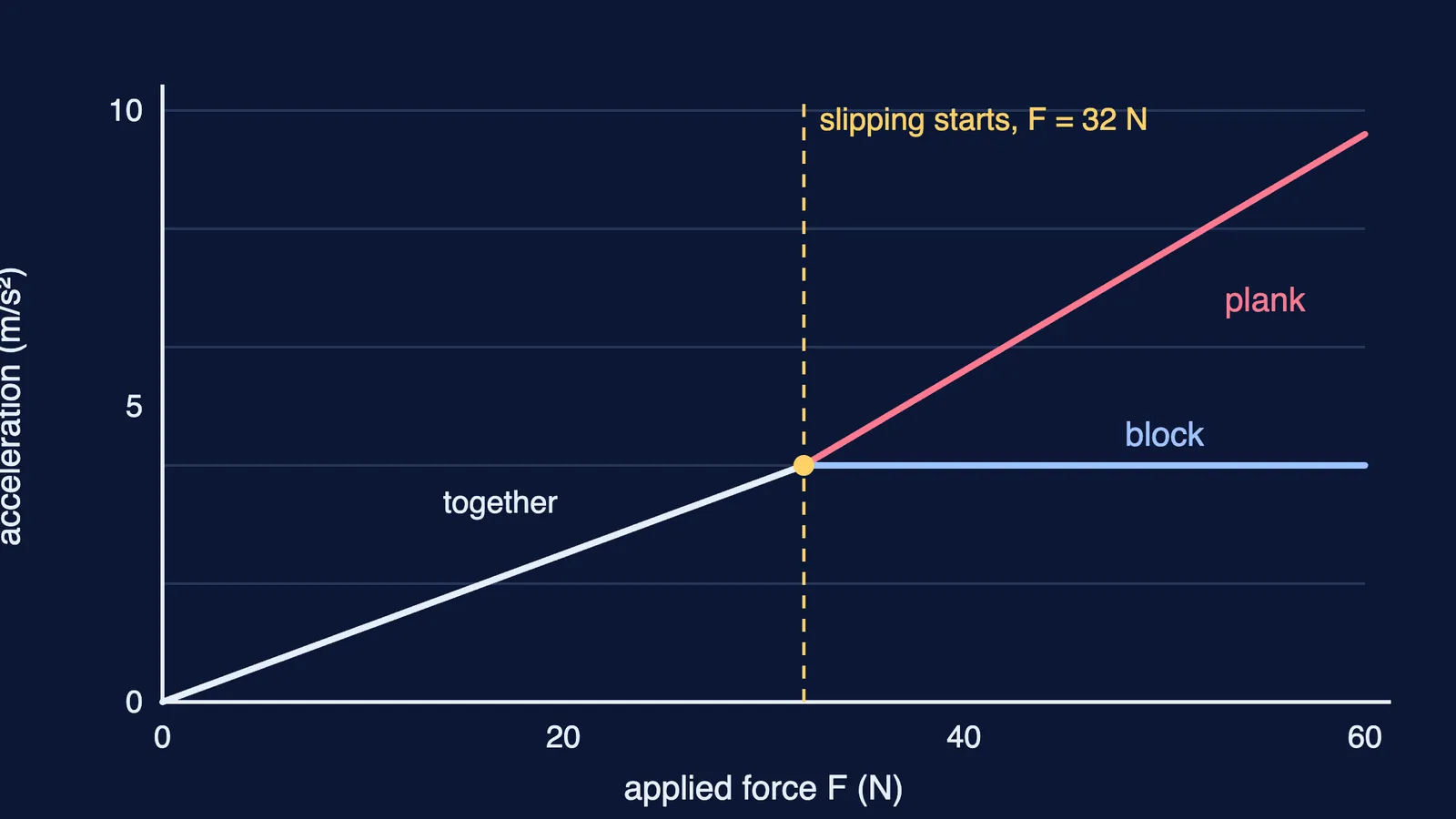
A 3 kg block rests at the front of a 1.8 m, 5 kg plank on a smooth floor. Friction coefficient between them: 0.4 (static and kinetic equal). A force F pulls the plank forward; g = 10 m/s².
Friction alone drives the block, so its largest acceleration is μg = 4 m/s².
They move together while F/(3 + 5) ≤ 4, up to F = 32 N.
At F = 24 N they share 3 m/s², and friction on the block is 3 × 3 = 9 N, not μN = 12 N.
At F = 40 N they slip. Block: 4 m/s². Plank: (40 − 12)/5 = 5.6 m/s². The block slides 1.8 m back along the plank in t = √(2 × 1.8/1.6) = 1.5 s and falls off.
Check: in 1.5 s the block moves 4.5 m and the plank 6.3 m, 1.8 m apart. Friction on the block points forward: it opposes relative sliding.
Hard to picture which surface slips? Fermi Simulation Lab has interactive simulations for the ideas that are easier to see than to read.
How should you practise laws of motion for JEE Advanced?
Week 1: free-body diagrams, pulleys and constraints; one equation per body.
Week 2: accelerating frames; solve each problem from the ground, then with a pseudo force.
Week 3: friction; assume no slipping, find the friction needed, then compare it with μN.
Week 4: mixed problems; judge each statement separately.
Stuck on where a method went wrong? The Fermi Problem Library has worked problems with a step-by-step solver that explains the reasoning rather than printing an answer.
Try these, then check:
A 12 N horizontal pull acts on a 4 kg box on a lift floor (static friction coefficient 0.25, g = 10 m/s²). Does it move with the lift at rest, or accelerating up at 3 m/s²?
A 2 kg block slides on a lift floor with kinetic friction coefficient 0.3. Find the friction when the lift accelerates up at 2 m/s², and down at 4 m/s².
Answers: at rest it slides (limit 10 N); accelerating up it stays put, held by 12 N of friction (limit 13 N). Friction is 7.2 N going up, 3.6 N going down.
For Class 11 foundations, see our Laws of Motion Class 11 guide.