On this page
This unit rewards students who can hold two equilibria in mind at once: a Ksp question quietly becomes a buffer question, and a Kp question turns on what Q does when the volume changes. Below: the official syllabus, how Advanced goes deeper than JEE Main, three original solved problems and a practice plan.
What is in the JEE Advanced chemical and ionic equilibrium syllabus?
The official JEE (Advanced) 2026 syllabus lists: "Law of mass action; Significance of ∆G and ∆G⊖ in chemical equilibrium; Equilibrium constant (Kp and Kc) and reaction quotient, Le Chatelier's principle (effect of concentration, temperature and pressure); Solubility product and its applications, common ion effect, pH and buffer solutions; Acids and bases (Brønsted and Lewis concepts); Hydrolysis of salts." The same document notes that the 2026 syllabus is unchanged from 2025. The 2027 syllabus has not been published yet (as of 19 November 2026).
What is announced: JEE (Advanced) 2027 will be held on 23 May 2027 (Sunday), organised by IIT Delhi. To appear, you must be among the top 2,50,000 successful candidates in the B.E./B.Tech. paper of JEE (Main) 2027, plus the other criteria there.
How is JEE Advanced equilibrium different from JEE Main?
On paper, very little. The JEE (Main) 2027 syllabus covers the same ideas, and also lists physical-process equilibria and Henry's law, which the Advanced unit does not. The Advanced list names two things explicitly: the reaction quotient, and "applications" of the solubility product. If you have finished our equilibrium guide for JEE Main, the syllabus is not the gap. Depth is.
The JEE (Advanced) 2026 Information Brochure says the exam has two compulsory papers of three hours each. Question types and marking are announced in the paper itself, so practise single-correct, multiple-correct and numerical answers. Our post on how partial marking works in multiple-correct questions explains why one wrong option can cost you more than leaving it blank.
Three habits make the difference:
Write Q before you move. Compare Q with K after every disturbance; don't just recite Le Chatelier.
Know which quantity is fixed. A buffer fixes pH, and so [OH⁻]; a rigid vessel fixes volume; a constant-pressure vessel does not.
Check a limiting case. Push a concentration to zero or a constant to infinity and ask whether your formula still makes sense.
Worked examples at Advanced level
All numbers are our own; the species are hypothetical.
1. Volume change and α. For A(g) ⇌ 2B(g), Kp = 0.50 bar. Pure A at 1.0 bar is sealed in a rigid vessel. Let A lose x bar: 4x²/(1 − x) = 0.50, so x = 0.297 bar. Then pA = 0.703 bar, pB = 0.593 bar and α = 0.297. Now double the volume at the same temperature. Both pressures halve, so Q = (0.297)²/0.352 = 0.25, below Kp: the reaction moves forward. Solving again gives pA = 0.305 bar, pB = 0.390 bar and α = 0.390. Kp is unchanged, yet α rises.
2. Ksp inside a buffer. A sparingly soluble M(OH)₂ has Ksp = 2.0 × 10⁻¹⁵ M³. Find its solubility in a buffer of 0.30 M base B and 0.10 M BH⁺ (pKb = 4.70). pOH = 4.70 + log(0.10/0.30) = 4.22, so [OH⁻] = 5.99 × 10⁻⁵ M. The buffer holds [OH⁻] fixed, so s = Ksp/[OH⁻]² = 5.6 × 10⁻⁷ M. In pure water, s = (Ksp/4)^(1/3) = 7.9 × 10⁻⁶ M, about 14 times more. Dimension check: M³ divided by M² gives M.
3. Hydrolysis and a limiting case. A salt BH⁺A⁻ is made from a weak acid HA (pKa = 4.80) and a weak base B (pKb = 4.20). The standard result pH = 7 + (pKa − pKb)/2 gives 7.30, with no concentration in it. Solving the full equilibrium gives 7.30 at 0.10 M, 7.23 at 10⁻⁴ M and 7.07 at 10⁻⁵ M. The formula drops [H⁺] and [OH⁻] from the charge balance; at high dilution they matter, so pH drifts towards 7.
Stuck on why a step works rather than what the answer is? The Fermi Problem Library has worked problems with a step-by-step solver that explains the reasoning rather than printing an answer.
How should you practise this unit?
Revise definitions with our Class 11 equilibrium guide if any feel shaky.
Spend one week on gas-phase equilibria: Kp, Kc, Q, and changes in volume, inert gas and temperature.
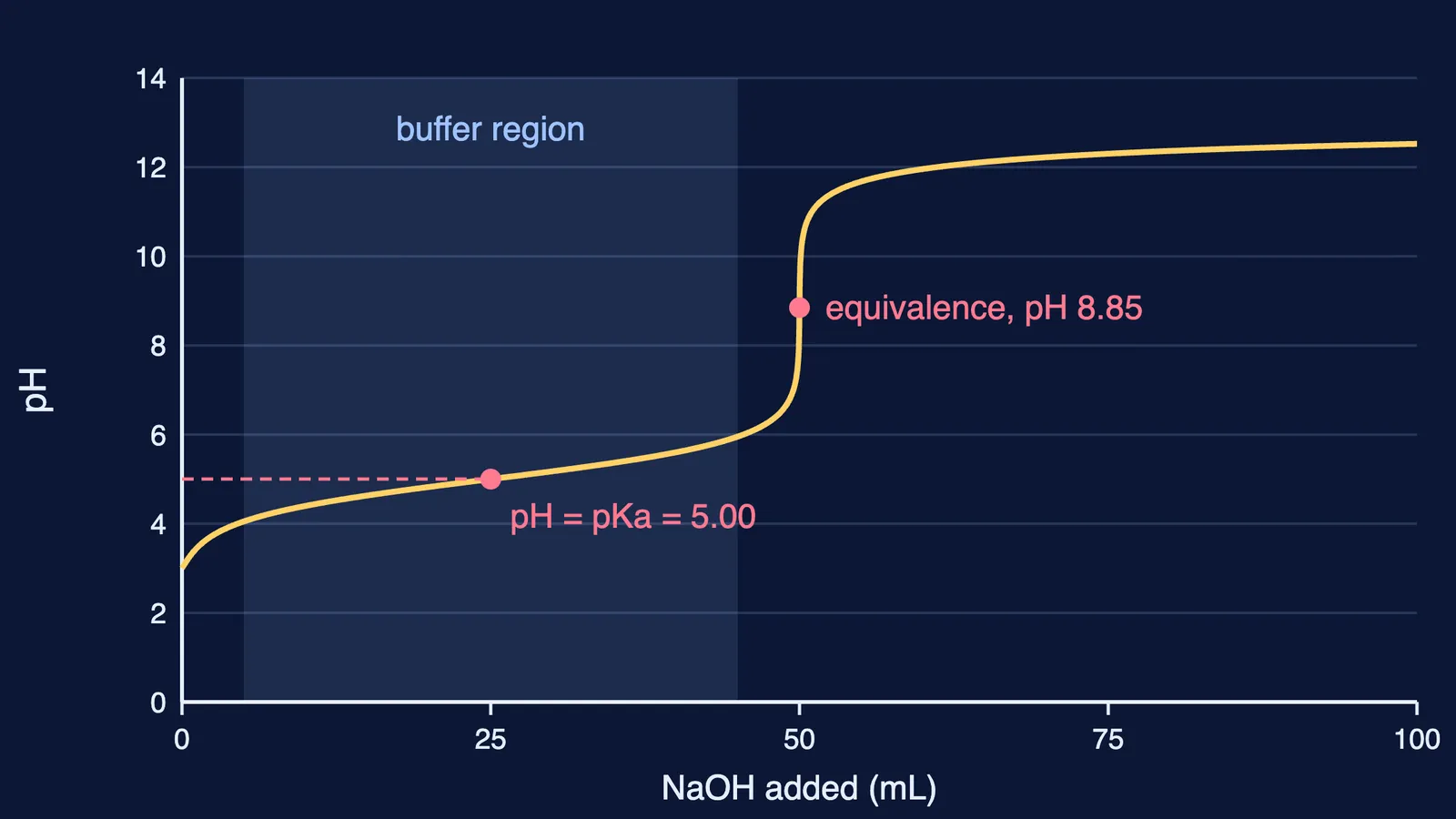
Spend one week on ionic equilibria: weak acids, buffers, hydrolysis and titration curves.
Spend one week on combined problems (Ksp with buffers, common ions, pH) as multiple-correct sets.
For every problem, note which quantity is fixed and check one limiting case.
Practice:
Repeat example 1 starting from pure A at 2.0 bar. Find α, and say why it is smaller.
Find the pH of 0.010 M HX, pKa = 5.00.
How many moles of solid NaOH, added to 1 L of 0.10 M HX (pKa = 5.00) without volume change, give pH 5.30?
Answers: α = 0.221 (higher pressure favours fewer moles of gas); pH 3.51; 0.0666 mol.