On this page
JEE (Advanced) 2027 will be held on 23 May 2027 (Sunday), organised by IIT Delhi, says the official JEE (Advanced) website. To sit it, you need to be among the top 2,50,000 candidates in the B.E./B.Tech paper of JEE (Main) 2027, as the eligibility page states. The 2026 Information Brochure says the 2026 exam had two papers of three hours each, both compulsory, with the marking scheme given only in the exam-day instructions.
What does the JEE Advanced syllabus say about gravitation?
The official JEE (Advanced) 2026 syllabus lists, under Mechanics: "Law of gravitation; Gravitational potential and field; Acceleration due to gravity; Kepler's law, Geostationary orbits, Motion of planets and satellites in circular orbits; Escape velocity." The same document notes that the 2026 syllabus is unchanged from 2025. As of 19 November 2026, the 2027 syllabus has not been published.
Unit 6 of NTA's JEE (Main) 2027 syllabus covers the same core: the law of gravitation, g and its variation with altitude and depth, Kepler's law, potential energy and potential, escape velocity, and satellite speed, period and energy. The Advanced list names two things the Main list does not: the gravitational field and geostationary orbits. The bigger difference is depth. Expect problems that join potential, energy and Kepler's laws, and practise judging several statements one by one. If basics feel shaky, start with our gravitation guide for JEE Main.
How do field and potential change inside a planet?
A uniform planet has radius 4000 km and surface gravity 6 m/s². A narrow shaft is drilled to a point A halfway to the centre. Which statements are true?
Inside a uniform sphere, g grows in proportion to r. At r = R/2, g = 6 × 1/2 = 3 m/s².
Outside, g falls as 1/r². At r = 2R (height R), g = 6/4 = 1.5 m/s².
Inside, V = −GM(3R² − r²)/(2R³). At r = R/2 this is −(11/8)GM/R.
Escape from A needs ½v² = (11/8)GM/R, so v = √(11gR/4) ≈ 8.12 km/s.
g at A equals g at height R: false, it is twice as large.
The potential at A is 11/8 of the surface potential: true.
From A, an object needs the surface escape speed √(2gR) ≈ 6.93 km/s: false, it needs 8.12 km/s.
g at A is 3 m/s²: true.
Checks: at r = R the inside formula gives −GM/R, the surface value; at r = 0 it gives −1.5GM/R, the bottom of the well.
How do you move a satellite into a stationary orbit?
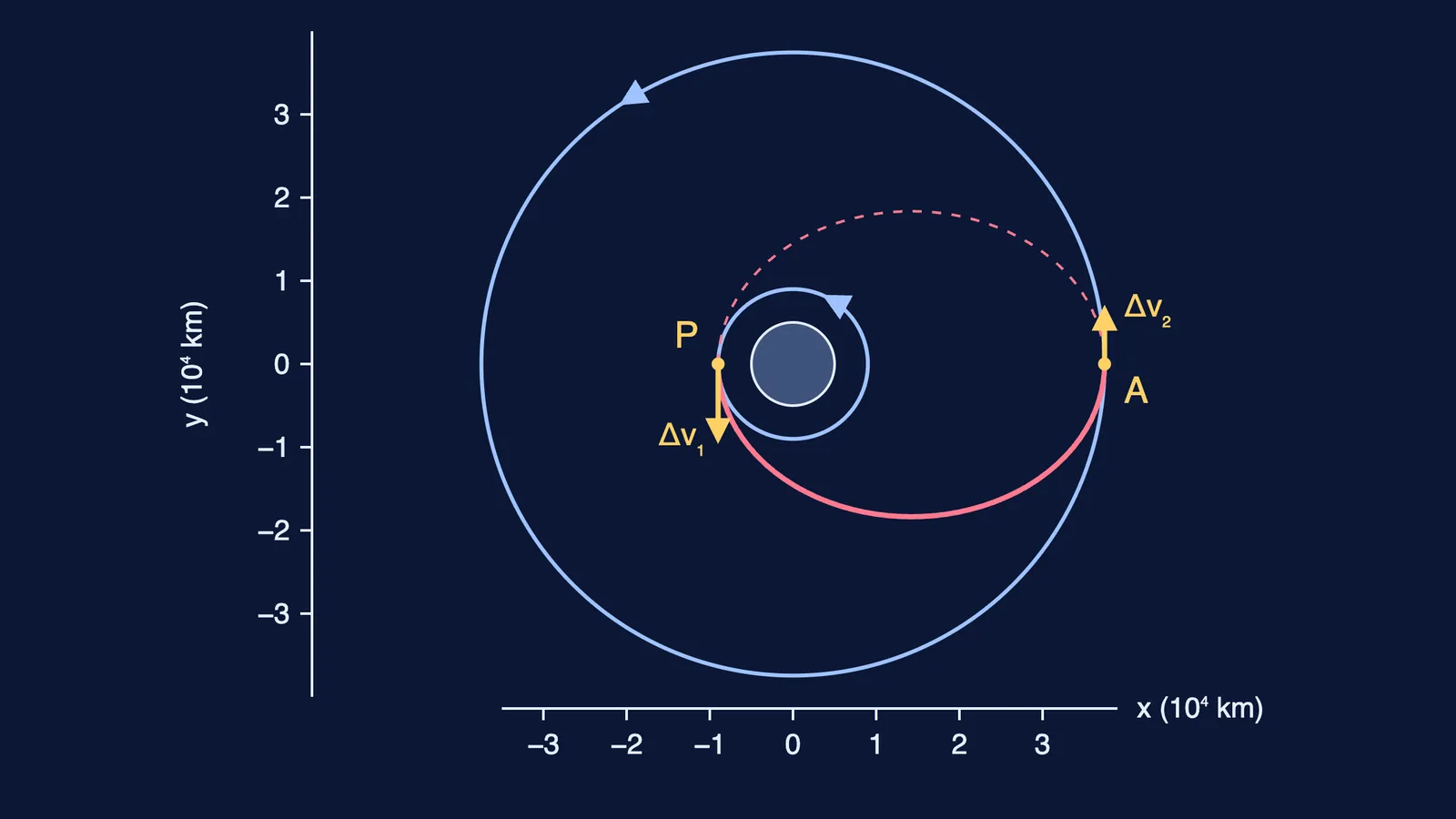
A planet of radius 5000 km has GM = 4.0 × 10¹⁴ m³/s² and turns once in 20 hours. A satellite circles it at 9000 km from the centre. It is fired forward at P to enter an ellipse that just reaches the stationary orbit at A, then fired forward again at A.
Stationary orbit: period 72,000 s, so r = (GM T²/4π²)^(1/3) ≈ 37,450 km.
Speed in the low orbit: √(GM/r) ≈ 6.67 km/s.
Speed at P on the ellipse: v = √(2GM·r_A/(r_P(r_P + r_A))) ≈ 8.47 km/s, so the first boost is ≈ 1.80 km/s.
Angular momentum is conserved, so v_A = v_P·r_P/r_A ≈ 2.03 km/s. The circular speed at A is ≈ 3.27 km/s, so the second boost is ≈ 1.23 km/s.
Kepler's third law with a = 23,225 km gives the transfer time (half a period): ≈ 4.88 hours.
Checks: set r_A = r_P and step 3 returns the circular speed. The total energy −GM/2a comes out the same at P and at A.
Hard to picture an ellipse with the planet at one focus? Fermi Simulation Lab has interactive simulations for the ideas that are easier to see than to read.
How should you practise gravitation for JEE Advanced?
Week 1: field and potential of shells and solid spheres, inside and outside; sketch g and V against r.
Week 2: escape and reaching a given height; write energy at both ends first.
Week 3: satellites and Kepler's laws: circular orbits, ellipses via angular momentum and energy.
Week 4: timed mixed problems; judge each multiple-correct option on its own, as our guide to partial marking in multiple-correct questions explains.
Stuck on where a method went wrong? The Fermi Problem Library has worked problems with a step-by-step solver that explains the reasoning rather than printing an answer.
Try these, then check:
A uniform planet has radius 3000 km. At what height above the surface is g equal to its value at depth R/3?
A satellite's closest and farthest distances from a planet's centre are 8000 km and 24,000 km. Find the ratio of its speeds there, and its period divided by that of a circular orbit of radius 8000 km.
On a planet with radius 3000 km and g = 4 m/s², what launch speed takes a stone to height R?
Answers: about 674 km; speed ratio 3, period ratio 2√2 ≈ 2.83; about 3.46 km/s.