On this page
JEE (Advanced) 2027 will be held on 23 May 2027, a Sunday, with IIT Delhi as the organising institute, according to the official JEE (Advanced) website. The 2027 syllabus has not been published yet, so this guide works from the official 2026 syllabus, which says it is unchanged from 2025. Integral calculus rewards a specific kind of practice at this level: fewer drill sums, more problems where two ideas meet.
What does the JEE Advanced syllabus say about integral calculus?
The JEE (Advanced) 2026 syllabus lists, under Mathematics, Integral Calculus:
Integration as the inverse process of differentiation, indefinite integrals of standard functions
Definite integrals as the limit of sums, definite integral and their properties, fundamental theorem of integral calculus
Integration by parts, integration by the methods of substitution and partial fractions
Application of definite integrals to the determination of areas bounded by simple curves
The same block also covers differential equations, which deserve their own preparation. Unit 8 of the JEE (Main) 2027 syllabus covers similar methods, but its text does not mention definite integrals as the limit of sums; the Advanced list does. If your basics are shaky, start with our guides to indefinite integrals for JEE Main and definite integrals and area for JEE Main.
How is integration for JEE Advanced different from JEE Main?
The 2026 Information Brochure says JEE (Advanced) 2026 had two papers of three hours each, and appearing in both was compulsory. It also says details of the marking scheme are given in the "Instructions to Candidates" at the time of the exam, so do not prepare for one fixed pattern. Our explainer on JEE Advanced question types covers multiple-correct and numerical-answer thinking.
What changes is depth. A single question may need a limit of a sum, then a property, then a sketch. Three habits help:
Sketch before you integrate. Area is never negative; a signed integral can be.
Check a limiting case. Put x = 0, or let a parameter go to 0, and see if your answer behaves.
Read every option. In a multiple-correct question, test each statement on its own.
What do Advanced-level integral problems look like?
These three are original, and each answer was checked symbolically and numerically.
Example 1 (limit of a sum). Find L = lim (n → ∞) of the sum over k = 1 to 2n of k/(n² + 3k²).
Divide top and bottom by n²: each term is (1/n) × (k/n)/(1 + 3(k/n)²). With x = k/n, x runs from 0 to 2, not 1, because k goes up to 2n. So L = ∫₀² x/(1 + 3x²) dx = (1/6) ln 13 ≈ 0.43. Using 0 to 1 by habit gives (1/6) ln 4 ≈ 0.23, a wrong answer that looks just as plausible.
Example 2 (fundamental theorem). A differentiable f has f(0) = 2 and ∫₀ˣ f(t) dt = x f(x) − x³ for all x. Find f(3).
Differentiate both sides: f(x) = f(x) + x f′(x) − 3x², so f′(x) = 3x. Then f(x) = (3/2)x² + 2 and f(3) = 15.5. Check by substituting back: both sides equal x³/2 + 2x.
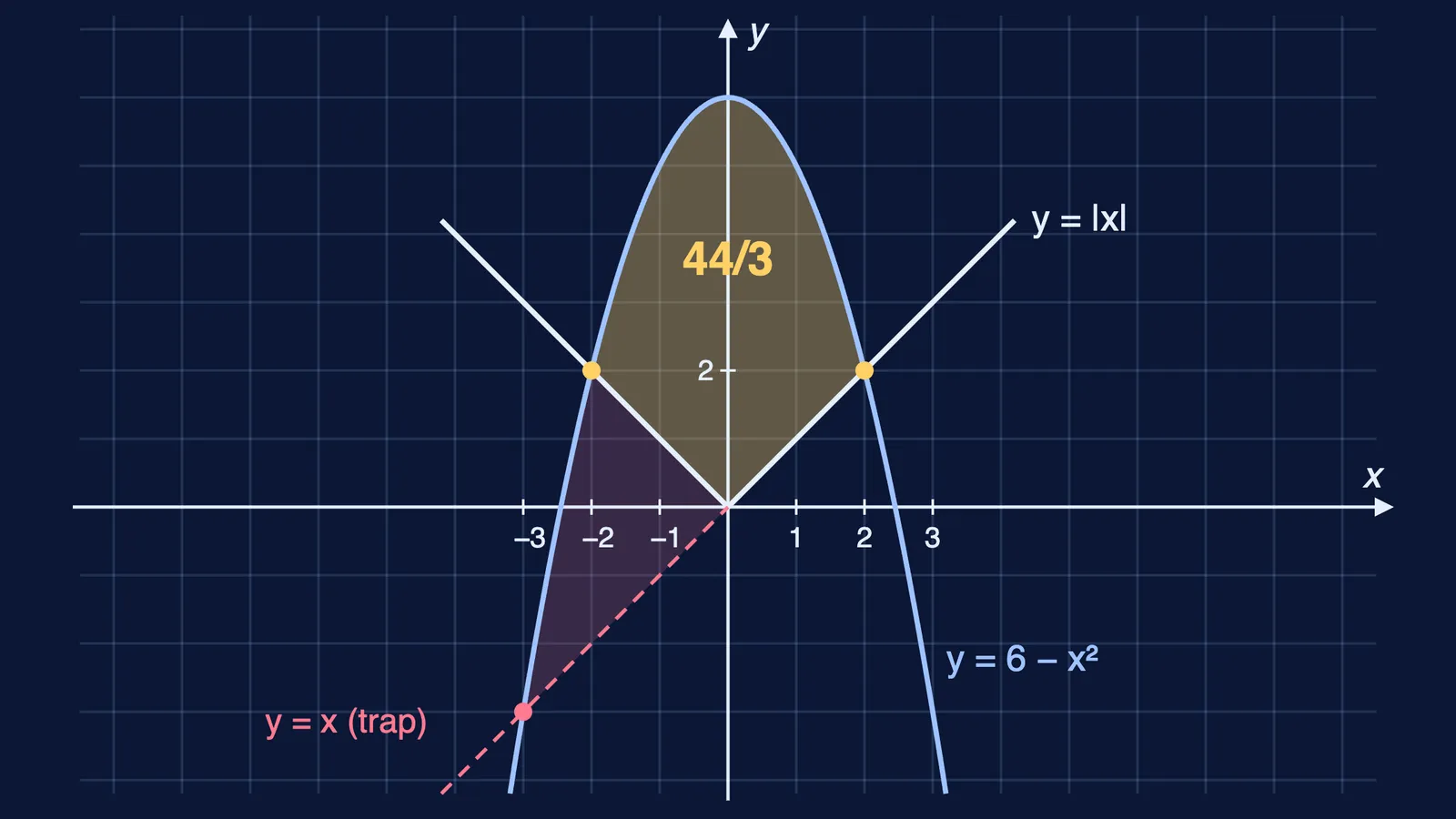
Example 3 (area with a modulus). Find the area enclosed by y = 6 − x² and y = |x|.
The curves meet where 6 − x² = x for x ≥ 0, so x = 2, and by symmetry at x = −2. Area = 2∫₀² (6 − x² − x) dx = 44/3 ≈ 14.67. If you read |x| as x, you get intersections at −3 and 2 and an area of 125/6 ≈ 20.83.
How should you plan your integral calculus preparation?
Week 1: standard integrals, substitution, parts and partial fractions, timed, with a one-line reason for each choice of method.
Week 2: definite integral properties (symmetry, a + b − x, even and odd functions) and limits of sums.
Week 3: the fundamental theorem with variable limits, and functional equations like Example 2.
Week 4: areas with modulus, piecewise and inverse-function curves; mixed sets under time.
Keep an error log by type: wrong limits, lost modulus, sign of area, missed property. Not sure why a step works? The Fermi Problem Library has worked problems with a step-by-step solver that explains the reasoning rather than printing an answer.
Practice questions
Find lim (n → ∞) of the sum over k = 1 to n of n²/(n + 2k)³.
Evaluate ∫₁⁵ [(x − 3)³ e^((x − 3)²) + |x − 3|] dx.
If g(x) = ∫ from x to 2x of dt/(1 + t³), find g′(1).
Answers: 1. 2/9; 2. 4 (the cubic term is odd about x = 3); 3. −5/18.