On this page
Preparing electrostatics for JEE Advanced means learning to join two ideas, such as Gauss's law and potential, and to spot what a question leaves unsaid.
JEE (Advanced) 2027, organised by IIT Delhi, is on 23 May 2027 (Sunday), per the official website. You need to be in the top 2,50,000 of the JEE (Main) 2027 B.E./B.Tech paper (eligibility).
What does the JEE Advanced syllabus include for electrostatics?
The 2027 syllabus is not published yet, so follow the JEE (Advanced) 2026 syllabus, unchanged from 2025. Under Electricity and Magnetism it lists:
Coulomb's law; electric field and potential
Electrical potential energy of a system of point charges and of electrical dipoles in a uniform electrostatic field
Electric field lines; flux of electric field
Gauss's law and its application in simple cases, such as, to find field due to infinitely long straight wire, uniformly charged infinite plane sheet and uniformly charged thin spherical shell
Capacitance; parallel plate capacitor with and without dielectrics; capacitors in series and parallel; energy stored in a capacitor
How is JEE Advanced electrostatics different from JEE Main?
The topic lists are close. The JEE (Main) 2027 syllabus names items the Advanced list does not spell out, such as equipotential surfaces and torque on a dipole, while Advanced asks for the potential energy of a system of point charges where Main says two. The real gap is depth. The 2026 Information Brochure says both three-hour papers are compulsory, questions test comprehension, reasoning and analytical ability, and the marking scheme is given at the exam. Formats can change from year to year, so practise judging each statement on its own, working answers without options and solving two-chapter problems. Our guide to JEE Advanced question types explains the formats; the JEE Main electrostatics guide covers the base.
Worked example 1: zero force, but not zero work
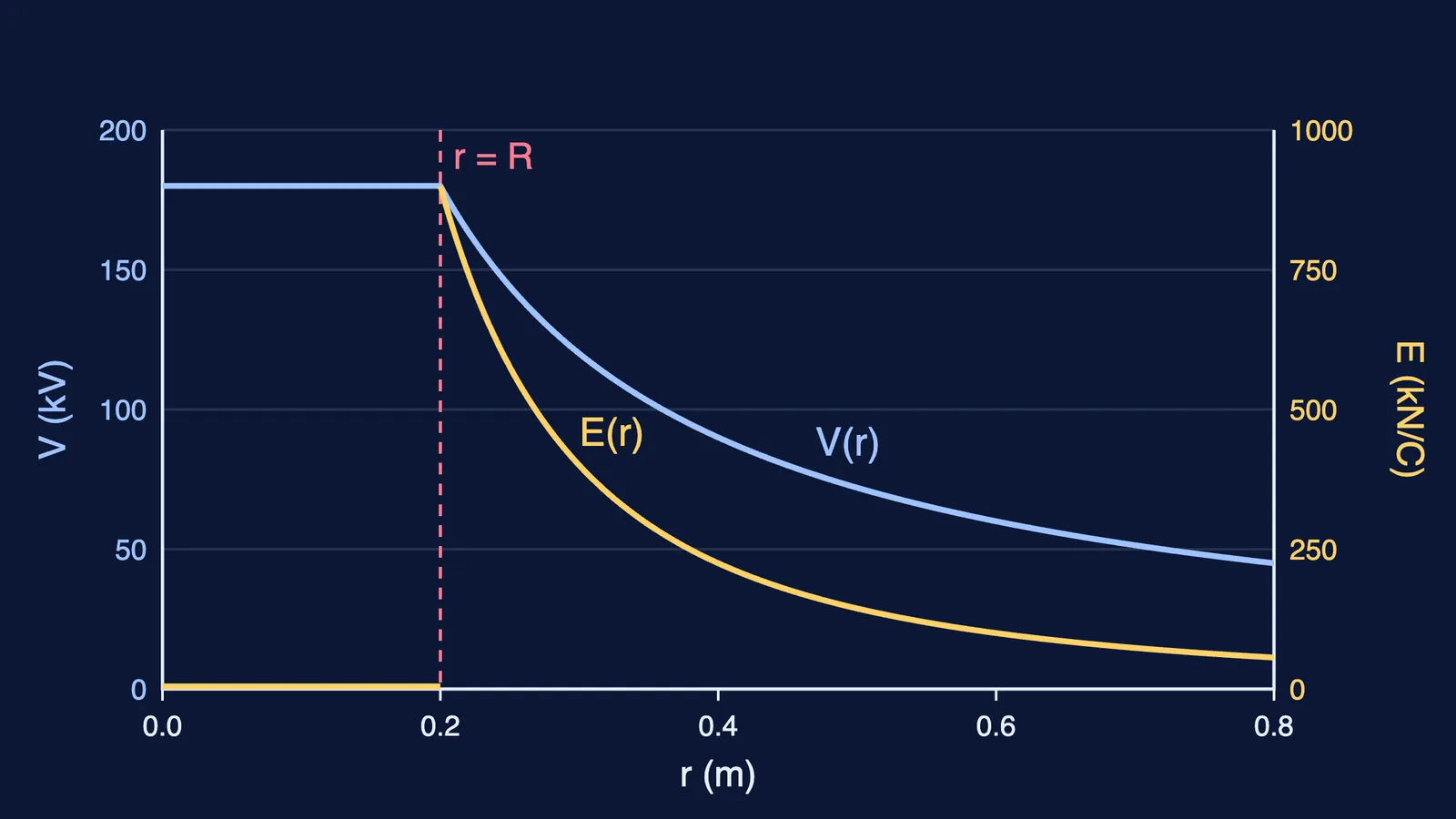
A thin shell of radius 0.20 m carries +4 μC spread uniformly. A charge of −1 μC sits 0.10 m from the centre. Take k = 9 × 10⁹ N m² C⁻². Which is true: (A) the shell exerts no force on the charge; (B) no work is needed to take the charge slowly to infinity?
Gauss's law: a sphere inside the shell encloses none of its charge, so the shell's field there is zero (derivation). (A) is true.
Potential inside equals the surface value: V = kQ/R = 9 × 10⁹ × 4 × 10⁻⁶ / 0.20 = 1.8 × 10⁵ V.
External work = q(V∞ − V) = (−1 × 10⁻⁶)(0 − 1.8 × 10⁵) = +0.18 J. (B) is false: outside the shell the field is not zero.
Check: C × V = J, and opposite charges attract, so positive work fits.
Worked example 2: a slab that is pulled in
A capacitor has plate area 0.02 m² and gap 2 mm. It is charged to 100 V and disconnected. A slab of dielectric constant 4, thickness 1 mm and full plate area is slid in. Use ε₀ = 8.854 × 10⁻¹² F/m.
C₀ = ε₀A/d = 8.854 × 10⁻¹¹ F. Charge Q = C₀V₀ = 8.854 × 10⁻⁹ C, and it stays fixed.
With the slab, C = ε₀A/(d − t + t/K) = ε₀A/(1.25 mm) = 1.6 C₀.
New voltage = 100/1.6 = 62.5 V.
Energy falls from 4.427 × 10⁻⁷ J to 2.767 × 10⁻⁷ J. The field pulls the slab in, so the hand holding it does −1.66 × 10⁻⁷ J of work.
With the battery connected, energy rises by 2.66 × 10⁻⁷ J, the battery supplies twice that and the slab is still pulled in. Limit check: K = 1 gives C = C₀.
Stuck on a step like this? The Fermi Problem Library has worked problems with a step-by-step solver that explains the reasoning rather than printing an answer.
How should you plan four weeks of practice?
Week 1: Coulomb's law, superposition, field lines.
Week 2: flux and Gauss's law for wire, sheet and shell; potential from field and back.
Week 3: energy of charge systems and dipoles; capacitors with dielectrics, battery on and off.
Week 4: timed mixed sets, checked for units and limits.
Practice questions (our own):
An infinite line carries 2 μC/m. Find the potential difference between 0.1 m and 0.4 m. Answer: 2kλ ln 4 ≈ 5.0 × 10⁴ V.
A 2 × 10⁻⁹ C m dipole in a 5 × 10⁴ N/C field turns from aligned to 120°. Work done by an external agent? Answer: pE(1 − cos 120°) = 1.5 × 10⁻⁴ J.
Charges +2 μC at A, +3 μC at B and −1 μC at C form a right triangle with AB = 0.30 m, BC = 0.40 m and AC = 0.50 m. Work to assemble them from far apart? Answer: k(20 − 7.5 − 4) × 10⁻¹² ≈ 7.7 × 10⁻² J.
Label each mistake: wrong idea, wrong sign or arithmetic slip.